


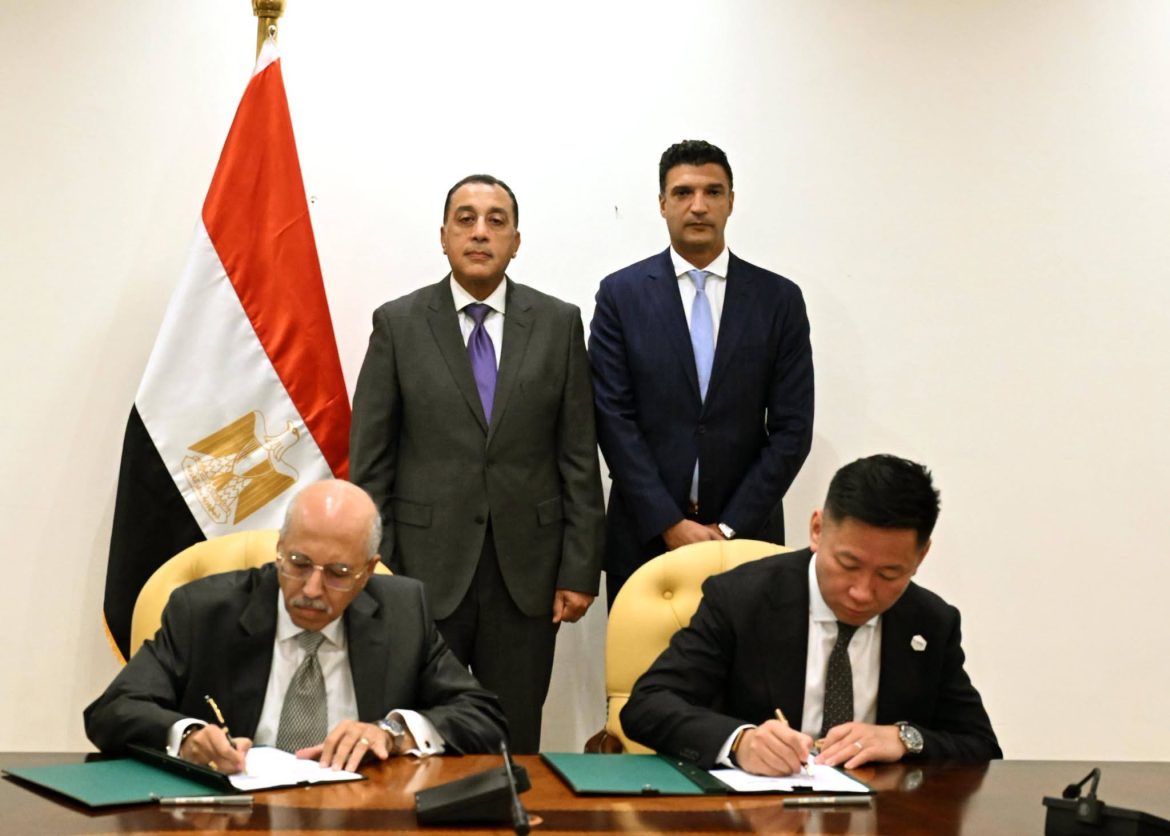
Egypt is moving to establish a domestic battery manufacturing base through a partnership between Egyptian battery maker BME and China’s Contemporary Amperex Technology Co. Limited (CATL), as Cairo seeks to shift from importing clean-energy equipment towards producing critical components locally.
The agreement, signed in Cairo on September 13, will establish a battery systems plant with an initial annual production capacity of 1 gigawatt-hour (GWh) and an investment of more than 2 billion Egyptian pounds, or about $39 million. The project is targeting 40% local content in its first phase and is expected to expand production capacity to 5 GWh annually in a second phase.
The initial production line will focus on batteries for heavy commercial vehicles before expanding into passenger-car batteries and energy-storage systems for solar and wind projects. The planned expansion places the project at the intersection of two of Egypt’s industrial priorities: the development of electric mobility and the rapid expansion of renewable power.

For Egypt, the significance of the project extends beyond the capacity of the factory itself. Battery systems are becoming an increasingly important component of both transport and electricity infrastructure as countries deploy more solar and wind power and seek alternatives to internal-combustion vehicles. Building domestic capacity could allow Egypt to retain a greater share of the economic value generated by those transitions rather than relying almost entirely on imported equipment.
The partnership also gives the project access to one of the world’s largest battery manufacturers. SNE Research data shows that CATL remained the leading supplier of electric-vehicle batteries globally in 2025, with 464.7 GWh of installations and a 39.2% market share. The company also ranked first in the global lithium-ion energy-storage system market, shipping 167 GWh in 2025 and accounting for 30% of the market.
CATL’s role is expected to include technology, production equipment and technical assistance. That element could be as important as the physical investment because battery manufacturing requires specialised engineering, quality-control systems, production processes and technical skills that are difficult to develop quickly without an established technology partner.
The Egyptian government is positioning the project within a wider industrial strategy aimed at increasing domestic manufacturing and attracting technology-intensive investment. Industry Minister Khaled Hashem has identified automotive manufacturing and electrical, engineering and electronics industries among the country’s priority industrial sectors, while the government’s broader industrial strategy seeks to deepen local production and expand non-oil exports.
The timing of the BME-CATL agreement also reflects the direction of Egypt-China economic relations. Chinese President Xi Jinping visited Egypt on September 1 and 2, 2026, during a state visit marking 70 years of diplomatic relations between the two countries. The joint communiqué issued after the visit emphasised deeper economic and industrial cooperation, while President Abdel Fattah El-Sisi separately highlighted industrial localisation and technology transfer as priorities in bilateral relations.
For Egypt, the battery project therefore fits into a broader attempt to use Chinese industrial capabilities to build domestic production rather than simply increase imports of Chinese equipment. That distinction is becoming increasingly important across Africa. Chinese manufacturers have built a dominant position in many clean-energy supply chains because of their scale, lower production costs and established manufacturing ecosystems. BloombergNEF’s 2026 South Africa Transition Factbook found that China accounted for 98% of South Africa’s solar imports and 95% of its battery imports in 2025. The report said the growing dependence on Chinese clean-energy equipment also presents an opportunity for African countries to develop domestic manufacturing and capture more value from expanding clean-energy supply chains.
The challenge for countries across the continent is therefore moving beyond deployment towards industrial participation. Importing solar panels, batteries, electric vehicles and other equipment can accelerate the energy transition, but it does not automatically create the manufacturing capabilities, skilled employment, supplier networks or export opportunities associated with those technologies.
Egypt’s 40% local-content target is consequently an important part of the project. If achieved, it could create demand for local engineering, assembly, electrical components, maintenance, logistics and other supporting services. Over time, deeper localisation could also help develop suppliers capable of serving other manufacturers and markets.
However, local content alone does not determine whether a clean-technology manufacturing industry becomes competitive. The availability and cost of electricity, skilled technical labour, access to finance, logistics, standards, research and development capacity and the reliability of upstream supply chains will all influence the project’s ability to scale.
The second phase could provide a more significant test. Expanding from heavy commercial vehicles to passenger cars and stationary energy storage would expose the plant to a broader range of technical specifications and market requirements. It would also connect the factory more directly to Egypt’s expanding renewable-energy infrastructure.
Egypt is already planning a substantial expansion of battery storage. In March 2026, the government announced agreements for standalone battery-energy-storage projects with a combined capacity of 5,620 MW. The country’s updated energy strategy targets a 45% share of renewable energy in the energy mix by 2028, while officials have also highlighted the need to expand storage capacity alongside solar and wind generation.
This creates a potential domestic market for the second phase of the BME plant. As the share of variable renewable energy increases, battery storage can help manage fluctuations in solar and wind generation, support grid stability and shift electricity availability towards periods of higher demand. The connection between battery manufacturing and renewable-energy deployment could also strengthen Egypt’s ambitions to become a regional energy and industrial hub. A local manufacturing base could eventually serve demand beyond Egypt if production becomes sufficiently competitive and meets the technical and certification requirements of external markets.
For the wider African market, the development points to a more complex phase of the clean-energy transition. The continent is likely to remain an important destination for Chinese clean-technology products because of its growing demand for solar power, electric mobility and energy-storage systems. At the same time, governments are increasingly interested in ensuring that the energy transition generates domestic industrial value.
The question is therefore shifting from how quickly Africa can import clean technologies to how much of their value chains African economies can capture. Egypt’s partnership with CATL offers one possible model: combine international technology and manufacturing expertise with domestic investment, local-content requirements, technical skills and access to a growing regional market. The long-term economic value of the project will depend on how far that model can move beyond final assembly and develop a broader domestic supplier base.
If the plant progresses from 1 GWh to 5 GWh as planned, its significance will ultimately be measured not only in battery output but in the industrial ecosystem built around it. For Egypt, that could mean a stronger position in electric mobility, renewable-energy storage and clean-technology exports. For Africa, it offers another indication that the next stage of the energy transition will increasingly be about where clean technologies are manufactured, who owns the capabilities to produce them and how much economic value remains within the continent.


