


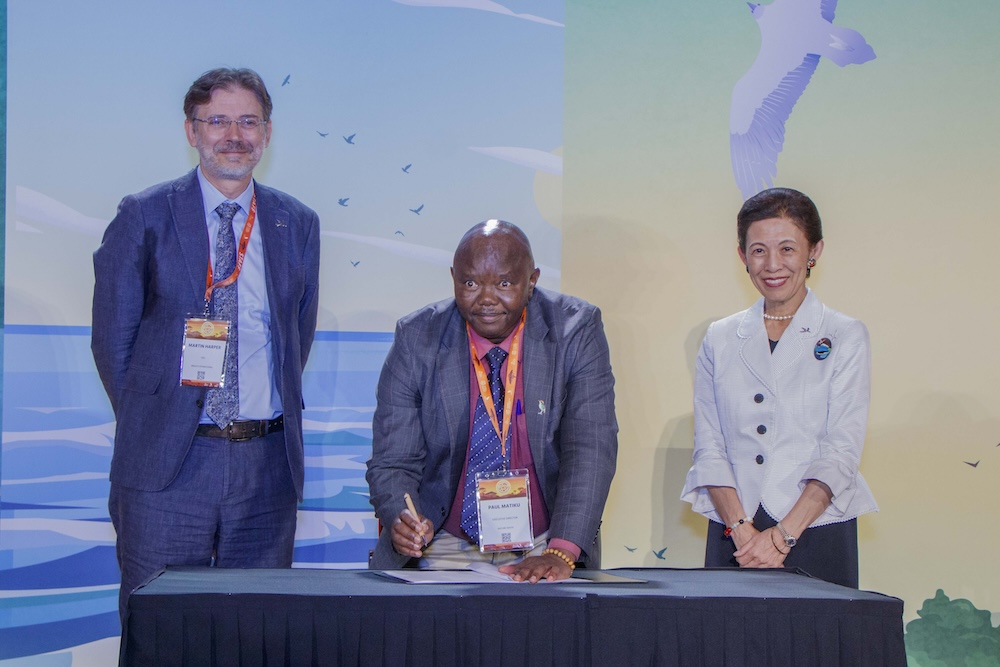
Governments, scientists, conservation organisations and financial institutions have committed to a new model of cross-border biodiversity protection after signing the Nairobi Flyways Declaration in Kenya, as more than $6 billion in conservation finance mobilised by development banks since 2021 is increasingly being directed towards protecting the ecosystems that sustain migratory species.
The declaration was adopted at the Global Flyways Summit in Nairobi on September 11, bringing together institutions working across Africa, Asia, Europe and the Americas around a conservation challenge that national borders cannot contain. Migratory birds depend on networks of breeding grounds, wetlands, forests, grasslands, coastlines and stopover sites spread across multiple countries, meaning the degradation of a single critical habitat can affect populations thousands of kilometres away.
The summit coincided with the launch of BirdLife International’s sixth State of the World’s Birds report, the first edition focused specifically on migratory species and the flyways they depend on. Its findings underline the scale of the challenge: 45% of the world’s 1,843 migratory bird species have declining population trends, while one in nine is threatened with extinction. Migratory shorebirds and seabirds are among the groups experiencing particularly severe declines.

The 2025 extinction of the Slender-billed Curlew has become one of the clearest indicators of what is at stake. The species was last confirmed in Morocco in February 1995 and its extinction represents the first recorded global bird extinction in mainland Eurasia and Africa in recent centuries, according to BirdLife. Six other migratory species are confirmed or suspected to have disappeared over the past 150 years.
The drivers are largely known. BirdLife identifies invasive species, agricultural expansion and intensification, climate change and unsustainable hunting and trapping among the principal pressures affecting migratory birds. The report also shows that conservation interventions can work when they are coordinated across an entire migration route rather than concentrated on isolated sites. Multi-country action, for example, has helped halt the decline of the Balkan breeding population of the Egyptian Vulture.
That evidence is reshaping the financing conversation around biodiversity. For decades, conservation funding has often been structured around individual protected areas, species or national programmes. The flyway approach instead treats ecological connectivity as an investment issue. A wetland in Kenya, for example, can be critical to a species that breeds in Europe or Asia, while changes in land use, infrastructure or water management in one country can affect ecosystems and populations across an entire migration route.
The Nairobi declaration therefore comes at a time when multilateral development banks are beginning to integrate flyway conservation into their lending frameworks. The Asian Development Bank is mobilising $3 billion over the next decade through its Regional Flyway Initiative to protect, restore and sustainably manage priority wetlands along the East Asian-Australasian Flyway. The initiative is designed to protect at least 50 priority wetlands and support the communities that depend on those ecosystems. ADB has emphasised that wetland conservation is not only a biodiversity issue but also a development concern because wetlands support livelihoods, water security, flood protection and local economies.
In Latin America and the Caribbean, the Development Bank of Latin America and the Caribbean, CAF, is mobilising between $3 billion and $5 billion through 2050 to safeguard more than 30 landscapes and seascapes. BirdLife, the National Audubon Society and CAF have also developed a Flyways Nature Bond Framework that establishes scientific and environmental criteria for assessing potential investments benefiting migratory birds and connected ecosystems.
The World Bank and BirdLife International are pursuing a similar model through the African-Eurasian Flyway Initiative, which covers one of the world’s most important migratory corridors. The flyway stretches from the Arctic to southern Africa and is used by more than two billion migratory birds and more than 500 avian species. The partnership is intended to mobilise finance for conservation, restoration and sustainable management of the ecosystems on which the birds and surrounding communities depend.
Together, these initiatives explain why the summit’s announcement of more than $6 billion in development-bank conservation finance is significant. The issue is no longer simply whether biodiversity receives funding, but whether financial institutions can build nature considerations into mainstream infrastructure, agriculture, water, energy and development investments.
The Global Environment Facility is also adding a smaller but potentially important layer of grant finance. In June 2026, its governing structures approved the Global Flyways Grant Mechanism, with $8.97 million in GEF funding and $107 million in co-financing. The programme is intended to support civil-society-led conservation, restoration and sustainable management across about nine million hectares of globally significant wetlands on the East Asian-Australasian Flyway.
For Africa, the financing shift is particularly important because many of the continent’s most significant wetlands and coastal ecosystems sit at the intersection of biodiversity conservation and local economic activity. Wetlands provide habitat for migratory birds but also support fisheries, agriculture, water supplies, tourism and flood regulation. Grasslands and forests along migration routes similarly provide ecological services while supporting pastoralism, farming and other rural livelihoods. Nature Kenya Executive Director Paul Matiku has argued that Africa’s role goes beyond hosting migratory species. The continent’s wetlands, grasslands and forests are essential parts of international flyways, making African governments and institutions central to the success of conservation efforts that begin outside the continent.
Kenya’s role as host of the Global Flyways Summit also reflects its position within the African-Eurasian migration system. The country’s wetlands and coastal ecosystems provide critical habitats for migratory species, while sites such as the Tana Delta demonstrate the connection between biodiversity, climate resilience and local livelihoods.
The Tana Delta provides one example of what integrated conservation investment can look like. Nature Kenya reports that mapping conducted in 2019 found serious degradation across 123,000 of the delta’s 130,000 hectares, with climate-driven floods and drought contributing to pressure on ecosystems and communities. Restoration efforts have subsequently incorporated local decision-making, policy development and land-use planning.
Such examples matter because the flyway approach requires conservation to move beyond protected-area boundaries. Migratory birds use landscapes that are also occupied by farms, towns, roads, energy infrastructure and industrial developments. Conservation therefore increasingly depends on how those competing land uses are planned and financed.
That creates a direct connection between biodiversity and development finance. Infrastructure investments, for example, can fragment habitats or create risks for birds through poorly located power lines and renewable-energy infrastructure. Agriculture can destroy wetlands or reduce feeding habitats through intensification, while climate change can alter the timing and availability of water and food along migration routes.
The response consequently requires more than conservation grants. It requires environmental safeguards, biodiversity-sensitive infrastructure planning, landscape restoration, community finance and investment standards that incorporate ecological connectivity. BirdLife has already been working with development-finance institutions to build this approach into mainstream lending. The organisation has identified the development of bird-inclusive investment principles and guidelines for multilateral development banks as an area of future work, aimed at mainstreaming nature-positive approaches into infrastructure and development finance.
The economic rationale is becoming harder to separate from the ecological one. When wetlands are degraded, communities can lose natural flood protection and water-storage capacity. When coastal ecosystems decline, fisheries and tourism can be affected. When forests and grasslands deteriorate, carbon-storage capacity and local livelihoods can come under pressure. Migratory birds can therefore function as indicators of wider ecosystem stress. BirdLife Chief Scientist Stuart Butchart has described migratory birds as sentinels of pressure on natural systems, while the organisation’s latest assessment concludes that the solutions to many of the drivers of decline are already understood. The remaining challenge is implementing them at the scale of entire flyways.
That is where the Nairobi Declaration could prove more consequential than a conventional conservation pledge. Its value will ultimately depend on whether governments and financial institutions translate the commitment into investment decisions, coordinated policies and measurable improvements in the condition of habitats along migration routes.
The financial commitments provide an important starting point, but the geography of flyways makes coordination essential. A country can protect its own wetlands while birds continue to lose breeding, feeding or stopover sites elsewhere along the same route. For Africa, the opportunity is therefore twofold. The continent can attract a larger share of international biodiversity and climate finance by demonstrating the global importance of its ecosystems, while using that finance to strengthen local conservation economies, community livelihoods and climate resilience.
The Nairobi summit has made the investment case more explicit: protecting migratory birds means protecting connected ecosystems across borders, and protecting those ecosystems increasingly requires development finance to account for nature. As biodiversity commitments move towards their 2030 deadlines, the success of the flyway model will depend on whether billions of dollars can be converted into functioning wetlands, connected habitats, sustainable land-use systems and stronger institutions on the ground. The birds may cross borders without difficulty. The institutions and capital needed to protect them must learn to do the same.


