


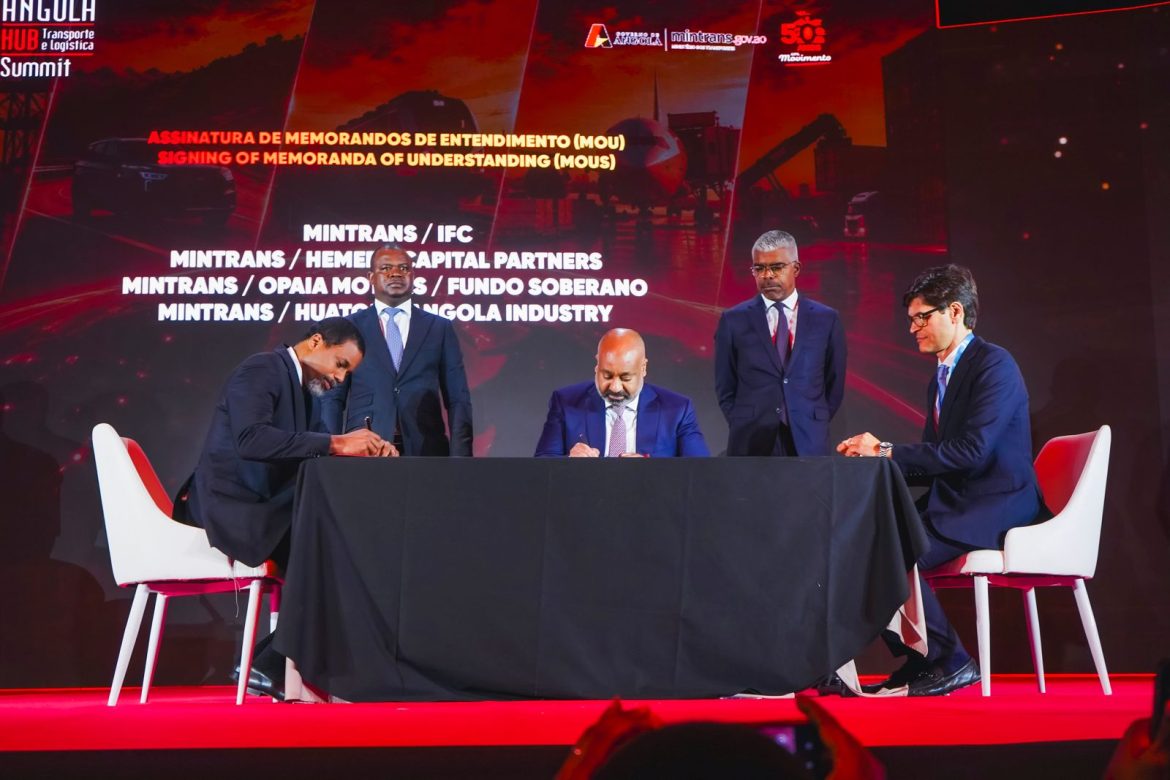
Angola has taken another step towards electrifying its transport system after OPAIA Motors, the Ministry of Transport and the Fundo Soberano de Angola signed a memorandum of understanding to establish the Ondjila Green programme, a proposed national network of charging infrastructure and electric mobility solutions. The agreement was signed during the second Angola Hub Transport and Logistics Summit in Luanda on September 28, placing electric mobility within a wider government agenda focused on transport modernisation, logistics efficiency and economic diversification.
The government says the programme will initially provide 2,000 charging points across the country and support the phased introduction of at least 1,000 electric buses. The network is intended to provide the infrastructure required for electric buses and other electric vehicles, with implementation expected to expand progressively beyond the initial phase. The programme is being developed through a partnership between the Ministry of Transport, Angola’s Sovereign Wealth Fund and OPAIA Motors.
The announcement comes as Angola seeks to reduce the economic exposure created by petroleum-based transport while developing a domestic automotive industry. The country approved its National Electric Mobility Strategy in 2024, establishing a policy framework for the acquisition, use, maintenance and charging of electric vehicles and setting out measures to build a national charging network, encourage private investment and increase the use of electric vehicles in public transport.

That policy backdrop makes Ondjila Green more than a charging infrastructure project. It positions transport electrification as part of a broader industrial and energy transition in which vehicle assembly, electricity supply, charging infrastructure, public transport and investment need to develop together.
OPAIA Motors is central to that strategy. In January 2026, OPAIA Group inaugurated what Reuters described as Angola’s only operational domestic vehicle assembly plant, with an annual capacity of 22,000 light vehicles and 1,000 buses. The company has indicated that it intends to move towards electric vehicle production as its industrial operations develop.
The connection between vehicle assembly and charging infrastructure is economically important. An increase in electric vehicle supply without sufficient charging capacity would constrain adoption, while charging infrastructure without a growing vehicle market could leave assets underutilised. Ondjila Green therefore seeks to address one of the central infrastructure gaps facing electric mobility in African markets: building the ecosystem around the vehicle, rather than treating the vehicle itself as the transition.
The programme also arrives against a difficult fiscal and energy backdrop. Angola has spent years reforming fuel subsidies that placed a substantial burden on public finances. According to the International Monetary Fund, fuel subsidies reached about 3 percent of GDP at their peak in 2021 and cost approximately $4.3 billion in 2022. A three-year reform programme launched in 2023 reduced the fiscal burden, although fuel prices remained below international market levels by the end of 2025.
This makes the economics of transport electrification particularly significant. Every kilometre shifted from an internal-combustion vehicle to an electric vehicle potentially changes the structure of energy demand from imported petroleum products towards electricity produced and distributed domestically. The fiscal benefit, however, will depend on the cost and reliability of electricity, the capital cost of electric vehicles, charging utilisation and the pace at which public transport operators can replace existing fleets.
Angola’s electricity system provides an important foundation but also creates planning requirements. The country’s electric mobility strategy recognises that the power network must be capable of meeting additional demand from electric vehicles and calls for adequate electricity supply, charging infrastructure and the potential integration of renewable energy into the charging system.
This will become increasingly important as charging infrastructure moves beyond pilot projects. A national network of 2,000 chargers would require coordinated decisions on grid capacity, connection costs, charging tariffs, land availability, maintenance, payment systems and technical standards. The National Electric Mobility Strategy assigns responsibilities across different institutions, including the transport and energy authorities, reflecting the cross-sector nature of the transition.
The initial Ondjila Green rollout is therefore likely to be as much a test of infrastructure economics as of vehicle technology. The ability of charging stations to generate sufficient utilisation will depend on the number and type of electric vehicles on the road, the routes they serve, charging speeds, electricity prices and the commercial arrangements governing station ownership and operation.
The programme’s focus on buses could provide a practical starting point. Public transport fleets have predictable routes, centralised operations and relatively high daily utilisation, characteristics that can make fleet electrification more commercially manageable than a fragmented market of private vehicles. The government has specifically identified urban public transport as a priority within its national electric mobility strategy.
For Luanda, where congestion and transport demand are closely linked to the country’s urbanisation, electrifying high-use public transport routes could also create wider economic effects. Lower operating costs, if achieved, could improve the economics of public transport operators, while cleaner vehicles could reduce local air pollution. The extent to which these benefits translate into lower fares, however, will depend on financing structures, operating costs, electricity tariffs and how savings are distributed across operators and passengers.
OPAIA’s project documents also point to considerably larger ambitions than the initial government announcement. The company has outlined a longer-term vision involving 22,000 electric vehicles, 2,000 charging points, 240 public stations and deployment across Angola’s 21 provinces and 164 municipalities over five years, with projected cumulative investment of about $2.4 billion. These are project targets and estimates rather than outcomes that have already been secured, making financing, procurement and phased implementation important determinants of whether they can be achieved.
The role of the Fundo Soberano de Angola gives the programme an additional investment dimension. The sovereign fund, chaired by Armando Manuel, manages assets with a mandate that includes strategic investment and long-term value creation. Its participation alongside the transport ministry and OPAIA Motors indicates that the project is being positioned not only as an environmental initiative but also as an infrastructure and industrial investment opportunity.
The broader policy environment is also moving in the same direction. Angola’s electric mobility strategy explicitly links vehicle electrification to lower emissions, reduced petroleum import dependence, new industrial activity and job creation. It also calls for incentives to attract private investors and for the development of charging infrastructure across the country.

For investors, the next stage will therefore be critical. A memorandum of understanding establishes a framework for cooperation, but large-scale electric mobility requires bankable projects, predictable regulation, viable tariffs, grid investment and clear revenue models. The success of the programme will ultimately depend on whether these conditions can be translated into projects that can attract long-term capital.
The Angola Hub Transport and Logistics Summit also placed Ondjila Green within a wider transport investment agenda. At the same event, the government announced an agreement with the International Finance Corporation to support the structuring of a public-private partnership for the development of the Northern Corridor linking Luanda with Malanje. The parallel focus on rail, logistics and electric mobility illustrates the government’s broader attempt to modernise transport infrastructure while improving connectivity and supporting economic diversification.
For Angola, electric mobility is therefore becoming less a question of whether electric vehicles can be introduced and more a question of whether the country can build the industrial, financial and energy systems needed to make them commercially viable. Ondjila Green provides a framework for that transition, but its significance will ultimately be measured by infrastructure delivered, vehicles operating, electricity reliably supplied and investment mobilised.
The project also offers a broader African lesson. Electric mobility cannot be scaled through vehicle imports alone. It requires charging networks, reliable power, suitable financing, regulatory certainty, local technical capacity and transport systems capable of absorbing new technologies. If Angola can align these components, its electric mobility strategy could become part of a wider industrialisation effort in which cleaner transport is linked to domestic manufacturing, energy investment and new infrastructure markets.


