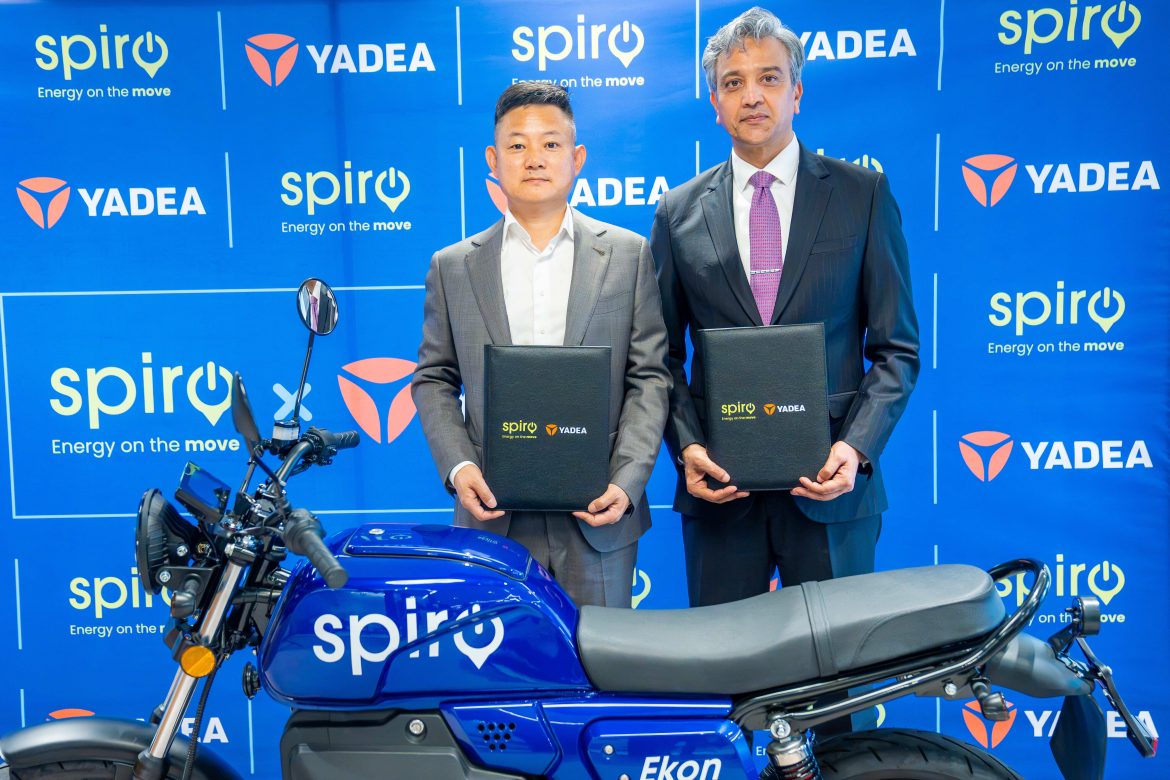
Africa’s electric mobility market is entering a more industrial phase as electric vehicle manufacturer Yadea partners with African mobility company Spiro to combine global manufacturing capacity with a regional battery-swapping network, potentially accelerating the adoption of electric motorcycles among commercial riders, logistics operators and commuters across the continent.
The strategic partnership, announced in Dubai on September 11, brings together Yadea’s manufacturing and research capabilities with Spiro’s operations and battery-swapping infrastructure across seven African markets. Under the agreement, Yadea will supply electric two-wheelers and related products for Spiro’s markets, while the two companies will develop customised vehicles designed around African road conditions and commercial transport requirements. Spiro will integrate the vehicles into its existing battery-swapping and energy infrastructure.
The arrangement is significant because Africa’s electric mobility challenge is increasingly moving beyond the question of whether electric motorcycles can work technically. The bigger questions are whether they can be produced and financed at sufficient scale, whether riders can access reliable charging or battery-swapping infrastructure, and whether the wider ecosystem can become commercially viable without depending indefinitely on subsidies.

The partnership places those questions at the centre of a China-Africa industrial relationship that is already becoming important to the continent’s clean-transport transition. Yadea has sold more than 100 million electric two-wheelers globally and says it has maintained the world’s leading position in electric two-wheeler sales for seven consecutive years. The company has more than 2,000 patents in electric-vehicle technology and production facilities serving international markets.
Spiro, meanwhile, has been building an African operating platform around electric motorcycles and battery swapping rather than simply selling vehicles. The company said in August that it had deployed more than 120,000 electric motorcycles, completed more than 31 million battery swaps and enabled more than 1.3 billion kilometres of zero-emission travel. It operates in seven African markets and has been expanding its battery-swapping infrastructure as part of its wider clean-energy strategy.
That infrastructure is critical to the commercial case for electric motorcycles. For many African motorcycle riders, particularly those operating taxis, delivery services and logistics businesses, time is a direct economic cost. Conventional electric charging can require a vehicle to remain stationary for hours, potentially reducing daily earnings. Battery swapping changes the model by allowing riders to exchange a depleted battery for a charged one within minutes.
The approach also separates the vehicle from part of its energy infrastructure. Instead of requiring every rider to own and manage charging equipment, the mobility operator can build a network of centrally managed batteries and swap stations. The model is particularly relevant in African cities where motorcycles play a major role in passenger and goods transport. Kenya alone has more than two million boda bodas, according to analysis contributing to the United Nations Industrial Development Organization’s Industrial Development Report 2026. The country has also seen increasing investment in battery swapping, electric motorcycle assembly and associated financing models.
Kenya launched its National Electric Mobility Policy in February 2026, explicitly linking electric transport with reduced petroleum dependence, energy security, lower emissions and green industrial development. The government said petroleum imports were costing the country about $5 billion annually, making transport electrification relevant not only to climate policy but also to foreign-exchange management and energy security.
Similar pressures exist elsewhere. African economies spend significant amounts on imported petroleum products, while motorcycle transport is deeply embedded in urban and rural commercial activity. Electrifying high-mileage motorcycles therefore has the potential to reduce exposure to oil-price volatility while creating demand for new industries around vehicles, batteries, software, maintenance, charging and energy services.
But the economic benefits will depend heavily on how much value is created locally. Africa’s electric-mobility sector still relies extensively on imported vehicles, batteries, components and technology. UNIDO has warned that continued dependence on imported completely knocked-down components can limit domestic value addition and leave local manufacturers concentrated in relatively low-value assembly activities. It has also identified gaps in charging infrastructure, supplier development, financing and electricity distribution as constraints to the sector’s industrial expansion.
The Spiro-Yadea agreement potentially addresses part of this challenge through localisation. The companies say they will co-develop two-wheelers specifically adapted to local road conditions and commercial use, while Spiro continues to expand its manufacturing and assembly footprint. That distinction matters. Designing electric motorcycles for African conditions requires more than adapting an existing consumer product. Commercial motorcycles can travel substantially longer distances each day, carry passengers or cargo, operate on rough roads and face climatic conditions that differ from those in their original markets. Battery durability, vehicle maintenance, spare-parts availability, software reliability and the economics of battery replacement can therefore determine whether an electric motorcycle becomes a viable income-generating asset.
The partnership also follows a substantial increase in investment into Spiro. In June, the company closed a $270 million funding round after securing an additional $55 million from NewTrails Capital, a Chinese growth-stage investment fund. Spiro said the capital would support expansion of its battery-swapping network, manufacturing footprint, technology development and presence in additional African markets. The combination of new capital and Yadea’s manufacturing capabilities gives Spiro a stronger platform for scaling. It also illustrates the growing role of Chinese capital and technology in Africa’s clean-technology transition. China already dominates much of the global electric-vehicle manufacturing value chain, particularly in batteries and two-wheelers. African markets are increasingly becoming destinations for those technologies while also developing their own demand, infrastructure and assembly capabilities.
Recent trade data illustrates the scale of that relationship. In the first half of 2026, African imports of electric motorcycles and three-wheelers from China rose sharply, although the market remains highly uneven across countries. North African markets have seen strong consumer demand for electric scooters, while East and West African markets have increasingly focused on commercial motorcycles and battery-swapping models. That divergence is important because Africa does not have a single electric-mobility market. A commuter purchasing an electric scooter in Casablanca faces different conditions from a boda boda operator in Nairobi or a delivery rider in Lagos. Vehicle design, financing, electricity reliability, road infrastructure, taxation, import duties and battery standards vary considerably between markets.
The companies’ decision to develop products specifically for African commercial conditions therefore reflects a broader shift from exporting technology to adapting business models. Standardisation will become another important issue as the sector expands. Battery-swapping networks work most efficiently when vehicles and batteries are interoperable or when a single operator has sufficient scale to maintain a large compatible fleet. Without common technical standards, riders can become locked into individual networks, potentially slowing the development of a broader market. The economics of battery ownership also remain central. Battery packs represent a significant proportion of an electric motorcycle’s value, and their performance deteriorates over time. Operators therefore need financing and asset-management models that account for battery life, replacement costs and residual values.
These issues will increasingly matter as African electric mobility companies move from pilot projects to mass commercial deployment. Spiro’s model is already moving in that direction. The company’s latest corporate updates indicate that its network has surpassed 135,000 deployed electric motorbikes and 50 million battery swaps, suggesting a rapidly expanding operational base. For policymakers, the emerging market presents both an industrial opportunity and a regulatory challenge. Governments can encourage electric-mobility adoption through tax incentives, reduced import duties, financing mechanisms, local manufacturing incentives and investment in electricity infrastructure. But they also need to establish standards for batteries, vehicle safety, charging and swapping infrastructure, data management and end-of-life battery recycling.
The environmental case must also be considered across the full lifecycle of the technology. Electric motorcycles produce no tailpipe emissions during operation, but their overall climate benefit depends partly on how electricity is generated and how batteries are manufactured, reused and eventually recycled.
This makes battery-swapping networks more than a transport infrastructure issue. They are increasingly part of the energy system. Where swap stations can be integrated with renewable electricity, storage and smart energy management, they can potentially become distributed energy assets. They can also provide predictable electricity demand in markets where transport electrification is still at an early stage. For Africa, that convergence between transport and energy could become one of the most important aspects of the electric-mobility transition. The Spiro-Yadea partnership therefore represents more than a vehicle supply agreement. It brings together three components that Africa needs to scale electric transport: manufacturing capacity, locally adapted products and energy infrastructure.
Whether the model succeeds commercially will depend on the affordability of vehicles, the density and reliability of battery-swapping networks, financing for riders and fleet operators, local manufacturing capacity and the ability of governments to provide consistent policy frameworks. The stakes extend beyond emissions. A successful shift from petrol motorcycles to electric two-wheelers could reduce exposure to imported fuel, lower operating costs for high-mileage riders and create new industrial opportunities around batteries, electronics, software, vehicle assembly and energy services.
The challenge is ensuring that the transition does not leave Africa primarily as a market for imported technology. The next phase will be measured by how much manufacturing, skills, intellectual property, supply-chain development and economic value can be retained within African economies. The Yadea-Spiro partnership gives that question greater urgency. As global electric-mobility companies increasingly look to Africa for growth, the continent’s opportunity is to turn rising demand for clean transport into an industrial development story of its own.