


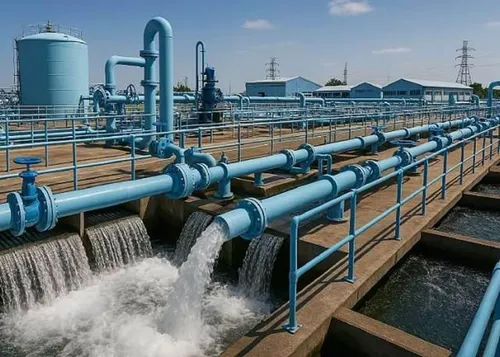
South Africa has secured a $1 billion loan from the New Development Bank (NDB) to upgrade metropolitan municipal services, tying infrastructure investment to reforms in the governance, financial sustainability and operational performance of water and sanitation, electricity and energy, and solid-waste systems. Signed by the National Treasury on September 15, the 16-year facility, which includes a three-year grace period, forms part of the government’s Metro Trading Services Reform Programme and is being financed alongside the World Bank, Asian Infrastructure Investment Bank, KfW Development Bank and the French Development Agency.
The structure of the financing is significant because the programme goes beyond funding physical infrastructure. According to South Africa’s National Treasury, the NDB facility is performance-based, with disbursement linked to institutional strengthening and independently verified performance targets approved by metropolitan councils. The approach places municipal governance and the financial sustainability of essential services alongside the capital investment required to repair or upgrade infrastructure.
 That distinction is important in a country where deteriorating infrastructure and weak municipal finances have increasingly become intertwined. Water networks, electricity distribution systems and waste services require continuous maintenance and predictable revenue to remain functional. Where municipalities struggle to collect revenue, manage expenditure or maintain assets, additional infrastructure funding can address immediate backlogs without necessarily resolving the institutional weaknesses that allowed those backlogs to accumulate.
South Africa’s recent experience with electricity debt illustrates the connection. Eskom reported in August that unpaid municipal debt had risen 17.9% to 111.6 billion rand by March 2026. Municipalities and metropolitan areas account for more than 40% of Eskom’s electricity sales, making municipal payment performance a material issue for the financial position and investment capacity of the national power utility.
The same relationship applies to water. Infrastructure that loses large volumes of treated water through leaks, or electricity networks that cannot reliably bill customers, weaken the revenue base required to maintain the systems. At the household level, the result can be unreliable services and higher costs as residents and businesses turn to private alternatives. At the institutional level, it can create a cycle in which deteriorating assets reduce service quality, weaker service quality undermines payment discipline, and falling revenue further limits maintenance.
Johannesburg provides a recent illustration of the economic consequences. Reuters reported in August that the city was losing an estimated 655 million litres of water a day through leaks and burst pipes, while some communities had experienced prolonged interruptions. The city was also dealing with significant budget pressures, illustrating how infrastructure deterioration and municipal finances can reinforce one another.
Against that backdrop, the NDB financing is effectively designed to address two sides of the municipal infrastructure problem at the same time. Capital expenditure can support the physical systems, while performance conditions are intended to strengthen the institutions responsible for operating those systems. The loan carries a maturity of 16 years and a three-year grace period, with an interest rate set at daily SOFR plus 1.18508%, according to National Treasury.
The use of development finance also reflects the scale and nature of infrastructure investment required at municipal level. The NDB has previously approved up to $1 billion for South Africa’s municipal water and sanitation infrastructure under the Municipal Infrastructure Grant, with the programme expected to support hundreds of projects across municipalities. The latest facility broadens the focus to metropolitan trading services and places greater emphasis on the operational and financial performance of utilities.
For African economies, this offers a relevant financing model as cities confront growing demands for water, electricity, sanitation and waste management. Rapid urbanisation is increasing the amount of infrastructure that municipalities must operate, while climate pressures are adding further stress to water systems, energy networks and urban waste infrastructure. Financing the construction of assets without securing their long-term operation can leave governments with expensive infrastructure that remains vulnerable to under-maintenance.
The challenge is particularly relevant as African cities increasingly seek external financing for infrastructure. Development banks can provide longer maturities and concessional terms that may be difficult to secure from commercial lenders, but such financing still creates obligations for public institutions. The economic value of the investment therefore depends on whether municipalities can convert capital expenditure into reliable services, stronger revenue collection and more disciplined asset management.
The performance-based design of the South African programme is consequently an important feature. Rather than treating infrastructure delivery as an end in itself, the financing links funding to measurable institutional outcomes. This places greater emphasis on questions that are often less visible than construction: whether utilities can recover costs, whether assets are maintained, whether procurement and financial controls work effectively, and whether municipal councils can monitor performance.
South Africa’s Auditor-General has continued to identify weaknesses in local government governance, financial management and service delivery, including problems involving the management of public resources and infrastructure. These issues matter because municipal infrastructure is ultimately a balance-sheet and service-delivery asset. Its value depends on how effectively it is operated over its useful life, not simply on the amount spent to build or rehabilitate it.
There is also an ESG dimension to the programme, although it is grounded in public-sector economics rather than corporate reporting. Reliable water and sanitation systems have direct social consequences; electricity networks affect economic productivity and access to essential services; and waste management influences environmental quality and public health. Governance determines whether the financial resources supporting these systems are used effectively and whether performance can be measured and held accountable.
For investors and development finance institutions, this increasingly makes municipal governance part of infrastructure risk. A technically sound water plant can still underperform if the municipality cannot maintain it or collect sufficient revenue to operate it. Likewise, electricity infrastructure can become financially unsustainable if billing systems fail or municipalities accumulate arrears to upstream suppliers.
The regional implications extend beyond South Africa. Other African countries face similar pressures as urban populations expand and governments attempt to finance infrastructure while managing constrained public finances. The South African model demonstrates the potential value of combining long-term development finance with institutional reform, while also highlighting the need for credible monitoring of whether reforms translate into measurable improvements.
 The $1 billion facility therefore represents more than an injection of capital into municipal infrastructure. Its significance will depend on whether the investment improves the financial and operational systems that keep essential services running. For South Africa, that means linking infrastructure rehabilitation with revenue management, maintenance, governance and accountability. For other African economies, the experience offers a practical reminder that sustainable infrastructure is ultimately as much about institutions and operating models as it is about concrete, pipes, cables and treatment facilities.


