


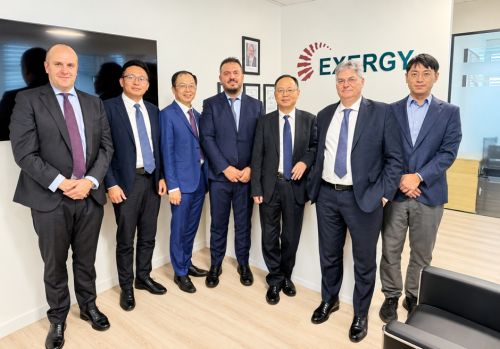
Kenya is strengthening its position as a regional base for clean-energy technology companies, with Italian geothermal specialist Exergy and Chinese inverter and energy-storage manufacturer GoodWe establishing new operations in the Kenyan capital within a day of each other, as international companies increasingly use the city to access East Africa’s expanding renewable-energy market.
Exergy announced on September 14 the establishment of Exergy East Africa Ltd., while GoodWe confirmed the opening of a regional office in Nairobi on September 15. Neither company disclosed the cost of the new operations, but both said their Kenyan presence would support activities beyond the domestic market. Exergy said the new subsidiary would strengthen its work with customers, project developers and institutions across East Africa, while GoodWe said its Nairobi office would provide technical support, training, demonstrations and partner engagement across the region.
The simultaneous expansion provides another indication of how Nairobi is evolving from a market for renewable-energy equipment into a base for commercial, technical and increasingly research activities serving multiple African countries. GoodWe’s move forms part of a broader localisation strategy, while Exergy said its Nairobi operation would support geothermal and clean-energy growth in East Africa.

Kenya’s domestic energy market is an important part of that calculation. The country had about 2.93 gigawatts of installed renewable-energy capacity as of June 2025, according to Kenya’s energy-sector statistics, accounting for more than 80% of total installed capacity. Geothermal, hydro, wind and solar made up the principal renewable sources.
The country’s generation profile is even more renewable-heavy. Kenya Power reported that renewable energy accounted for 90% of its generation mix during the 2024/25 financial year, compared with 92% the previous year. The International Energy Agency has similarly described Kenya as a regional leader in renewable electricity, noting that almost 90% of generation comes from renewable sources.
That combination gives technology companies a market in which renewable-energy equipment is already part of mainstream power-system development rather than a marginal segment. It also creates demand for technologies that address the next challenges associated with a high-renewables system, including grid flexibility, energy storage, power-quality management, distributed generation and system integration.
For Exergy, Kenya offers a particularly relevant operating environment. The company specialises in geothermal technology, including Organic Rankine Cycle systems, and its decision to establish a permanent East African presence comes as Kenya remains one of the world’s leading geothermal markets. The Nairobi subsidiary is intended to bring the company closer to project developers, industrial customers and institutions while supporting its activities elsewhere in the region.
GoodWe’s expansion addresses a different but increasingly important part of the energy system. Its product portfolio includes solar inverters, energy-storage systems and related energy-management technologies. The company said the Nairobi office would bring technical support, training and product demonstrations closer to installers, distributors, engineering, procurement and construction firms and customers.
The importance of such support is increasing as renewable-energy markets mature. The deployment of solar and battery systems requires more than equipment sales. Developers and customers need installation expertise, system design, commissioning, maintenance, technical training and after-sales support. Establishing those capabilities locally can reduce the distance between technology manufacturers and the companies deploying their equipment.
Nairobi’s attraction is also being reinforced by other clean-technology investments. Energy-storage company AlphaESS opened a Kenyan subsidiary in November 2025 and designated Kenya as an operational hub for its African activities, citing the country’s energy policies and growing distributed solar and storage market. The company said its Nairobi office would support its broader African expansion.
In June 2026, Solaire Africa opened a regional headquarters in Nairobi to coordinate sales, system design and after-sales services. The company said the new office would support its expansion across Africa, adding another layer to the city’s growing clean-energy services ecosystem. The pattern extends beyond stationary energy. Electric-mobility company Spiro announced in May that it would establish its first African research and development centre in Kenya following its acquisition of motorcycle engineering and design firm Coexlion. The planned centre is intended to support the development of electric motorcycles adapted to African road conditions, rider behaviour and market requirements.
That shift from sales and distribution towards engineering and research is significant. Spiro said Coexlion’s 28 engineers had worked on more than 25 motorcycle programmes covering chassis and frame development, vehicle integration, battery systems, reliability engineering and industrial design. Its planned Kenyan R&D centre would complement the company’s existing technology capabilities and support greater localisation of product development.
Taken together, the investments suggest that Nairobi’s clean-technology proposition is broadening. The city is increasingly hosting not only companies selling solar panels, inverters or electric vehicles, but also firms building technical-support networks, managing regional operations and developing products intended for African markets.
That distinction matters because the economic value of the clean-energy transition is not limited to generation capacity. Renewable projects create demand for engineering, software, equipment maintenance, financial services, technical training, logistics and data-driven energy management. A city that becomes a regional base for those activities can capture a larger share of the value chain surrounding energy investment.
Kenya’s regulatory environment is another factor. The country has established policies supporting renewable generation, distributed energy and electric mobility, while regulators and utilities are increasingly addressing the operational requirements of integrating variable renewable energy. The IEA’s 2026 assessment of Kenya’s power system warned that adding generation capacity alone will not be sufficient, with flexibility, storage, open-access arrangements and ancillary services becoming increasingly important as variable renewable energy expands.
This creates a market for technologies that can solve system-level problems rather than simply add generation. Battery storage, advanced inverters, energy-management systems and grid-support technologies are likely to become increasingly relevant as the share of solar and wind grows alongside Kenya’s established geothermal and hydropower resources.
The regional dimension is equally important. East Africa’s electricity and energy markets are becoming more interconnected, with cross-border electricity trade expanding and countries pursuing different combinations of geothermal, hydro, wind, solar and natural-gas generation. Kenya’s position in the region gives companies based in Nairobi proximity to markets with varying levels of energy access, renewable-resource potential and infrastructure development.
The commercial opportunity, however, comes with execution challenges. Regional operations do not automatically translate into regional market penetration. Companies still need reliable local partners, skilled technicians, efficient supply chains, predictable regulation and financing mechanisms capable of supporting clean-energy deployment.

There is also a question of how much technological capability remains within African markets. The opening of regional offices can strengthen local skills and after-sales capacity, but deeper economic benefits will depend on whether companies develop local engineering teams, training programmes, supplier networks, assembly operations and research partnerships.
For Kenya, that is potentially the next stage of the clean-energy opportunity. The country has already established a power system in which renewables provide the dominant share of electricity generation. The next opportunity is to build an ecosystem around that system—one capable of supplying the equipment, skills, digital tools, financing and technical expertise required to manage a more sophisticated energy economy.
Nairobi’s recent influx of clean-technology companies therefore reflects more than confidence in Kenya’s renewable-energy market. Exergy’s geothermal focus, GoodWe’s energy-storage and inverter business, AlphaESS’s storage operations, Solaire Africa’s regional solar platform and Spiro’s planned mobility R&D centre point towards a broader transition in which Nairobi is being used as a commercial and technical gateway into East Africa.
The extent to which that positioning translates into long-term industrial value will depend on whether the city can move beyond being a regional headquarters location and develop deeper local capabilities in engineering, research, manufacturing, finance and technical services. For a continent seeking to capture more value from its clean-energy transition, that distinction could be as important as the megawatts being added to the grid.


