


By Alice Ruhweza and Evelyn Lusenaka
Africa has spent years building the policies, regulations and research institutions needed to modernise its seed sector. The bigger challenge now is turning those frameworks into functioning markets that consistently deliver affordable, quality and climate-resilient seed to farmers.
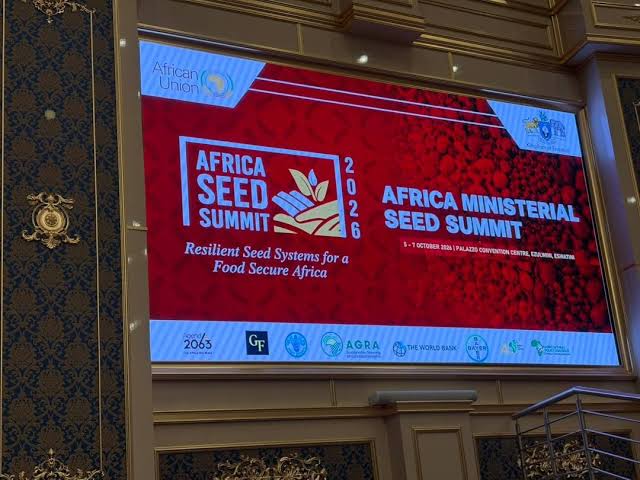
That gap is emerging as one of the most important tests of Africa’s agricultural transformation agenda, with the African Union convening the inaugural Seed Investment Summit in Ezulwini, Eswatini, from October 5 to 7. The summit is bringing together governments, researchers, farmers, seed companies, development partners and investors around the theme of resilient seed systems for a food-secure Africa. It is also expected to launch the 2025 African Seed Sector Performance Index and consider commitments on public financing, private investment and regulatory reform.
The latest evidence suggests that the continent’s problem is not simply a shortage of policy. The 2025 African Seed Sector Performance Index, developed by the African Union Commission, AGRA’s Centre of Excellence for Seed Systems in Africa and The African Seed Access Index, assessed 50 of the African Union’s 55 member states. It represents the second assessment after the 2023 baseline and provides the first systematic time-series comparison of seed-sector performance across African countries.

The data point to a persistent difference between policy design and market performance. The average continental score is 4.63 out of 10, while countries such as South Africa, Egypt, Zambia, Kenya and Zimbabwe rank substantially higher. Kenya, for example, scores 7.64, placing it among the stronger performers even as significant gaps remain across individual crops and parts of the seed value chain.
West Africa illustrates the problem particularly clearly. ECOWAS countries score highly on national seed policy frameworks but considerably lower on whether quality seed reaches farmers. The contrast suggests that governments have made progress in creating rules for the sector without necessarily building all the commercial, institutional and distribution systems required to make those rules work in practice.
That distinction matters because releasing an improved crop variety is only the beginning of the process. A variety developed by a research institution must move through licensing, early-generation seed production, multiplication, certification, inspection, distribution and retail before it becomes useful to a farmer. If any link is weak, the public investment in breeding may never translate into higher productivity in the field.
Seed companies face similar constraints. Commercial multiplication requires access to reliable foundation seed, predictable licensing arrangements, working capital and a distribution network capable of reaching farmers before planting windows close. Companies also need evidence that farmers will purchase a variety because it delivers characteristics that matter economically, such as higher yields, drought tolerance, shorter maturity periods or stronger market demand.
The business case becomes particularly difficult for crops that receive less commercial attention than major staples. Limited breeding investment, thin markets and weak demand information can discourage private companies from developing and multiplying varieties for crops that may nevertheless be important for nutrition, climate resilience or regional food security.
The result is an agricultural paradox: Africa can have improved varieties sitting in research systems while farmers continue planting older varieties or relying on saved and locally exchanged seed.
AGRA’s Centre of Excellence for Seed Systems in Africa, or CESSA, has increasingly focused on this market-development problem. The organisation describes seed systems as a chain linking research, variety development, production, quality assurance, commercialisation and distribution. Its current work includes strengthening early-generation and certified seed supply, improving distribution networks, supporting variety licensing and release pathways and creating conditions for viable seed enterprises.
The investment question is becoming just as important as the regulatory one. Seed is a seasonal business, and companies need capital to produce inventory before farmers purchase it. At the same time, seed enterprises need sufficient market visibility to determine which varieties to produce and in what quantities.
Nigeria’s recent reforms illustrate the direction some governments are taking. In 2025, the country announced a ₦50 billion Presidential Catalytic Seed Fund alongside the Seeds for Renewed Hope Programme and a new national seed-system strategy. The measures were designed to strengthen seed production and access while supporting wider agricultural productivity.
Such investments highlight a broader lesson: seed-sector strategies need to be treated as investment programmes rather than documents that sit separately from national agricultural budgets. The role of farmer-managed seed systems also needs to be recognised in that transition. Much of Africa’s seed supply still moves through farmers saving, exchanging and locally trading seed. These systems remain particularly important for locally adapted varieties and for farmers operating far from formal commercial distribution networks.
A stronger formal seed market therefore does not necessarily mean replacing community-based systems. The more practical approach is to allow the two systems to coexist. Farmers should be able to maintain and exchange locally adapted varieties while also having reliable access to certified and improved seed when commercial varieties offer clear economic or resilience advantages.
Regional integration presents another opportunity. Africa has developed seed harmonisation frameworks through regional economic communities, but regulatory alignment does not always translate into seamless movement of seed across borders. For seed companies, the size of the addressable market is critical because breeding, multiplication, certification and distribution require significant upfront investment.
The African Continental Free Trade Area could potentially expand that market, but agricultural trade integration depends on practical systems that allow products to move efficiently. Seed is no exception. A variety that has already undergone approval in one market should, where regional standards allow, face fewer duplicated procedures when entering another market.
The issue is becoming more urgent under Africa’s new agricultural policy framework. The Kampala CAADP Strategy and Action Plan for 2026–2035 places increased emphasis on productivity, investment, resilient agrifood systems, regional trade and stronger agricultural governance. The African Union has set out a continental implementation framework intended to guide national and regional investment and monitoring over the next decade.
The new CAADP agenda also places greater emphasis on accountability. In March 2026, the African Union held a continental consultation to refine the results framework and indicators that will be used to track implementation of the Kampala Strategy and Action Plan. That makes the Seed Sector Performance Index potentially more important than simply a ranking exercise. The index is designed to provide standardised information on national seed systems and serves as a diagnostic and accountability tool for governments, regional economic communities, development partners and private-sector actors.
For the seed sector, the more meaningful measure of progress will therefore be whether policy scores translate into improvements in actual farmer access. That means tracking whether more varieties reach commercial production, whether seed companies can secure financing, whether counterfeit seed is kept out of markets, whether farmers can obtain certified seed close to where they farm and whether regional markets become easier to serve.
The African Union’s Ezulwini summit is consequently taking place at an important point in the continent’s agricultural policy cycle. The meeting’s agenda includes implementation of seed policy and regulatory instruments, mobilisation of public and private investment, inclusive seed-sector development and the use of technology to accelerate agricultural development.
For Africa’s farmers, however, the ultimate test will remain much simpler. A seed policy has value only when it helps place the right seed in the farmer’s hands at the right time and at a price the farmer can afford. The next phase of Africa’s seed transformation will therefore require less emphasis on writing new rules in isolation and more attention to making existing systems commercially viable, regionally connected and accountable for delivery. Africa has built much of the policy architecture. The challenge now is to make the markets work.


