


Côte d’Ivoire is turning to satellite technology and artificial intelligence to strengthen environmental monitoring, improve agricultural traceability and build the data infrastructure needed to support carbon markets and climate finance as the country faces mounting pressure to protect its remaining forests.
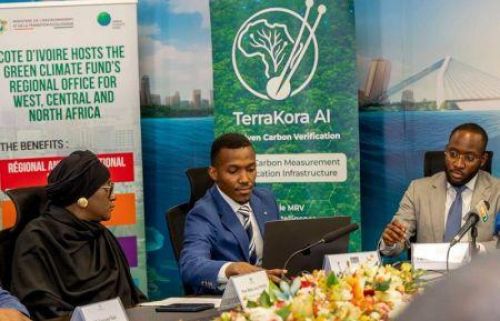
The Ministry of Environment and Ecological Transition signed a 24-month framework agreement with Ivorian geospatial technology company TerraKora AI on October 2 to strengthen national capabilities for observing, analysing and monitoring ecosystems. The partnership will combine Earth observation, geospatial analysis, artificial intelligence and digital measurement, reporting and verification systems to produce environmental data that can be updated more regularly and used in public decision-making.
The agreement was signed by Environment and Ecological Transition Minister Abou Bamba and TerraKora AI co-founder and Chief Executive Officer Kolia Alpha-Yaya Touré, with the participation of the company’s co-founder and technology director Axel Guéi. The National Bureau of Technical Studies and Development (BNETD), through its Centre for Geographic and Digital Information, will also contribute technical expertise to the initiative.
The technology is expected to combine satellite imagery with field-level information and artificial intelligence to map land use, identify environmental changes, monitor ecosystem restoration and estimate carbon stocks. The objective is to move environmental management towards more frequent and data-driven measurement rather than relying primarily on periodic assessments.
That need is particularly acute in Côte d’Ivoire, where the country’s forest estate has undergone significant decline over several decades. The National Forest and Wildlife Inventory published in 2021 estimated national forest cover at 2.97 million hectares, equivalent to 9.2% of the country’s territory. The government has described continuous monitoring of forests and wildlife as necessary for guiding conservation policy and managing pressures on ecosystems.
The scale of the historical loss gives the new monitoring system an importance beyond technology. Côte d’Ivoire has set a policy objective of increasing forest cover to at least 20% of its territory by 2030, requiring restoration and protection efforts to be supported by credible information on where forests are being lost, restored or maintained. Government data has previously indicated that forest cover exceeded 20% of national territory in the 1960s, compared with the 9.2% recorded in the 2021 inventory.
Agriculture is another major reason why the quality and availability of environmental data matter. Cocoa, coffee, cashew and rubber are important components of Côte d’Ivoire’s agricultural economy, while several of these commodities are also directly exposed to increasingly stringent international requirements around deforestation and supply-chain traceability.
The European Union’s Deforestation Regulation is particularly relevant. From December 30, 2026, large and medium-sized operators placing covered commodities on the EU market or exporting them will have to demonstrate that products are deforestation-free and produced in accordance with relevant laws in the country of production. Cocoa, coffee and rubber are among the commodities covered by the regulation, while companies must be able to link products to the plots where they were produced using geolocation information.
For Côte d’Ivoire, one of the world’s largest cocoa producers, this makes geospatial information increasingly relevant to market access. Reuters reported in September that cocoa traders, cooperatives and buying agents in the country were facing difficulties adapting to a new national traceability system being introduced ahead of the EU regulation, which is scheduled to take effect for major operators at the end of 2026.
A stronger national environmental data system could therefore serve two objectives at once: helping government monitor forest and land-use change while giving agricultural value chains better information for demonstrating origin, land-use history and environmental compliance.
The potential application to carbon markets adds another layer. Côte d’Ivoire has established a national carbon registry intended to operationalise the country’s Article 6 framework and provide infrastructure for carbon-market and non-market mechanisms. The registry identifies reliable monitoring and accounting as central components of the country’s carbon-market architecture.
The TerraKora AI agreement is intended to strengthen that measurement infrastructure through digital MRV. More reliable estimates of biomass, carbon stocks, land-use change and restoration outcomes could help project developers and public authorities document results from emissions-reduction and carbon-removal activities.
That does not automatically make such projects eligible for carbon finance. Carbon markets require methodologies, baselines, additionality assessments, verification and safeguards in addition to monitoring technology. But stronger environmental data can reduce one of the persistent constraints facing nature-based projects: the difficulty of establishing credible and auditable evidence of what has changed on the ground.
The financial implications could become significant as governments and investors increasingly look for measurable environmental outcomes before committing capital. For Côte d’Ivoire, better monitoring could potentially strengthen the evidence base for climate finance, forest restoration programmes and carbon-market transactions while giving public institutions greater visibility over the performance of environmental investments.
TerraKora AI has positioned its technology around the development of sovereign environmental data infrastructure, including satellite observation, artificial intelligence and environmental modelling. The company has also highlighted applications in agricultural traceability, restoration and carbon finance.
The involvement of BNETD is also important because its Centre for Geographic and Digital Information serves as Côte d’Ivoire’s national geospatial information authority. Fernand Balé is listed as director of the centre, which has also participated in international work on geospatial information and geodesy.
The partnership consequently reflects a wider shift in environmental governance across Africa: from collecting information primarily for reporting purposes towards building digital systems that can inform economic decisions, land management and investment. For agricultural producers, the value of such systems will depend partly on whether the information can be translated into practical tools for farmers and supply-chain operators rather than remaining concentrated within government databases or technology platforms. The experience of Côte d’Ivoire’s cocoa traceability reforms suggests that digital systems can face implementation challenges when equipment, connectivity, training and institutional coordination do not reach rural actors at the same pace as policy requirements.
For policymakers, the challenge will be to ensure that increasingly sophisticated environmental data strengthens accountability without creating another layer of administrative burden for smallholders. For investors and carbon-market participants, the priority will be whether the information is sufficiently transparent, consistent and independently verifiable to support financial decisions.
The 24-month agreement therefore places Côte d’Ivoire at the intersection of three increasingly connected agendas: environmental protection, agricultural market access and climate finance. Satellite imagery and artificial intelligence cannot by themselves reverse deforestation or guarantee the integrity of carbon projects. They can, however, improve the ability of institutions to measure what is happening across landscapes and provide evidence on whether interventions are producing the results they claim.
As Côte d’Ivoire seeks to restore forest cover, strengthen commodity traceability and expand its participation in carbon markets, the quality of that evidence is likely to become an increasingly important economic asset. The TerraKora AI partnership signals an effort to build that infrastructure at national level, linking environ


