


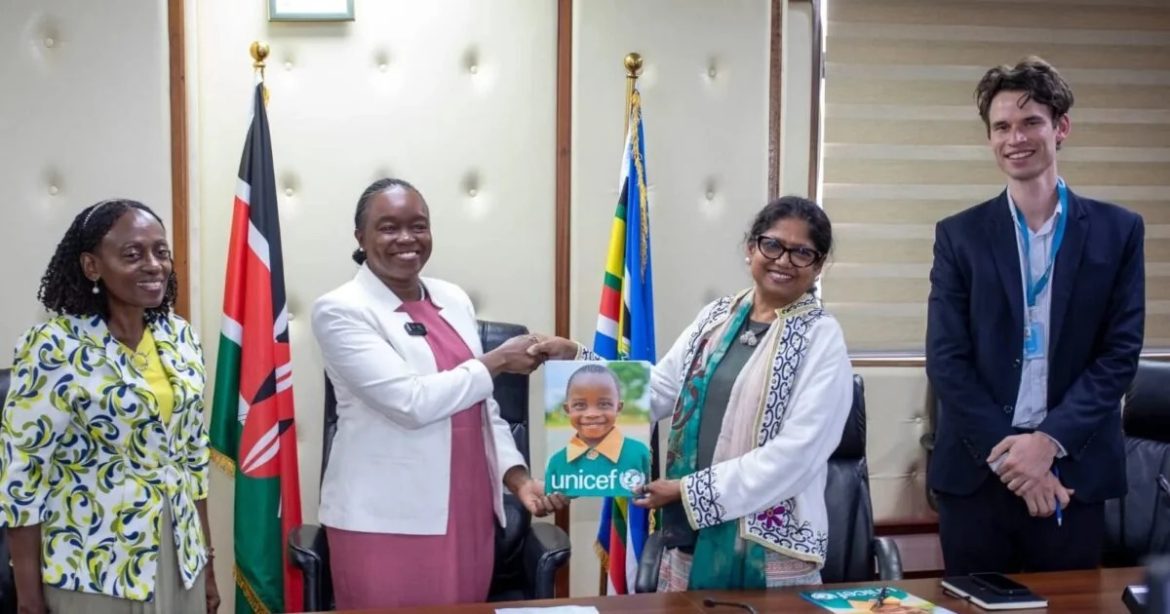
Kenya has signed an international declaration committing to place children and young people at the centre of climate policy, investment and decision-making, joining more than 80 countries that have endorsed the Intergovernmental Declaration on Children, Youth and Climate Action during COP31 in Antalya, Türkiye.
Environment, Climate Change and Forestry Cabinet Secretary Deborah Barasa signed the declaration on behalf of Kenya during the UN climate conference, fulfilling a commitment first launched at COP25 in Madrid in 2019. The declaration calls on governments to account for children’s rights and specific vulnerabilities in climate policies, Nationally Determined Contributions (NDCs), adaptation plans and investment decisions, while strengthening opportunities for young people to participate meaningfully in climate policymaking.
For Kenya, the commitment comes against a substantial and uneven climate risk burden. About 12 million of the country’s 24.6 million children face moderate to very high climate and disaster risks, according to UNICEF’s Kenya Children’s Climate and Disaster Risk Model. Around 2.4 million children live in seven counties classified as facing very high levels of climate and environmental risk: Turkana, Samburu, Marsabit, Wajir, Mandera, Garissa and Tana River.
The risks extend beyond exposure to droughts and floods. UNICEF data show that about nine million Kenyan children are exposed to drought and water scarcity, while more than 1.3 million face flood risks. Climate shocks can interrupt water and sanitation services, damage health and education infrastructure and increase food and nutrition insecurity. The effects are particularly acute where public services are already constrained, leaving households and county governments with fewer buffers when extreme weather disrupts normal service delivery.
The declaration therefore places an emphasis on the resilience of essential services rather than treating children only as recipients of climate interventions. Kenya said implementation would draw on its National Climate Change Action Plan, Nationally Determined Contributions and gender and climate commitments, with priorities including climate-resilient essential services, accessible climate finance and stronger community capacity to withstand climate-related shocks.
Read also:Project developers urge governments to prioritise article 6 implementation as COP31 approaches
That approach has implications for public investment. Climate adaptation for children is closely tied to the reliability of systems such as water supply, sanitation, healthcare, schools, nutrition programmes and social protection. When these systems fail during droughts or floods, the immediate cost falls on households and public agencies, while longer-term costs can emerge through disrupted learning, poor health and reduced economic opportunity.
UNICEF’s climate finance analysis for Kenya notes that climate-related disruption to education and nutrition can undermine investments already made in human capital, while pressure on health and social services can increase the burden on public finances. The analysis also identifies climate-related economic stress as a factor that can intensify risks including displacement and child protection concerns.
The government’s commitment also seeks to move young people from the margins of climate policy into decision-making. Under the declaration, governments are encouraged to strengthen climate education and create meaningful opportunities for children and youth to participate in climate processes. UNICEF says the framework was developed around priorities identified by children and young people themselves.
This is increasingly relevant to Kenya’s climate governance as counties and national institutions translate broad climate commitments into local programmes. UNICEF’s climate landscape analysis found that climate risks vary significantly across the country and that children in arid, rural and informal-settlement communities can face compounded exposure to environmental and socioeconomic vulnerabilities. The organisation has argued that the available subnational risk data can help governments target adaptation investment according to where children face the greatest risks.
Kenya’s move also comes as child and youth participation gains greater prominence at COP31. The UN Framework Convention on Climate Change has dedicated COP31 activities to children and youth, including forums intended to bring young people into discussions with policymakers and negotiators. UN Climate Change Executive Secretary Simon Stiell said at the conference that young people should have a greater stake in designing and delivering practical climate solutions.

For Kenya, the test will now be whether the declaration becomes embedded in planning and financing decisions rather than remaining a diplomatic commitment. The government says it will track progress through child-focused climate risk assessments and indicators covering the resilience of essential services, financing directed towards those services and youth participation in climate policy processes.
The significance of that monitoring will extend beyond climate policy. With roughly half of Kenya’s children already exposed to moderate or higher climate and disaster risks, the effectiveness of adaptation spending increasingly intersects with the country’s investment in education, health, water infrastructure, food security and future workforce capacity. Kenya’s signature at COP31 has therefore established a policy commitment; its economic and social significance will depend on how consistently that commitment is reflected in budgets, infrastructure decisions and county-level implementation.


