


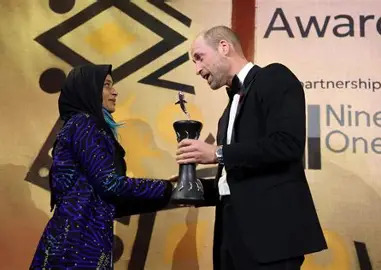
Kenyan conservationist Raabia Hawa has received the 2026 Tusk Award for Conservation in Africa after more than a decade of work protecting wildlife, coastal ecosystems and community land in northern Kenya, where threats from the militant group al-Shabaab and pressure from illegal fishing and extractive interests have made environmental protection an unusually dangerous undertaking. The award was presented in London on Nov. 11 and includes three years of funding for her organization, Ulinzi Africa Foundation, according to Mongabay’s report.
Hawa, a former broadcast journalist and Montessori teacher, founded Ulinzi Africa Foundation in 2014 to conduct frontline patrols against elephant poaching and wildlife crime. Its work later expanded to challenge illegal industrial bottom-trawling and support communities, including rural women, contesting mining concessions in Lamu and Tana River counties, where the Tana River reaches the Indian Ocean and marine and terrestrial ecosystems converge.
According to Mongabay, Hawa’s public opposition to environmental destruction has brought death threats and led to her being designated a target by al-Shabaab. The foundation has nevertheless continued operating with limited resources and substantial volunteer support from her family. Hawa dedicated the award to her father, Abdul Kadir Hawa, whom she credited with giving her the confidence to pursue her work.
The recognition matters beyond one organization. Across parts of Africa affected by insurgency, organized wildlife crime and weak state presence, conservation groups often work in the same places where public security, transport and communications systems are thin. That raises the cost of patrols, insurance, staff protection and field monitoring, while making it harder to maintain reliable biodiversity data or enforce fishing, mining and land-use rules.
In Kenya’s northern coastal counties, these pressures are also economic. Bottom-trawling can damage seabed habitats and intensify competition over fisheries on which coastal households depend. Disputes over mining concessions can affect land access, water sources and local livelihoods. When defenders face intimidation, conservation failures can therefore spill into food security, county revenue, tourism prospects and the credibility of public institutions responsible for environmental regulation.
The award also points to a financing problem in African conservation. International biodiversity frameworks increasingly emphasise protection and restoration, but implementation depends on organisations able to work consistently at community level. Security expenditure can divert scarce funds away from ecological surveys, community engagement and habitat restoration. Short funding cycles add another layer of fragility, particularly for small African-led organisations operating outside the continent’s best-financed parks.

Tusk says its annual conservation awards, established in 2013 with investment manager Ninety-One and in conjunction with the Prince of Wales, provide finalists with grants and international recognition. The Tusk Award for Conservation in Africa recognises an emerging leader whose work has demonstrated significant conservation impact, while the 2026 ceremony was held at Raffles London on Nov. 11.
For Hawa and Ulinzi Africa Foundation, the three-year funding attached to the honour may provide a measure of stability. The broader test is whether governments and funders treat protection for environmental defenders as part of conservation infrastructure rather than an incidental security cost. Without that support, Africa’s biodiversity commitments will continue to rely heavily on individuals and community organisations carrying risks that formal environmental programmes do not fully price.


