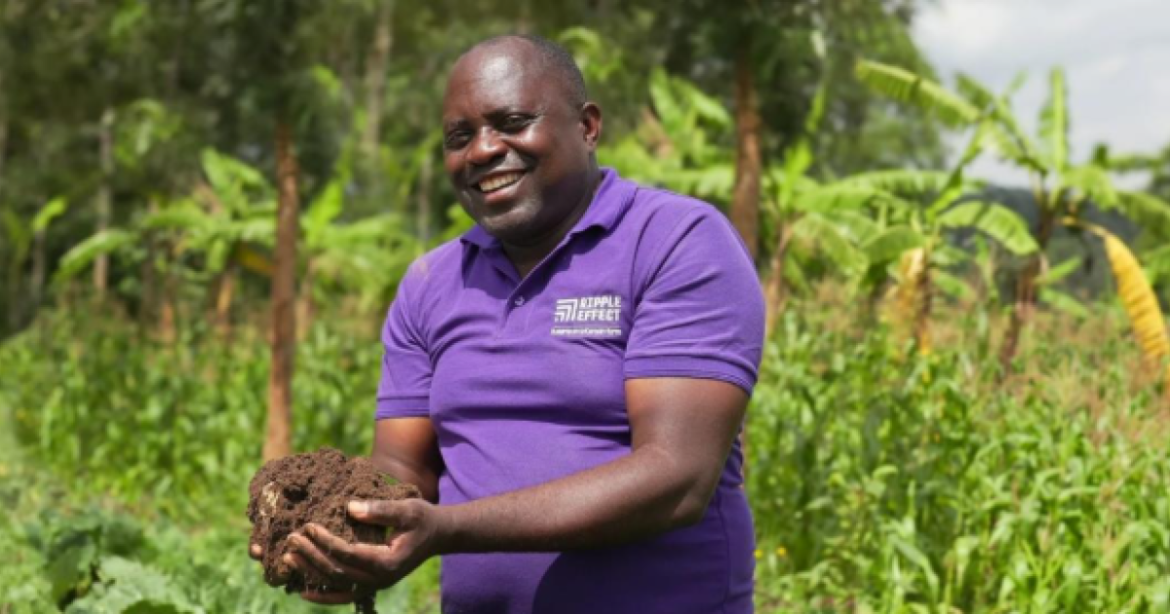
Ripple Effect Kenya will launch a five-acre agroecology hub in Chesero, Malava Sub-County, Kakamega County, on November 19, 2026, establishing a demonstration and learning centre focused on sustainable agriculture, livestock development and rural enterprise. Developed with funding from Riverford, the facility is intended to give farmers, agricultural organisations and development partners a practical setting to explore farming methods aimed at improving soil health, diversifying production and strengthening resilience to changing weather conditions.
The hub has been divided into five functional zones and already includes fruit trees, cereals, indigenous vegetables, horticultural crops and forage grasses. Its demonstration gardens feature keyhole, mandala, double-dug and sunken-bed designs, which provide different approaches to growing crops and managing available land and resources.
The launch will bring together representatives from county government, farmer organisations, development partners, research institutions, private-sector actors and local communities. Ripple Effect says the facility will serve as a space for demonstrating agricultural practices, exchanging technical knowledge and exploring ways to translate sustainable farming approaches into stronger rural livelihoods.

Alfred Juma, Programme Manager at Ripple Effect Kenya, said the hub was intended to connect farmers with technical experts and partners around practical approaches suited to local farming conditions. He said the organisation wanted the facility to become a place where agricultural knowledge could be demonstrated, shared and applied to improve the resilience of farming households.
The project also incorporates an enterprise dimension. Ripple Effect plans to explore income-generating opportunities through the sale of seedlings, planting materials and other agricultural products. These activities are intended to help establish a model that can support the hub’s continued operation, learning activities and engagement with farming communities. However, the organisation has indicated that additional infrastructure and facilities remain under development, meaning the launch will introduce the existing demonstrations and the longer-term vision rather than mark completion of the entire site.
The hub’s approach is based on agroecology, which applies ecological principles to agricultural production. Practices can include crop diversification, soil cover, composting, agroforestry, biological pest management and the integration of livestock into farming systems. These approaches are intended to improve the use of natural resources, support soil fertility and reduce dependence on costly external agricultural inputs.
Ripple Effect’s wider agroecology programme promotes its Agroecological Climate Positive Approach, which works with smallholder farmers to adapt production methods to local land and resource conditions. The organisation’s approach includes using compost and mulch to improve soil fertility and water retention, incorporating multipurpose trees into farms, diversifying crops and improving livestock management. It also emphasises the use of locally available materials and indigenous knowledge rather than assuming that all farmers have access to the same land, capital or inputs.
The demonstration gardens at Chesero provide a setting for farmers to observe different cultivation layouts and consider how they might be adapted to their own plots. Keyhole gardens, for example, are designed to make efficient use of relatively small spaces, while sunken beds can be used to manage water around crops. Double-dug beds involve deeper soil preparation, while mandala gardens organise cultivation around a circular layout. Their suitability will depend on local soil conditions, water availability, labour and the crops being grown.
The inclusion of fruit trees, indigenous vegetables, cereals and forage grasses also reflects the hub’s emphasis on diversified production. Different crops and plant varieties can serve different household and commercial purposes, including food, nutrition, livestock feed and potential market sales. The site’s livestock-related demonstrations are expected to complement crop production, although the launch announcement does not specify the livestock species, facilities or demonstration activities that will be available.
The initiative comes as Kenya advances its National Agroecology Strategy for Food System Transformation 2024–2033. Developed by the Ministry of Agriculture and Livestock Development in collaboration with county governments and other stakeholders, the strategy seeks to promote sustainable food systems, climate-resilient livelihoods, food and nutrition security, and social inclusion. It provides a national policy framework for integrating agroecological principles into agricultural production, processing, distribution and consumption.
The strategy places importance on practical implementation and participation by county governments, farmer organisations and other actors in the food system. The Kakamega hub could provide a local setting for demonstrating some of these approaches, although its launch does not in itself establish a formal implementation partnership with the national strategy.
Kakamega County has also been pursuing climate-resilient agricultural initiatives through farmer training and extension programmes. In July 2026, the county government reported that 45 Farmer Field School groups were benefiting from training and capacity-building under the FAO-Green Climate Fund Tunza Programme, supported by 15 trained facilitators. The programme focuses on climate-smart farming practices and sustainable livelihoods.
In the same month, Ripple Effect held a farmers’ field day in Kakamega in collaboration with Vivamos and the Kenya National Farmers Federation. Demonstrations covered homemade organic fertilisers, keyhole gardens, fertility trenches, indigenous seed preservation, beekeeping and the use of Black Soldier Fly larvae as a source of manure for poultry production. The activities illustrate the organisation’s existing work to introduce practical agricultural techniques that farmers can apply using locally accessible resources.
Ripple Effect is also implementing a Sustainable Food and Environment Improvement project in Kakamega County, running from July 2025 to December 2026. The programme aims to support more than 2,000 smallholder farmers through agroecology, improved nutrition, diversified livelihoods, community-led extension services and stronger food and nutrition security. Its activities include training in climate-smart agriculture, livestock management, enterprise development and improved connections to markets and essential services. The five-acre hub provides a physical demonstration space that can complement this wider programme, although the organisation has not disclosed how many farmers will use the facility or whether it will serve as a formal training centre for all project participants.
Funding from Riverford adds an international partnership dimension to the initiative. The UK-based organic farming business has supported Ripple Effect since 2010, with the partnership focused on sustainable agriculture and rural livelihoods. Ripple Effect’s funding information describes Riverford’s contributions as supporting agricultural initiatives in East Africa, including work on intercropping, soil health and food security. The Kakamega hub extends this relationship through support for a dedicated demonstration and learning facility.
For local farming communities, the hub’s longer-term relevance will depend on whether the demonstrations translate into practices that farmers can adopt and sustain on their own land. Access to planting materials, technical advice, livestock management support and reliable markets will influence the extent to which learning can lead to changes in production and household income. The proposed sale of seedlings and other agricultural products could also provide a route for connecting the demonstration site with local agricultural enterprises.
The November 19 launch will introduce the hub’s existing facilities and its planned role in farmer learning, sustainable production and rural enterprise. With additional infrastructure still being developed, its future contribution will depend on the expansion of facilities, continued engagement with farming organisations and the ability to turn demonstrations into locally applicable agricultural practices.