


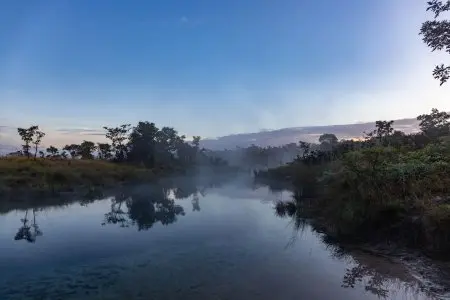
Experienced hunters in Angola’s central and southeastern highlands are being recruited by traditional leaders to monitor illegal hunting, forest disturbance and poorly managed fires across Lisima Lya Mwono, a vast network of wetlands, peatlands and miombo woodlands that supplies water to the Okavango and Zambezi river systems. The community-led initiative is intended to strengthen conservation across one of Southern Africa’s most important water sources by combining local ecological knowledge, traditional authority and mobile monitoring technology.
The programme has so far appointed 75 hunters from Luchaze and other local communities as “Watchers”, known locally as Tunyiungi va Lisima. Selected by village chiefs, they patrol woodlands, observe established hunting routes and report unauthorised extraction of wildlife and other natural resources. Organisers plan to expand the network to 100 Watchers, according to Mongabay.
Their recruitment followed concerns raised about four years ago by community elders who had observed hunters arriving from outside the highlands to obtain bushmeat without permission from traditional leaders. Some of the outsiders reportedly recruited local residents and disregarded customary rules governing where hunting could take place, which animals could be killed and how meat should be distributed within villages.

The response differs from conventional conservation enforcement, which often relies on state-employed rangers and restrictions designed by institutions outside the affected landscape. In Lisima Lya Mwono, the monitoring system is built around people who already understand wildlife movements, vegetation patterns, seasonal fire use and the social rules governing access to natural resources.
The Watchers use smartphones to record the coordinates of hunting camps, photograph forests and source lakes, document fires and report suspected illegal hunting through audio messages in local languages. Information is transmitted to community leaders, allowing villages to intervene before unlawfully obtained bushmeat is moved out of the area. Camera traps monitored with community participation have recorded roan antelope, common duiker and sitatunga, alongside lions, leopards, cheetahs and African wild dogs.
The landscape under surveillance extends well beyond a single wetland. Lisima Lya Mwono, meaning “Source of Life” in the Luchaze language, forms part of an Angolan water tower covering more than 150,000 square kilometres of forests, rivers, lakes, marshes and peatlands. Its headwaters feed river systems connected to Botswana’s Okavango Delta and the Zambezi basin, making activities in remote Angolan communities consequential for water availability, biodiversity and rural economies across Southern Africa.
Angola designated 53,670 square kilometres of Lisima Lya Mwono as its first Wetland of International Importance under the Ramsar Convention, with the designation announced in January 2026. The site, listed as Ramsar Site No. 2584, lies within the Zambezi biogeographical region and contains deep sandy soils that absorb rainfall and release it gradually into clear, low-mineral streams. The hydrological system supports extensive miombo forests and peatlands as well as threatened wildlife and more than 18 endemic or near-endemic fish species.
The National Geographic Okavango Wilderness Project estimates that the wider Angolan Highlands Water Tower holds about 423 cubic kilometres of water and supplies approximately 95% of the water flowing into the Okavango Delta. The broader system contributes freshwater to seven countries, placing the management of Angola’s upland forests and wetlands within a regional water-security framework rather than a narrowly national conservation agenda.
For Angola, the initiative tests whether community institutions can provide practical environmental oversight in remote areas where government enforcement capacity is limited and infrastructure remains thin. Formal Ramsar recognition raises the international profile of the wetland but does not by itself establish a fully funded management system or provide comprehensive protection under Angolan law. Mongabay reported that the designated area and its surrounding landscape still lack equivalent formal domestic protection.
That gap matters because the principal pressures are likely to arise from changes in land use rather than subsistence hunting alone. Greater road access could increase commercial bushmeat hunting, timber extraction and agricultural expansion. Water abstraction and unspecified development have also been identified by the Ramsar Convention as threats to the site’s ecological character
Fire management presents a similar governance challenge. Residents use fire to prepare agricultural land, support hunting, regenerate grass and encourage the growth of medicinal plants. Some miombo species are adapted to fire, but burning at the wrong time or in sensitive locations can damage forests, threaten settlements and reduce the capacity of soils and peatlands to regulate water. Researchers are therefore developing an integrated fire-management plan that incorporates community practices rather than treating all burning as environmental degradation.
The economic question is whether conservation duties can be connected to viable livelihoods. Hunting, fishing, beekeeping and shifting agriculture remain important sources of food and income in the highlands. Restricting these activities without alternatives could transfer the cost of protecting a regionally important water system to communities with limited access to markets, public services and formal employment.
A durable arrangement would require clearly defined community rights, reliable financing for monitoring, coordination with provincial and national authorities and credible procedures for responding to reported violations. It would also need safeguards to ensure that traditional enforcement is transparent and that conservation benefits are distributed beyond the individuals directly employed as Watchers.

For Southern Africa, the programme illustrates the close relationship between local land management and regional economic security. The Okavango and Zambezi systems support households, agriculture, fisheries, tourism and electricity infrastructure across several countries. Damage to their Angolan headwaters would therefore carry costs beyond biodiversity loss, including greater pressure on water supplies and rural livelihoods downstream.
Lisima Lya Mwono’s international status gives Angola a stronger basis for attracting conservation finance and coordinating with countries that share its water. The experience of its hunters also suggests that protecting strategic African ecosystems may depend less on removing people from landscapes than on strengthening the institutions through which communities already regulate them.


