


The African Development Bank Group is committing $20 million in reimbursable grants to advance four green hydrogen and derivatives projects in Egypt, Morocco, Namibia and South Africa, targeting projects with an estimated combined investment value of $23 billion as African governments seek to turn renewable-energy resources into industrial capacity, export revenues and lower-carbon production. The financing, to be provided through the Sustainable Energy Fund for Africa (SEFA) subject to approval by the Bank’s Board, is intended to take the projects closer to investment readiness and address one of the main constraints facing Africa’s emerging hydrogen industry: converting large project concepts into bankable developments.
The four projects cover different applications of green hydrogen and its derivatives. Egypt’s Project Ra, sponsored by DAI Infrastruktur GmbH, is set to receive $3.55 million; Morocco’s Guelmim Green Hydrogen Valley, sponsored by Nareva Holding, has been allocated $5.28 million; Namibia’s Hyphen project, sponsored by Hyphen Hydrogen Energy, is expected to receive $5.93 million; and South Africa’s Saldanha Hydrogen Direct Reduced Iron project, involving Enertrag and ArcelorMittal South Africa, has been allocated $5.24 million. Together, the projects represent an estimated 20 gigawatts of equivalent solar and wind generation, 7 gigawatts of electrolyser capacity and 2,950 megawatt-hours of battery storage.
The scale of the proposed developments is considerably larger than the initial grant envelope. That distinction is important because the AfDB financing is not intended to fund construction of the projects in full. Instead, the grants are designed to support project preparation and improve bankability, potentially helping developers address technical, financial and institutional requirements before larger pools of commercial and development capital can be mobilised. SEFA’s broader mandate is to use catalytic finance and technical assistance to remove market barriers, strengthen project pipelines, and improve the risk-return profile of renewable energy investments in Africa.
The financing follows the Africa Green Hydrogen Programme’s 2026 call for proposals, which attracted 81 applications from projects across 18 African countries. The four selected projects therefore represent only part of a much wider pipeline of proposed hydrogen developments on the continent.
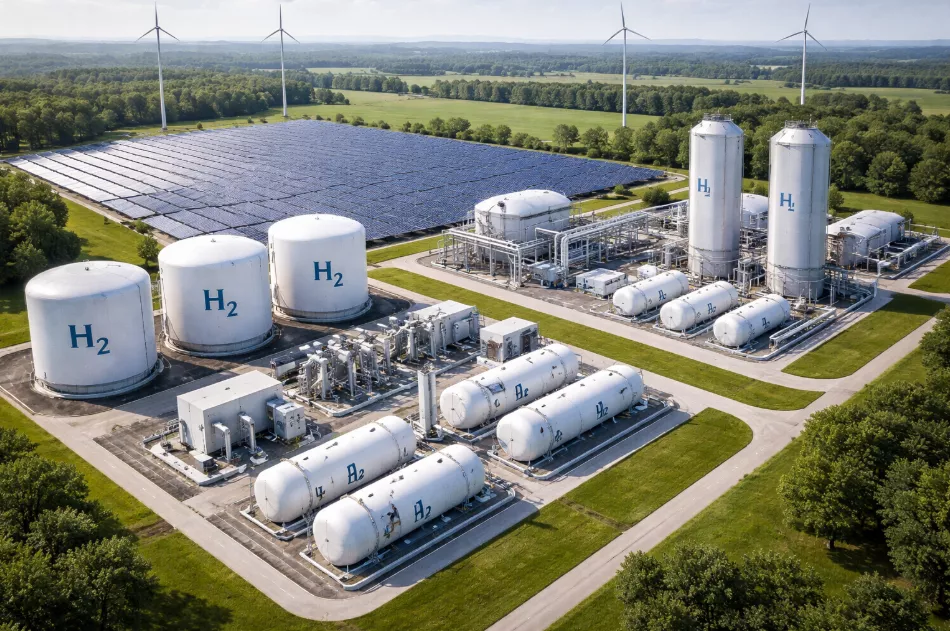
That pipeline reflects Africa’s growing interest in using abundant renewable resources to produce hydrogen without the emissions associated with conventional fossil-fuel-based hydrogen. Green hydrogen is produced by using renewable electricity to split water into hydrogen and oxygen through electrolysis. Its potential applications extend beyond energy supply into fertiliser production, shipping fuels, aviation fuels, and industrial processes such as steelmaking.
For African economies, the industrial applications may be more consequential than hydrogen as a standalone energy product. Countries with large renewable resources and established industrial or mineral sectors can potentially use hydrogen to change how commodities are processed before export. South Africa’s Saldanha Hydrogen DRI project illustrates this approach by seeking to use renewable energy and hydrogen to produce low-carbon iron through direct reduced iron technology. The project is also intended to make use of existing industrial infrastructure and support domestic beneficiation.
Read also: https://www.afdb.org/en/news-keywords/sustainable-energy-fund-africa
This connection between renewable power and industrial processing is central to the economics of Africa’s energy transition. Producing hydrogen solely for export could generate foreign exchange, but developing domestic industrial applications could create additional demand for electricity, engineering services, infrastructure and skilled labour. It could also allow mineral-producing countries to capture a larger share of value before products enter international supply chains.
The challenge is that green hydrogen projects are capital-intensive and require several infrastructure systems to work simultaneously. Large developments need substantial renewable-generation capacity, electrolysers, water supply, storage, transmission infrastructure, ports and transport links, as well as reliable buyers for the resulting hydrogen or derivatives. The financial viability of a project can therefore depend on several interconnected investments being delivered at the right scale and timing.
Water is another important consideration. Electrolysis requires water, while some African hydrogen projects are in water-stressed regions. The AfDB says the programme could support projects that increase access to desalinated potable water and electricity by using surplus generation, but the environmental and economic implications of water use will depend on project design, local water availability and how competing community, agricultural and industrial needs are managed.
The Bank’s own guidelines for sustainable hydrogen projects underline the importance of these issues. Developed with international partners including the United Nations Industrial Development Organization, the United Nations Environment Programme and the African Development Bank, the guidelines identify people, the planet, prosperity and renewable-energy provision as four areas for assessing hydrogen projects. They emphasise local value creation, sustainable financing, labour standards, skills development, water protection, and responsible resource use.
That framework is relevant because the size of Africa’s hydrogen pipeline creates both an investment opportunity and a governance challenge. Large projects can attract foreign capital and technology, but the economic benefits will depend on the extent to which local companies, workers, and institutions participate in their development and operation. Without adequate local linkages, hydrogen production could remain largely an export-oriented enclave with limited connections to surrounding economies.
The four projects span countries pursuing different industrial strategies. Egypt is developing Project Ra around sustainable marine and aviation fuels, while Morocco’s Guelmim Green Hydrogen Valley is also focused on derivatives. Namibia’s Hyphen project is part of the country’s wider effort to develop a large-scale green-hydrogen industry, while South Africa is linking hydrogen directly to low-carbon iron production.
Their different applications also demonstrate why hydrogen policy is increasingly becoming an industrial-policy question rather than simply an energy-policy issue. Countries are assessing whether renewable electricity can be converted into products with higher economic value, including green ammonia, sustainable fuels, and low-carbon industrial materials. The outcome will depend on access to markets, production costs, infrastructure, and the ability to secure long-term buyers.
Export markets will be particularly important. Hydrogen derivatives can be transported more easily than pure hydrogen, making products such as ammonia and sustainable fuels potential channels for connecting African production with international markets. Egypt’s Project Ra, for example, is being developed around the Suez Canal corridor and aims to produce green ammonia for global markets.
However, access to international markets will increasingly be shaped by carbon standards and industrial policies in importing economies. This could create opportunities for African producers able to demonstrate low-carbon production, but it also raises the cost of meeting certification, traceability and environmental requirements. The ability to satisfy those requirements could become part of the competitiveness of African hydrogen exports.
The financing structure is therefore significant. Development institutions can absorb some of the early-stage risks that commercial lenders and investors may be unwilling to take before technical studies. Offtake arrangements, infrastructure plans, and regulatory frameworks are sufficiently developed. SEFA’s role is explicitly designed around this catalytic function, providing concessional finance and technical assistance to address barriers that prevent renewable energy projects from reaching investment decisions.
For public finances, the approach could help governments attract private capital without carrying out the full cost of developing large energy projects on their balance sheets. But it also means that public and concessional funding needs to be directed towards projects with credible commercial structures, transparent risk allocation and measurable development benefits. The fact that the four selected projects represent an estimated $23 billion in potential investment illustrates the leverage that relatively modest project-preparation finance can seek to achieve, while also highlighting the substantial amount of capital still required beyond the initial grants.
The broader test for Africa’s hydrogen ambitions will consequently be whether project pipelines can move through feasibility, financing, construction and operation without losing sight of domestic economic value. Renewable energy capacity, industrial infrastructure and skills development will need to expand alongside hydrogen production if the sector is to contribute meaningfully to wider economic transformation.
 The AfDB’s decision marks an early financing step rather than evidence that the continent’s hydrogen industry has reached commercial maturity. Yet the move shows where development finance is increasingly being directed: towards projects that connect renewable resources with industrial production and international markets. For Egypt, Morocco, Namibia and South Africa, the immediate task is to convert project preparation support into credible investment structures. For the wider continent, the experience could help clarify whether green hydrogen can become more than an export opportunity and instead form part of a broader strategy for renewable-energy expansion, industrial decarbonisation, value addition and economic diversification.


