


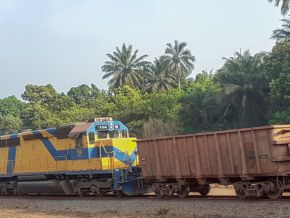
Zimbabwe is turning back to rail as mining investment increases pressure on the country’s freight infrastructure, with the National Railways of Zimbabwe negotiating a $115 million financing facility from the African Export-Import Bank to purchase locomotives, wagons and repair sections of its network.
The proposed facility would finance 10 locomotives and 315 wagons, while also supporting repairs to parts of the railway infrastructure, according to John Mangudya, chief executive of Mutapa Investments, the sovereign wealth fund that oversees NRZ. Mangudya disclosed the negotiations on September 17 as NRZ commissioned three locomotives and 100 wagons refurbished through a partnership with Zimasco, the Zimbabwean ferrochrome business of China’s Sinosteel.
The financing comes as Zimbabwe attempts to rebuild a railway system whose freight volumes have fallen sharply after years of underinvestment. NRZ moved about 12 million tonnes of freight annually during its stronger operating years in the 1990s, but volumes fell to about 2 million tonnes in 2025. The decline has shifted a significant share of heavy freight onto roads, increasing pressure on an already constrained road network while raising logistics costs for mining and other export-oriented industries.

For Zimbabwe, the timing is closely linked to the changing structure of its mining economy. Lithium has emerged as one of the country’s most important new mineral industries, creating additional demand for reliable transport routes connecting mines to regional ports. NRZ began transporting lithium concentrate to Mozambique’s Port of Maputo in July 2026 through a partnership involving Beitbridge Bulawayo Railway, a subsidiary of South Africa’s Grindrod, and Zimbabwean logistics company Silvergill.
The approximately 1,000-kilometre route connects Gwanda with Beitbridge, continues through the NRZ network to the Mozambican border at Chicualacuala and then follows the Limpopo line to Maputo. The arrangement provides mining companies with an alternative to road haulage for moving mineral exports to international markets.
The development illustrates how the revival of rail is becoming connected to Zimbabwe’s broader mineral-export strategy. The country has become one of Africa’s leading lithium producers, while Chinese companies have invested about $2 billion in Zimbabwe’s lithium sector since 2021. Industry projections cited by Reuters indicate that Zimbabwe could produce about 344,000 tonnes of lithium sulphate annually by 2030 as processing capacity expands.
That growth creates a logistical question beyond the mines themselves. Higher mineral production does not automatically translate into greater export capacity if transport infrastructure remains constrained. Mines need dependable links to processing facilities, border crossings and ports, while exporters require predictable freight capacity to manage delivery schedules and costs.
Rail can play a particularly important role in this equation because bulk mineral transportation over long distances can place significant pressure on road networks. Zimbabwe’s National Development Strategy 2 for 2026-2030 explicitly identifies rail as the preferred mode for heavy cargo and calls for the rehabilitation of NRZ infrastructure, alongside regulatory measures to encourage or require the movement of bulk goods by rail.
The strategy links the decline of rail freight directly to road infrastructure pressures. It notes that NRZ freight capacity has fallen well below its installed capacity and that the resulting shift of heavy cargo to roads has contributed to deterioration of major transport corridors, including roads affected by coal and mineral haulage.
The proposed Afreximbank financing would therefore address only part of a much larger infrastructure requirement. Mangudya estimates that NRZ needs about $600 million to modernise its rolling stock and railway network. At $115 million, the proposed facility would cover less than one-fifth of that requirement, leaving the railway operator dependent on additional financing, partnerships and investment to undertake a more comprehensive rehabilitation.
This funding gap is significant because railway infrastructure requires coordinated investment. New locomotives and wagons can increase carrying capacity, but their effectiveness depends on the condition of tracks, signalling systems, bridges, workshops, terminals and border infrastructure. Bottlenecks in any of these components can limit the amount of freight that the system can move.
NRZ has increasingly turned to private-sector partnerships as one way of addressing this constraint. The refurbishment of three locomotives and 100 wagons through Zimasco demonstrates how mining companies can participate directly in restoring freight capacity that is important to their own supply chains. The lithium route to Maputo similarly relies on cooperation between the state railway operator and private logistics companies.
These partnerships point towards a potentially broader model for rail rehabilitation in Zimbabwe, in which public infrastructure, mining companies, logistics operators and development-finance institutions contribute different forms of capital and expertise. The financing discussions with Afreximbank also place rail within a wider African trade and infrastructure agenda. Zimbabwe’s railway network does not operate in isolation. Its connections to Mozambique, South Africa and the wider Southern African Development Community transport system determine how efficiently minerals and manufactured goods can reach regional and international markets.
The Maputo corridor is particularly relevant as Zimbabwe seeks to diversify its export routes and reduce dependence on road transportation. Better rail connectivity can also strengthen regional trade by lowering the logistical barriers associated with moving bulk commodities across borders. There is also a sustainability dimension to the shift. Rail can move large volumes of freight using significantly less road space than equivalent truck movements, potentially reducing road maintenance requirements and congestion along major corridors. For a mining-dependent economy, moving more bulk freight by rail can therefore become part of a broader infrastructure-efficiency strategy.
But the environmental and economic benefits will depend on the performance of the railway itself. An unreliable rail system can force mining companies back onto roads, limiting the value of new infrastructure investment. The priority is therefore not simply to increase the number of locomotives and wagons, but to restore a network capable of providing predictable, competitive and commercially viable freight services.
Zimbabwe’s mining sector is also changing in ways that make this requirement more urgent. Lithium has joined established mineral industries such as ferrochrome, gold and platinum as an important source of export activity, while the government is seeking greater local processing and value addition. Processing plants will require reliable inputs and transport links, while finished or semi-processed products will still need access to regional logistics corridors.
The country’s decision to place NRZ under Mutapa Investments adds another dimension to the rehabilitation effort, with the sovereign wealth fund expected to focus on the commercial performance of assets under its oversight. For NRZ, increasing freight volumes will be important not only for national infrastructure policy but also for the financial sustainability of the railway itself.

The immediate $115 million financing proposal is therefore only one component of a much larger test. Zimbabwe needs to determine how to finance the remaining rehabilitation requirement, restore customer confidence, improve operational performance and create a freight system capable of responding to mining-sector demand without transferring excessive costs onto the road network.
The return of lithium shipments to rail provides an early indication of what that system could support. But the longer-term opportunity extends beyond one mineral or one export route. If Zimbabwe can rebuild NRZ into a reliable freight network, rail could become a critical link between the country’s mines, processing facilities, industrial centres and regional ports. That would give infrastructure investment a role not simply in moving commodities, but in supporting mineral value addition, regional trade and the competitiveness of Zimbabwe’s broader economy.
The proposed Afreximbank facility therefore represents more than a request for new locomotives and wagons. It is an early financing step in a much larger effort to reconnect Zimbabwe’s mineral economy with the rail infrastructure needed to move it.


