


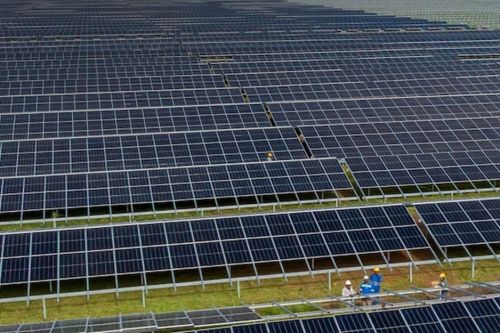
Zambia’s electricity system is entering another phase of diversification after the 100 MWac Maamba Solar PV Project injected its first power into the national grid on September 24, adding utility-scale solar generation as the country seeks to reduce its exposure to hydropower and the climate risks associated with dependence on rainfall. Developed by Maamba Solar Energy Limited, the project has entered commissioning and is expected to undergo synchronisation, testing and performance verification before reaching full commercial operation.
The project is a joint venture between Nava Global PTE Limited, the international arm of India-listed Nava Limited, which holds a 65% stake, and Zambia’s ZCCM Investments Holdings, which owns the remaining 35%. Located in Maamba in Sinazongwe District, Southern Province, the solar plant sits alongside existing Maamba thermal power operations and represents an investment of about $90 million. Its entire output is covered by a 20-year power purchase agreement with Zambia’s state-owned electricity utility, ZESCO, providing the project with a long-term offtake arrangement as it moves through commissioning.
The first injection comes as solar has rapidly increased its presence in Zambia’s electricity system. The Ministry of Energy says installed generation capacity increased from 3,100 MW in 2021 to 4,576 MW in 2026, while installed solar capacity rose from 88 MW to 841 MW over the same period. That expansion has been supported by projects including the Itimpi solar plant and the Chisamba Solar Complex, whose second phase recently doubled the complex’s capacity to 200 MW.

The pace of solar deployment marks a significant change in a power system that has historically depended heavily on hydropower. Government projections indicate that solar capacity could reach 2,733 MW by 2031, representing about 26% of projected installed generation capacity. Hydropower is projected at 4,279 MW, or roughly 42%, while thermal generation is expected to reach 2,555 MW. The resulting generation system is projected at about 10,182 MW, although the Ministry of Energy has stressed that these figures cover projects already under implementation and could change as additional projects are developed.
That qualification is important because Zambia’s electricity requirements are likely to continue evolving alongside mining, manufacturing, commercial activity and household electrification. The International Monetary Fund has noted that electricity demand remains a constraint, particularly as demand from mining and large businesses grows. Its assessment also identifies a pipeline of solar projects that could materially increase generation capacity over the medium term.
The diversification drive has been shaped by the experience of the 2023-2024 drought. Zambia entered the crisis with hydropower accounting for roughly 80% or more of electricity generation, leaving the system highly exposed to declining reservoir levels. According to the IMF, Lake Kariba’s available output fell by as much as 80% at the lowest point of the drought, contributing to load-shedding of up to 20 hours a day in some urban areas. The resulting power shortages affected households and businesses and constrained industrial production and economic activity.
Zambian parliamentary records from 2024 similarly linked prolonged load-shedding to low water levels following below-normal rainfall during the 2023/2024 rainy season, when the El Niño weather pattern contributed to drought conditions. At the height of the crisis, the country faced a substantial gap between available generation and peak demand.
The economic significance of that exposure extends well beyond electricity availability. Zambia’s mining sector is particularly electricity-intensive, with the World Bank noting that mining accounts for around half of national electricity consumption. Power shortages therefore create implications for production schedules, operating costs, investment decisions and the wider supply chains connected to mining. The World Bank has identified diversification of the generation mix, alongside regional power integration and expanded access, as important elements of strengthening Zambia’s energy security.
Solar does not eliminate the challenges facing the electricity system. Variable generation introduces its own requirements for transmission capacity, grid management, storage, complementary generation and demand management. As the share of solar increases, Zambia will need to ensure that new generation is matched by adequate infrastructure for evacuation and balancing. The development of a more diversified generation portfolio therefore involves not only building additional megawatts but also strengthening the systems that allow those megawatts to be reliably delivered to consumers.
The Maamba project nevertheless illustrates how private and public capital can combine around long-term power offtake arrangements. ZCCM-IH’s participation provides a domestic institutional stake, while Nava brings international private-sector investment and development capacity. The 20-year PPA with ZESCO provides a contractual framework for selling the plant’s output, while the project’s location alongside existing power infrastructure provides an established energy-development base in Southern Province.
For Nava, the project also represents a diversification of its energy portfolio into utility-scale renewable generation. The company has described the Maamba solar project as its first utility-scale solar venture, expanding its presence beyond its established activities in power generation, mining and ferroalloys. For ZCCM-IH, the investment adds another renewable-energy asset to a portfolio that already includes interests across Zambia’s mining and energy sectors.
The broader policy direction is therefore increasingly centred on reducing concentration risk in Zambia’s power system. Government’s stated objective is to reduce hydropower’s share of installed capacity from about 85% to approximately 42% by 2031, while increasing solar to around 26% and thermal generation to about 25%. The Ministry has explicitly linked the strategy to the lessons of the 2023/2024 drought, when reduced hydropower generation exposed the consequences of relying heavily on a single generation source.

For businesses operating in Zambia, the significance of this transition will ultimately be measured not only by installed capacity but by reliability, predictability and the cost of electricity. The drought demonstrated that a large generation portfolio can still become vulnerable when a dominant source is exposed to the same climate variable across the system. A broader mix of solar, hydro, thermal and potentially other renewable sources can distribute that exposure, although it also creates new investment requirements around grids, flexibility and system management.
Maamba’s first power injection therefore represents more than the addition of another 100 MW to Zambia’s installed capacity. It is part of a wider restructuring of the country’s electricity system in response to rising demand, climate variability and the economic consequences of unreliable power. With solar capacity already approaching 1 GW and a much larger pipeline under development, Zambia’s energy challenge is increasingly shifting from whether it can add new generation to how effectively it can integrate, finance and deliver a more diversified electricity supply.
The direction of travel will matter beyond Zambia. Across southern Africa, several electricity systems face the combined pressures of growing demand, ageing infrastructure, climate variability and the need to mobilise private capital for new generation. Zambia’s experience illustrates the economic case for treating power diversification as both an energy-security issue and an investment and resilience question. The effectiveness of that transition will depend on whether new generation is accompanied by the transmission, financing and institutional capacity required to convert installed capacity into dependable electricity for households and productive sectors.


