


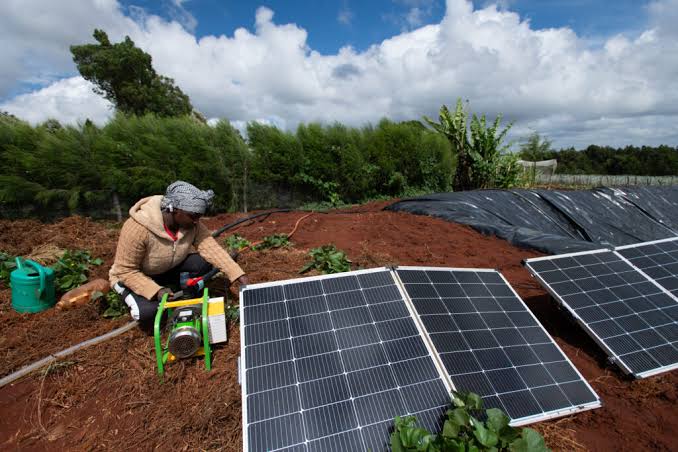
Kenyan climate-tech company SunCulture has secured a $10 million securitisation facility from Mirova’s Gigaton Fund to unlock capital tied up in farmer repayments and expand access to solar-powered irrigation, highlighting how structured finance could help address one of the key constraints to scaling productive-use energy technologies across African agriculture. The transaction, announced on September 24, 2026, with financial technology company Kaleidofin supporting the structure, will allow SunCulture Kenya to transfer eligible customer receivables to a dedicated vehicle and recycle capital into financing new solar irrigation systems.
The transaction addresses a financing challenge that is particularly relevant to pay-as-you-go agricultural technologies. SunCulture sells solar irrigation systems to farmers and allows customers to repay the cost of equipment over time. While this model reduces the upfront financial barrier for farmers, it also means that capital remains tied up in receivables for the duration of customer repayment schedules. Under the new structure, the Mirova Gigaton Fund is providing senior secured financing to a special purpose vehicle that acquires receivables originated by SunCulture Kenya. This gives the company earlier access to part of the value of those future repayments, enabling it to redeploy capital toward additional customers rather than waiting for the full repayment cycle.
For African climate-tech businesses, the distinction is important. The availability of technology does not necessarily translate into widespread adoption when companies must finance customers for extended periods while simultaneously funding inventory, distribution and operations. Receivables-based financing can potentially shorten that capital cycle by converting predictable future cash flows into funding that can be deployed again. In SunCulture’s case, the structure is specifically linked to productive-use solar irrigation assets, connecting climate finance with an agricultural business model rather than financing energy access solely as a household or infrastructure challenge. Mirova described the transaction as a mechanism to mobilise institutional capital for climate-smart agriculture and develop a financing model that could be replicated across distributed productive-use energy assets.

Samir Ibrahim, co-founder and chief executive of SunCulture, said the constraint on irrigation in Kenya has been less about farmer demand than the availability, cost and duration of financing. He said the transaction provides the company with longer-term, foreign-exchange-protected capital and allows it to recycle financing more quickly into new farmers. The comments underline a broader issue in African agricultural finance: the economics of a technology can be viable while the financing structure required to put that technology in farmers’ hands remains difficult to scale.
The size of the opportunity is substantial. The 2024 Off-Grid Solar Market Trends Report, produced by the World Bank’s Energy Sector Management Assistance Program and GOGLA, estimated a total addressable market of about 30.9 million solar water pumps globally based on unelectrified farming households and water-resource constraints. The report recorded roughly 23,000 solar water pumps sold in 2023 and estimated that continued market trends would result in about 354,000 sales between 2024 and 2030. Under a universal-access scenario, however, the financing requirement for the total addressable market was estimated at about $16 billion.
The gap is also visible in sub-Saharan Africa. Earlier GOGLA analysis estimated 5.2 million smallholder farmers in rural, off-grid areas of the region had potential demand for solar water pumps, while affordability constraints reduced the addressable market to about 640,000 farmers, valued at roughly $684 million at the time of the analysis. The figures illustrate that the market constraint is not simply technological availability. Purchasing power, financing terms and the ability of providers to carry customer receivables all influence how quickly solar irrigation can move from a viable product to a mass agricultural technology.
Kenya provides a particularly important setting for this financing model because agriculture remains deeply connected to employment, exports, household incomes and food security, while irrigation remains relatively limited. World Bank analysis has previously identified irrigation as a major opportunity for improving agricultural productivity and resilience in Kenya, noting that much of the country’s agricultural production remains exposed to rainfall variability. The institution has also supported farmer-led irrigation initiatives designed to expand water-efficient irrigation systems and improve access to finance and markets for smallholders.
The economic implications extend beyond replacing diesel-powered pumps with solar equipment. Irrigation can change the production economics of farms by allowing farmers to cultivate during periods when rainfall is insufficient, increase the frequency of production and diversify into higher-value crops. Research cited by GOGLA found that among nearly 1,200 solar water pump customers surveyed across East and Southern Africa, 90% reported increased income, with 47% reporting a significant increase and 43% a slight increase. Respondents attributed the gains to factors including increased production, lower farming costs and expansion of cultivated land.
This makes the financing architecture as important as the equipment itself. A solar pump can reduce exposure to fuel costs and improve access to water, but a farmer who cannot afford the initial purchase may never reach those benefits. Likewise, a provider that must wait several years to recover the full value of financed equipment can face limits on how many additional customers it can serve without raising more working capital. The securitisation model attempts to address both sides of that equation by keeping the farmer-facing repayment model while giving the provider a mechanism to recycle capital more rapidly.
The transaction also reflects a broader evolution in African climate finance, where institutional investors are increasingly being connected to pools of smaller productive assets through structured financial vehicles. Rather than relying solely on conventional corporate debt or equity, such structures can allow future customer cash flows to become the basis for additional financing. Kaleidofin supported the transaction through portfolio monitoring, receivables selection and cash-flow modelling, according to information released following the deal.
For the wider solar irrigation market, the question will be whether structures of this kind can be replicated without compromising affordability for farmers or creating excessive financial risk for providers and investors. Solar irrigation businesses operate across markets where currency volatility, agricultural seasonality, credit risk and uneven farmer incomes can affect repayment performance. GOGLA has previously identified inflation, currency depreciation and reduced consumer purchasing power as significant pressures on off-grid solar companies operating in African markets.
The SunCulture transaction therefore sits at the intersection of agricultural finance, distributed renewable energy and climate adaptation. Its immediate purpose is to release capital from existing customer receivables, but its wider significance lies in testing whether institutional finance can support the repeated deployment of relatively small productive assets at scale. For African agriculture, where irrigation, energy access and affordable credit remain interconnected constraints, the ability to finance the customer may be just as important as the ability to manufacture and distribute the technology.
If the model performs as intended, the transaction could provide a reference point for financing other distributed productive-use assets, from solar-powered agricultural equipment to cold storage and other technologies that generate economic value for small businesses and farmers. The central challenge remains turning demand into commercially sustainable deployment. In that context, the next phase of Africa’s clean-energy transition may depend not only on how much capital is mobilised, but on how efficiently that capital can be recycled through the businesses and financial structures serving the continent’s productive economy.


