


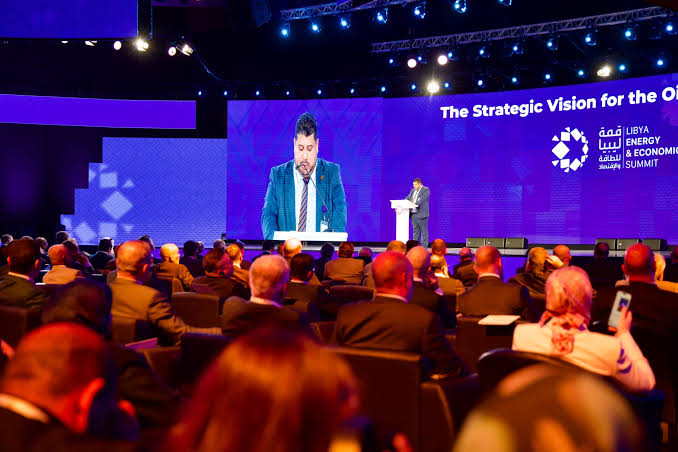
South Korea and Libya are exploring a potential oil-refining partnership that could link Libya’s need for domestic fuel supplies with Seoul’s search for more diversified crude sources, as both countries seek to revive economic ties after years of limited engagement. The proposal was discussed during the Libya-South Korea Economic Cooperation Forum held in Tripoli on September 27-28, where Korean and Libyan officials and companies examined opportunities in energy, infrastructure, technology and trade. The discussions include the possibility of Korean companies supporting crude refining in Libya to supply gasoline and diesel to the domestic market, while South Korea could potentially secure a share of Libyan crude for its own refineries. No formal agreement covering the proposals has been announced.
For Libya, the refining proposal comes as the country continues to manage the challenge of converting its substantial crude resources into reliable supplies of petroleum products for its domestic economy. Libya’s National Oil Corporation recently restarted initial refining units at the Zawiya refinery after crude flows through the Sharara-Zawiya pipeline resumed, with refined products expected to support fuel stations and power-generation operations. The episode illustrates the importance of functioning crude-to-product infrastructure in a market where disruptions to oil infrastructure can quickly affect fuel availability and public services.
For South Korea, the proposed relationship is closely connected to energy-security concerns. The country has one of the world’s largest refining systems, with the International Energy Agency putting national refining capacity at about 3.5 million barrels per day. Korean refineries process imported crude into fuels and petrochemical feedstocks, while petroleum products such as gasoline, diesel and jet fuel are also exported. South Korea’s exposure to external energy markets is therefore not simply a question of securing volumes but also of maintaining access to suitable crude grades, shipping routes and reliable commercial counterparties.
That exposure has become more significant amid disruption to Middle Eastern oil flows. Middle Eastern suppliers accounted for about 62% of South Korea’s crude imports during January-August 2026, according to data cited by S&P Global, although the share had fallen from nearly 70% in 2025 as refiners increased purchases from the Americas, Oceania and Africa. South Korea has also been actively developing alternative supply arrangements. In April, Seoul announced that it had secured 273 million barrels of crude through routes outside the Strait of Hormuz, including supplies from Saudi Arabia, Kazakhstan and Oman.
The diversification strategy has since become more structural. In September, South Korea announced a plan to reduce the share of its crude imports sourced from the Middle East to 50% by 2035, compared with about 70% in 2025. The strategy includes expanding crude stockpiles and broadening the country’s supplier base. Against that backdrop, Libyan crude offers Seoul another potential source from outside the Gulf, although the commercial value of such an arrangement would depend on crude specifications, pricing, shipping economics and the ability of Korean refineries to process the relevant grades efficiently.
The possibility of sourcing Libyan crude is not entirely new. In April, South Korea’s Deputy Foreign Minister for Economic Affairs Park Jong-han travelled to Libya and held discussions with officials of the National Oil Corporation over potential purchases of Libyan heavy crude by Korean companies. The NOC indicated that it was willing to allocate supplies to South Korea subject to conditions including crude specifications, delivery timing and buyer credibility. Seoul subsequently continued diplomatic engagement, with Vice Foreign Minister Park Yoonjoo telling Libya’s Minister of State for African Affairs in June that South Korea wanted to expand the presence of Korean companies in Libya’s crude oil and refining sectors.
The September forum broadens that energy discussion into a wider industrial relationship. The Korean and Libyan governments described the forum as an opportunity to develop investment, technology transfer, technical cooperation and commercial partnerships. Participants included Samsung Electronics, LG Electronics, Hyundai Engineering and Construction, Daewoo Engineering and Construction and Hyundai Heavy Industries, alongside Libyan institutions including the Ministry of Economy and Trade, the General Electricity Company of Libya and the Ministry of Housing and Construction. Energy, infrastructure, digital technology and healthcare were among the areas discussed.
The relationship has a substantial historical base. South Korea and Libya established diplomatic relations in December 1980, while Korean companies subsequently became significant participants in Libya’s construction and infrastructure development. Korean government sources record approximately $36.8 billion in cumulative construction orders through 2019, while more recent reporting citing the Korean Embassy in Libya puts Korean companies’ contracts across construction, engineering and the Great Man-Made River project at about $36.7 billion.
The current effort is therefore less about creating an entirely new commercial corridor than about rebuilding an established one around contemporary needs. Libya is seeking investment that can contribute to production, technology transfer and economic diversification, while South Korean companies are looking for opportunities in reconstruction, infrastructure and energy. Libya’s Minister of Economy and Trade, Suhail Abu Shiha, said during the forum that Tripoli wanted partnerships based on investment, production and technology transfer rather than simply expanding the country’s supplier base.
Trade remains relatively modest compared with the historical scale of Korean contracting activity. UN Comtrade-based data show South Korean exports to Libya reached about $454.9 million in 2025, while imports from Libya stood at approximately $138.2 million. Libya’s exports to South Korea were dominated by mineral fuels and oils, alongside aluminium and lead. This leaves considerable room for the relationship to shift from a primarily goods-and-contracts model toward longer-term industrial partnerships.

For Libya, a successful refining partnership could potentially improve the conversion of domestic crude into fuels required by transport, industry and electricity generation while creating opportunities for engineering, maintenance, technology transfer and local industrial participation. For South Korea, access to Libyan crude could complement its broader supplier-diversification strategy and reduce exposure to concentrated shipping routes. The commercial structure, however, will matter: the proposals still require agreement on crude quality, financing, infrastructure, offtake arrangements, operating responsibilities and security conditions before they can develop into binding investments.
The broader significance is that energy cooperation is becoming a possible anchor for a wider Libya-South Korea economic relationship. The September forum was the first Korean government economic forum held in Libya since the country’s 2014 civil war, according to South Korea’s Yonhap news agency, signalling a renewed institutional effort to reconnect Korean companies with the Libyan market. If the two sides can translate the current discussions into commercially viable projects, refining, crude supply, infrastructure and technology could become interconnected components of a broader industrial partnership rather than isolated transactions. For Libya, that would place greater emphasis on domestic value creation from its energy resources; for South Korea, it would add another African supply relationship to an increasingly diversified energy-security strategy.


