


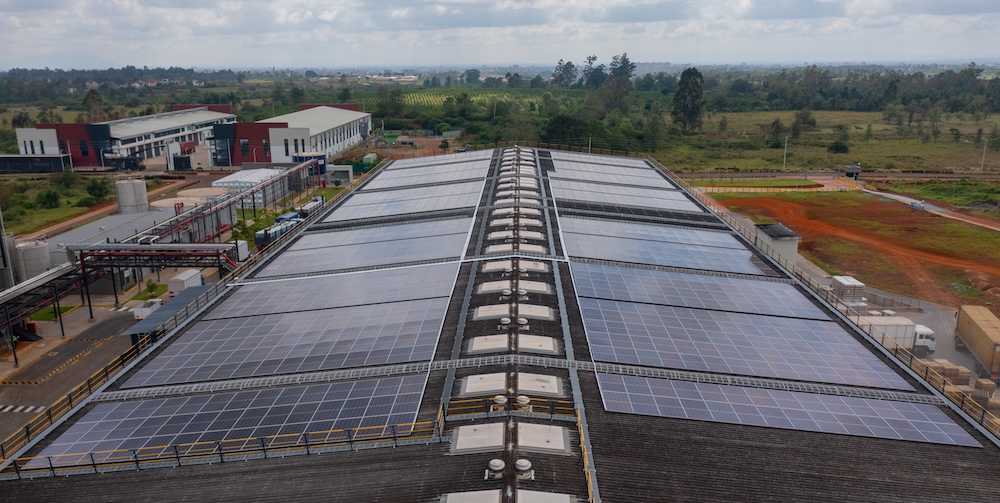
Kenya has tightened the regulatory framework governing private solar generation, introducing a tariff charge for electricity injected into the Kenya Power network without the required approval as the country manages a rapidly changing power system in which households, businesses and institutions are increasingly producing electricity behind the meter. The Energy and Petroleum Regulatory Authority (EPRA) amended Kenya Power’s electricity tariff schedule through a Gazette Notice published on September 18, 2026, defining unauthorised electricity fed into the distribution network as “dumping” and providing for the electricity to be measured and charged at the applicable base tariff. The provision also allows for further action where unauthorised injection causes injury or damage to equipment.
The change comes as Kenya expands its use of distributed renewable energy while the national grid is already absorbing significant amounts of variable generation from large-scale wind and solar projects. Kenya Power said in August that variable renewable energy sources accounted for 34% of the energy mix during daytime peak demand of about 1,900 megawatts and 36% during periods of lower demand of about 1,200 MW. The utility warned that rapid changes in wind and solar output can affect grid frequency and voltage, increasing the importance of managing how generation is connected and operated across the system.
The new provision does not mean that households and businesses with solar panels are automatically subject to a new penalty. Kenya’s regulatory framework permits eligible consumers to export surplus renewable electricity through net metering, but the system requires approval and an agreement with the relevant electricity licensee. Under the Energy (Net-Metering) Regulations, 2024, net metering allows consumers to supply electricity to the grid when they have excess generation and use credits during periods when their own production is insufficient. The regulations apply to renewable-energy systems below 1 MW and set capacity limits of 4 kW for domestic single-phase customers and 10 kW for domestic three-phase customers, while commercial and industrial installations can reach up to 1 MW subject to specified conditions.

The distinction between generation and export is increasingly important for Kenya’s solar market. A household may install photovoltaic panels and an inverter primarily to reduce its dependence on Kenya Power, with batteries or other equipment used to keep excess generation within the premises. But where a system operates in parallel with the distribution network and electricity flows back through the connection, the installation enters a different regulatory category. The 2024 net-metering rules require the customer to obtain the relevant approval and establish a net-metering arrangement before operating in that manner.
The financial treatment under approved net metering is also different from a conventional electricity sale. EPRA’s regulations provide that a consumer receives a credit equivalent to 50% of each unit exported during a billing period. The credit can be carried forward where it exceeds electricity supplied by the licensee, although unused credits are forfeited at the end of the licensee’s financial year. In other words, a customer exporting 100 kilowatt-hours does not receive cash for 100 kWh; the regulatory mechanism provides an energy credit equivalent to 50 kWh under the applicable billing arrangement.
The September tariff amendment adds another layer to this framework by establishing a commercial consequence for electricity entering the Kenya Power network without the required authorisation. Reporting on the notice indicates that such electricity is classified as dumping and charged at the applicable base tariff. The provision therefore creates a distinction between a regulated two-way electricity relationship and an uncontrolled flow of privately generated electricity into the distribution system.
That distinction matters for the operation of Kenya’s distribution infrastructure. Kenya Power has argued that variable renewable generation needs to be integrated carefully because sudden changes in output can increase pressure on grid stability. An approved distributed-generation installation gives the utility and regulator visibility over the equipment, connection point, metering arrangements and technical characteristics of the system. The net-metering regulations also allow a licensee to disconnect a system where its output violates the grid code or where continued operation threatens the safety, reliability or security of the distribution system.
Read alos:Kenya power warns rising wind and solar dependence could test grid stability and electricity costs
Safety is another consideration. Electricity flowing in both directions across a customer connection changes the assumptions that network operators and technicians make when maintaining distribution infrastructure. A properly authorised installation can be incorporated into those operating arrangements. An unauthorised connection, by contrast, may create risks that are harder for the utility to identify and manage. This makes the regulatory question broader than whether a customer should pay a charge: it concerns how Kenya maintains a safe and predictable electricity network as private generation becomes more widespread.
The growth of distributed generation is taking place alongside an expansion of Kenya’s broader solar market. The government’s draft National Energy Policy 2025 noted that the country had approximately 200,000 photovoltaic solar home systems and estimated about 210.3 MW of grid-connected solar capacity at the time of its assessment, while identifying battery storage and better integration of variable renewable energy as important opportunities. The National Energy Compact has also identified captive power as a growing part of the electricity system, with captive generation capacity standing at about 575 MW in December 2024.
Government planning increasingly recognises that this shift requires new technical and regulatory arrangements. Kenya’s draft National Energy Policy calls for guidelines governing the integration, operation and monitoring of captive power plants, as well as technical standards intended to address grid stability and safety. It also identifies mechanisms for compensating grid-connected captive generators for ancillary and other grid services as an area for development.
The issue therefore sits within a much larger transformation of Kenya’s electricity system. The country is attempting to expand access, maintain reliability and increase renewable generation while managing the operational consequences of having more electricity produced at different points across the network. At the national level, Kenya already relies heavily on renewable generation, with geothermal, hydro, wind and solar forming the backbone of installed capacity. The government’s energy planning has identified further solar and battery-storage deployment as part of the pathway towards a cleaner electricity system.
For businesses, the regulatory change has particular significance because commercial and industrial facilities are increasingly using solar to manage electricity costs and improve energy resilience. Under the 2024 net-metering regulations, commercial and industrial customers can operate renewable-energy systems of up to 1 MW, subject to their maximum demand and other requirements. This creates an established pathway for businesses that want to export eligible surplus electricity rather than simply consume all the power they generate.
The amendment also raises questions about the treatment of systems installed before the September 2026 publication. The notice was reported as taking effect from July 1, 2025, more than a year before it was published. pv magazine reported on September 22 that the backdated provision had not been accompanied by a public explanation and that there had been no enforcement notices or retroactive billing advisories issued under the new dumping definition at the time of its report.
That distinction between a legal effective date and enforcement practice will matter for solar owners and businesses. A retrospective provision does not by itself establish how historical electricity exports would be measured, which systems would be examined or how any potential liability would be calculated. Those questions will depend on how EPRA and Kenya Power implement the amended tariff framework and communicate the requirements to customers.

For consumers, the practical issue is therefore not whether they own solar panels but whether their systems are capable of sending electricity into the Kenya Power network and, if so, whether that export has been authorised. The configuration of the inverter, the connection arrangement, the meter, the presence of batteries and the existence of a valid net-metering agreement can all determine how a particular installation is treated. EPRA’s regulations require approval before a customer makes modifications to an approved net-metering system or its connection point, reinforcing the importance of keeping installations within the authorised configuration.
Kenya’s challenge is to balance the rapid growth of distributed solar with the technical and commercial requirements of a national electricity network. Private generation can reduce demand from the utility, improve energy resilience for businesses and households and contribute to the country’s renewable-energy objectives. But electricity exported into the grid becomes part of a shared infrastructure system, where voltage, frequency, safety, metering and system balancing have consequences beyond the individual premises.
The September amendment consequently marks a shift in the way Kenya is formalising that relationship. Rather than treating private solar generation only as an individual customer’s energy investment, the rules increasingly recognise it as part of the wider electricity market. For Kenya’s energy transition, the longer-term issue will be whether regulation, grid investment, storage, digital monitoring and clear market rules can develop quickly enough to accommodate a growing population of electricity producers without undermining the reliability and safety of the network on which those producers ultimately depend.


