


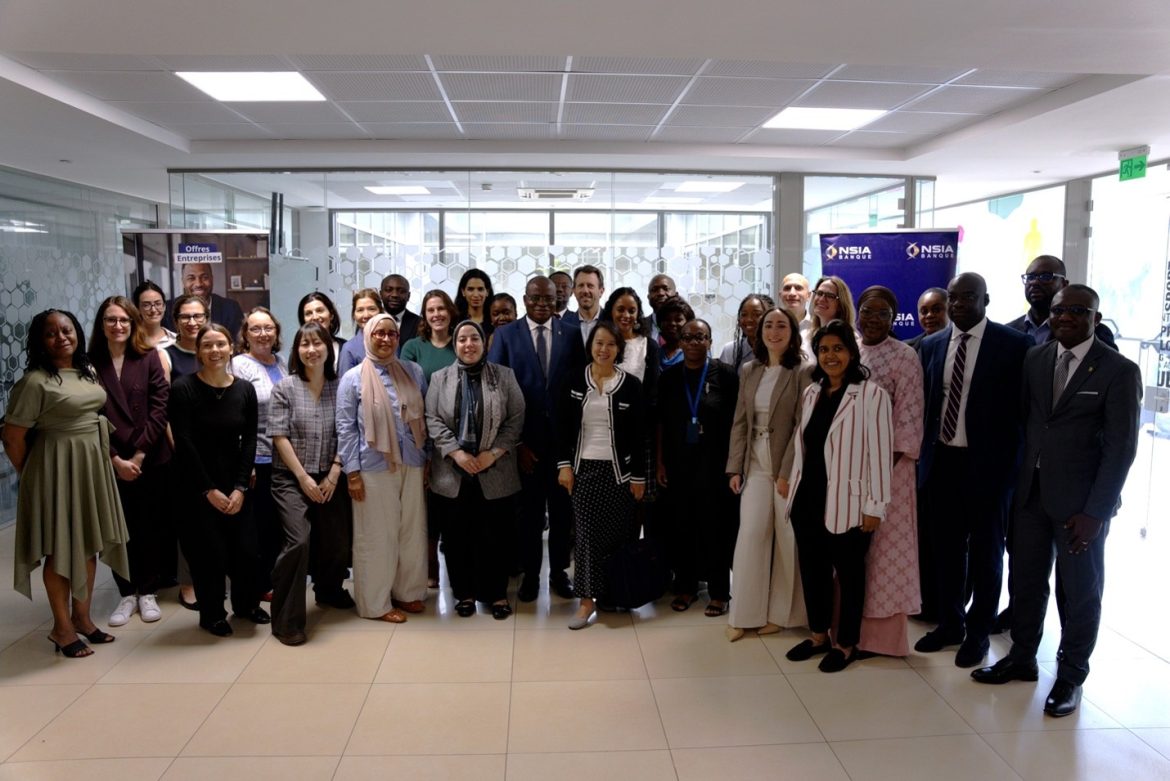
NSIA Bank Côte d’Ivoire has provided CFA2.219 billion ($3.84 million) in financing to 20 women-led small and medium-sized enterprises under a partnership with the African Development Bank’s Affirmative Finance Action for Women in Africa (AFAWA), highlighting the role of risk-sharing and tailored financial products in expanding credit to businesses that often face structural financing constraints. The results were reviewed in Abidjan on September 24 during a learning and monitoring visit involving the African Development Bank, the Women Entrepreneurs Finance Initiative (We-Fi) and partner financial institutions. The businesses supported by the programme operate across sectors including agribusiness, construction, transport, trade, education, hospitality, distribution and services.
The partnership forms part of a broader effort by the African Development Bank to change how financial institutions assess and serve women-owned and women-led enterprises. AFAWA uses guarantees, technical assistance, capacity building and partnerships with commercial banks to reduce some of the risks associated with lending to women entrepreneurs. The initiative currently identifies an estimated $49 billion financing gap for women-owned and women-led small and medium-sized enterprises across Africa, making access to appropriate financial products a wider financial-system issue rather than simply a question of individual business performance.
For NSIA Bank, the Côte d’Ivoire programme has combined financing with business support. The bank has developed financing solutions intended to respond to the circumstances of women entrepreneurs, while the wider partnership has sought to strengthen the institution’s capacity to identify, assess and serve women-led SMEs. During the September review, AfDB and We-Fi representatives visited NSIA Bank and met entrepreneurs who had received AFAWA-supported financing, including Ariane Monney of Casa Èkwa, Yvette Yelematou Soro of Lemias Engineering and Blandine Koffi of Poisson d’Afrique.
The businesses illustrate the diversity of sectors in which women entrepreneurs are operating in Côte d’Ivoire. They range from construction and fisheries to hospitality and food-related activities, reflecting the extent to which women’s enterprises are embedded in the real economy rather than concentrated in a single commercial segment. For these businesses, access to credit can determine whether an enterprise can acquire equipment, expand productive capacity, enter new markets or take on larger contracts.
The structure of the AfDB partnership is important because it does not rely solely on conventional commercial lending. According to the Bank’s We-Fi implementation report, its collaboration with NSIA Bank included a €50 million financing facility comprising a €25 million subordinated loan, a €15 million portfolio guarantee covering 50% of the risk of a credit portfolio for women’s SMEs, and a €10 million trade-finance line. Of the guarantee envelope, €4.5 million came from We-Fi. The project was designed to increase the proportion of SMEs in NSIA Bank’s portfolio to 15%, with a specific focus on women-owned businesses.
Such structures address one of the central problems facing SME finance in African markets: the gap between businesses that require capital and the risk parameters applied by commercial lenders. A guarantee does not eliminate credit risk, but it can reduce the portion borne by the financial institution and make lending possible to businesses that might otherwise fall outside conventional credit criteria. AFAWA’s model therefore combines financial capital with institutional changes intended to make banks more responsive to the characteristics of women-led businesses.
The approach also extends beyond the provision of loans. AFAWA’s wider programme includes technical assistance for financial institutions and women-owned SMEs, covering areas such as financial literacy, business-plan development, financial management, mentorship and the design of gender-responsive financial products. Its We-Fi reporting has emphasised that technical assistance is necessary to strengthen both the supply of finance from banks and the ability of enterprises to use that finance effectively.
This distinction is particularly relevant for smaller businesses. A loan can provide working capital, but enterprises may still struggle with financial reporting, procurement requirements, market access, cash-flow management or the ability to demonstrate future repayment capacity. The combination of finance and non-financial support is intended to address some of these constraints while helping banks build more sustainable women-focused SME portfolios.
The NSIA partnership also sits within a wider expansion of AFAWA across Africa. The AfDB’s programme has partnered with financial institutions in multiple markets, using credit lines, guarantees and technical assistance to increase lending to women-led enterprises. In its 2024 progress report, the Bank said We-Fi had committed $14 million across 11 projects expected to empower more than 12,000 women-owned and women-led SMEs and provide access to finance for 7,000 women-led enterprises. The programme reported more than 6,400 women entrepreneurs benefiting from access to finance and technical assistance by June 2024.
Côte d’Ivoire is an important market for this strategy because of the size and diversity of its private sector and its position within the West African regional economy. Access to finance for smaller businesses has implications beyond individual firms: it affects employment, local supply chains, domestic production and the ability of enterprises to participate in regional markets. For women-owned companies in sectors such as agriculture, construction, trade and services, improved access to credit can also influence how quickly businesses move from small-scale operations into more formal and productive enterprises.
The financing challenge is not unique to Côte d’Ivoire. Across Africa, women-owned businesses often operate with smaller capital bases and face barriers related to collateral, credit histories and access to formal financial services. AFAWA’s strategy consequently seeks to change the architecture through which finance is delivered, rather than relying only on subsidised lending. Its approach combines financial instruments with technical assistance and engagement with financial institutions and policymakers.
The September review also provided an opportunity to examine how the model is working on the ground. According to the AfDB, the four-day learning event brought together AFAWA, We-Fi, financial institutions and other partners for discussions on digital finance, business growth, market access, research, care responsibilities, networks, technology and climate innovation. The programme concluded with a review of lessons learned and areas where participating institutions could strengthen their support to women entrepreneurs.
That broader agenda is increasingly important as African financial institutions move towards digital lending and data-driven credit assessment. Digital tools can lower transaction costs and potentially make it easier for smaller businesses to access financial services, but their effectiveness depends on the quality of business data, digital infrastructure and the ability of enterprises to participate in formal financial systems. AFAWA’s emphasis on both financial products and institutional capacity reflects this wider shift.
For NSIA Bank, the programme also comes as the institution expands its broader SME financing activities. In June 2026, the bank announced a €30 million financing partnership with British International Investment to increase its capacity to finance Ivorian SMEs, with particular attention to women entrepreneurship. NSIA Bank said the facility would support sectors capable of creating value, employment and economic opportunities.
The bank’s wider financial position provides another indication of the scale at which it operates. NSIA Banque Côte d’Ivoire reported net income of CFA40.7 billion for 2025, while total assets surpassed CFA3 trillion. It also reported CFA40 billion committed to renewable-energy projects during the year, illustrating how SME finance and sustainability financing are increasingly becoming components of the bank’s broader growth strategy.

The AFAWA partnership therefore provides a case study in how development finance can be used to influence commercial banking behaviour. Rather than replacing banks, the model seeks to use guarantees, concessional resources and technical assistance to make particular market segments more commercially accessible. The longer-term question is whether institutions can continue lending to women-led SMEs after external support declines and whether the financing produces sufficiently strong portfolios to encourage further private-sector participation.
For the 20 businesses that have already received CFA2.219 billion, the immediate significance is access to capital for investment, working capital and expansion. For the wider financial system, the programme offers a test of whether risk-sharing mechanisms can help commercial banks reach businesses that conventional lending models may underserve. And for Côte d’Ivoire’s economy, the outcome will ultimately be measured not only in the amount disbursed but in whether women-led enterprises can use that capital to increase productivity, create employment, enter new markets and build businesses capable of sustaining growth beyond the life of the partnership.
The NSIA Bank-AfDB programme is scheduled to run until February 22, 2029. Its remaining years will therefore provide further evidence on whether a combination of commercial finance, guarantees and business support can produce durable changes in women’s access to capital. For Africa’s financial institutions, the experience points to a broader question: how can banks move from treating women entrepreneurs as an underserved customer segment to building commercially sustainable financial markets around the businesses they operate?


