


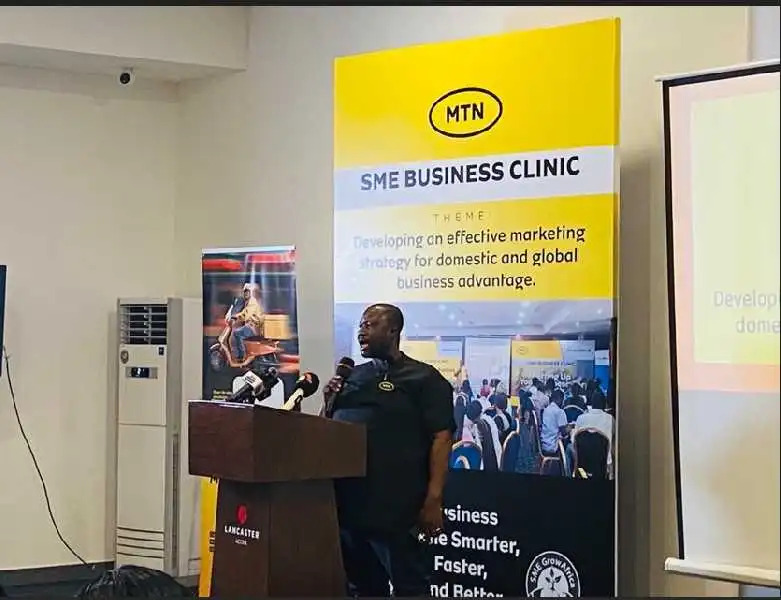
MTN Business is supporting small and medium-sized enterprises (SMEs) in Ghana to strengthen their digital capabilities, improve business operations and expand their access to online markets, as technology becomes increasingly important to the competitiveness of smaller businesses. The initiative was highlighted at an SME capacity-building clinic organised by Graphic Communications Group Ltd (GCGL) in collaboration with MTN Business in Sunyani, the Bono Regional capital, on 30 September 2026. The inaugural clinic brought together about 200 SME owners, entrepreneurs, start-ups, business managers and aspiring entrepreneurs for training covering digitalisation, soft skills, team building, business performance and sustainability. The organisers said the programme will become an annual initiative and will be decentralised across all 16 regions of Ghana.
The programme comes as Ghana’s small-business sector faces an increasingly important transition from traditional, location-dependent business models towards digitally enabled operations. For many SMEs, digitalisation is no longer limited to maintaining a social media account or accepting electronic payments. It increasingly involves establishing an online presence, managing customer relationships, improving internal administration, accessing financial services, protecting digital accounts and reaching customers beyond a business’s immediate geographical market.
Speaking during the clinic, Eric Antwi, Regional Sales Manager of MTN Business, Northern Business Unit, said digital tools had become increasingly important for SMEs seeking to expand their day-to-day activities and customer base. MTN Business used the programme to introduce entrepreneurs to digital and financial solutions intended to help them establish an online presence, improve customer service and manage their businesses more efficiently. The intervention reflects the growing role of telecommunications companies as providers of business technology and support services alongside their traditional connectivity functions.

One of the solutions highlighted was Yello Biz, which provides SMEs with tools including website creation, the Unicom customer-service platform and Microsoft 365. These services are designed to help businesses establish a more structured digital presence and improve how they communicate and work with customers. For smaller enterprises that traditionally depend on physical premises, local networks and word-of-mouth marketing, digital tools can potentially widen the geographical reach of their products and services while reducing some of the barriers to accessing new customers.
The emphasis on online visibility is particularly relevant as Ghana’s enterprise sector becomes more connected to digital markets. In June 2026, the Ghana Enterprises Agency (GEA), United Nations Development Programme (UNDP) and Ghana-India Kofi Annan Centre of Excellence in ICT (GI-KACE) launched the MSME Digital Gateway, a national platform designed to connect entrepreneurs with business information, advisory services, financing opportunities, digital learning resources and domestic and international markets. The platform also provides a digital marketplace through which MSMEs can showcase and sell products.
The Digital Gateway is intended to address a structural challenge facing businesses across Ghana: access to business support has often been fragmented across different institutions, websites and service providers. The new platform is designed as a single digital entry point and is being rolled out nationwide through trained Digital Champions and the Ghana Enterprises Agency’s network of Regional Offices and Business Advisory Centres. The programme aims to strengthen the resilience, competitiveness and digital capabilities of at least 25,000 Ghanaian MSMEs, with particular attention to women- and youth-owned businesses.
The developments in Sunyani therefore form part of a wider movement towards decentralising digital enterprise support. Ghana’s digital transformation agenda for SMEs is no longer concentrated solely in Accra and other major commercial centres. The nationwide rollout of the MSME Digital Gateway, together with initiatives such as the GCGL-MTN clinic, points towards a model in which entrepreneurs in regional and district economies can increasingly access digital business tools and advisory support without having to rely entirely on institutions located in the country’s largest cities.
MTN Business also highlighted Adwumapa, a solution tailored towards women entrepreneurs. The service combines connectivity with access to business support, including a professional website, Yello Biz, business messaging, market access, training and access to financial services. MTN Ghana describes Adwumapa as a programme intended to support women in business through a combination of connectivity, financial and business-development tools.
The focus on women entrepreneurs is significant because digital access can influence not only how businesses reach customers but also how entrepreneurs access finance, information and support networks. For women-owned enterprises, programmes that combine digital tools with financing, training and market access can address several constraints simultaneously. However, the effectiveness of such initiatives will ultimately depend on whether entrepreneurs can translate access to technology into higher productivity, stronger revenues and more resilient businesses.
MTN Business also promoted its Merchant Business SIM, which provides SMEs with access to savings and loan-related services. The combination of digital tools and financial services reflects an increasingly integrated approach to SME development in which connectivity, payments, credit, customer management and online marketing are becoming interconnected elements of business operations.
Digital adoption, however, also introduces new risks. During the Sunyani clinic, Antwi cautioned entrepreneurs against disclosing personal identification numbers or entering security codes received from unknown individuals. The warning comes as more SMEs rely on mobile and digital financial services, making cybersecurity and digital fraud awareness increasingly important components of business management. MTN Ghana has similarly warned SMEs that protecting digital and mobile financial accounts requires individual users to exercise caution around suspicious messages, links, calls and requests for verification codes.
This security dimension is particularly important for smaller enterprises that may not have dedicated information-technology or cybersecurity teams. As SMEs move more business functions online, protecting payment accounts, customer information and business credentials becomes part of operational resilience. Digitalisation can therefore create new opportunities for growth while simultaneously requiring businesses to develop new capabilities for managing cyber and financial risks.
The Sunyani programme also included follow-up support for selected businesses. Five enterprises were identified for further engagement covering financial literacy, continued coaching and business support. The emphasis on follow-up is relevant because the impact of capacity-building programmes often depends on whether businesses receive assistance in applying new skills after formal training ends.
A one-day clinic can introduce entrepreneurs to digital tools, but sustained adoption may require practical coaching, troubleshooting, financial guidance and support in adapting technology to specific business models. The organisers’ decision to incorporate continued coaching therefore shifts the programme from simple awareness-building towards a longer-term business-development approach.
Benjamin Korsinah Tsatsu, Senior Zonal Business Manager of GCGL for Ashanti, Bono, Ahafo and Northern, said businesses were increasingly moving beyond traditional brick-and-mortar models and needed to integrate digital tools into their products and service delivery. That shift is particularly relevant outside Ghana’s main commercial centres, where businesses can use digital channels to reduce the limitations imposed by physical market size.
For businesses in regions such as Bono, digital markets can potentially connect local producers and service providers with customers elsewhere in Ghana and beyond. A food processor, fashion enterprise, agricultural business or professional service provider in Sunyani, for example, does not necessarily have to rely exclusively on customers who physically visit the business. Online catalogues, digital payments, social commerce and e-commerce platforms can expand the potential customer base, provided businesses have the skills and logistics required to fulfil orders reliably.
The wider national digital-support ecosystem is also becoming more structured. The MSME Digital Gateway provides access to business registration and compliance information, financing and investment opportunities, advisory services, digital and entrepreneurship learning resources, and market opportunities. Its nationwide rollout is being supported by Digital Champions working through Business Advisory Centres to help entrepreneurs register on and navigate the platform.
Ghana’s focus on digitalising MSME support reflects the importance of the sector to the national economy. According to UNDP Ghana, 92% of registered businesses in the country are classified as micro, small and medium-sized enterprises. The organisation has identified limited visibility, market access and connections to reliable business support among challenges affecting many of these businesses. Improving digital capabilities therefore has implications beyond individual enterprises, potentially affecting employment, productivity, innovation and the ability of smaller businesses to participate in wider markets.
The regional dimension also matters. Ghana’s SMEs operate within an economy increasingly connected to the African Continental Free Trade Area, digital commerce and regional value chains. Digital business tools can potentially help smaller enterprises discover customers and suppliers beyond their immediate communities, although this requires more than connectivity. Businesses need reliable logistics, appropriate financial services, product standards, digital skills and knowledge of market requirements to convert online visibility into sustainable commercial opportunities.
The experience also highlights the importance of combining technology with human capabilities. Digital tools can improve efficiency, but entrepreneurs still need financial literacy, customer-service skills, record-keeping, management capabilities and knowledge of their markets. The Sunyani clinic’s inclusion of soft skills, team building and business performance alongside digitalisation recognises that technology is an enabler rather than a substitute for sound business management.
The planned decentralisation of the GCGL-MTN initiative across all 16 regions could therefore provide a wider platform for addressing regional disparities in access to business-development support. Extending practical training beyond Accra and Kumasi can help ensure that digitalisation is not concentrated among businesses already located in the country’s major technology and commercial centres.
The challenge will be sustaining that support at scale. As more businesses come online, training programmes will need to move beyond basic awareness towards measurable improvements in productivity, market access, financial management and business resilience. Digital platforms will also need to remain accessible and relevant to enterprises with different levels of technological maturity.
The combination of private-sector initiatives such as the MTN Business programme and public-development interventions such as the MSME Digital Gateway indicates that Ghana is increasingly treating digitalisation as part of its broader enterprise-development strategy. The emphasis is shifting from simply providing businesses with connectivity towards creating an ecosystem in which entrepreneurs can use digital infrastructure to access information, finance, markets and customers.
For Ghana’s SMEs, the opportunity lies in turning that access into productive economic activity. Businesses that can establish credible online identities, manage customer relationships, use digital financial services, protect their accounts and reach wider markets may be better positioned to compete as commerce becomes increasingly digital. For policymakers and private-sector partners, the task will be to ensure that the benefits of this transition reach enterprises beyond the country’s major commercial centres.
The Sunyani clinic therefore illustrates a broader development trend in Ghana: digital inclusion is becoming increasingly connected to enterprise competitiveness. By combining digital tools with financial literacy, coaching, cybersecurity awareness and market access, initiatives such as the GCGL-MTN programme can help smaller businesses move from basic technology adoption towards more sustained digital participation. Its planned expansion across Ghana’s 16 regions could provide a practical test of whether decentralised capacity building can translate digital access into stronger businesses, wider markets and more inclusive economic growth.


