


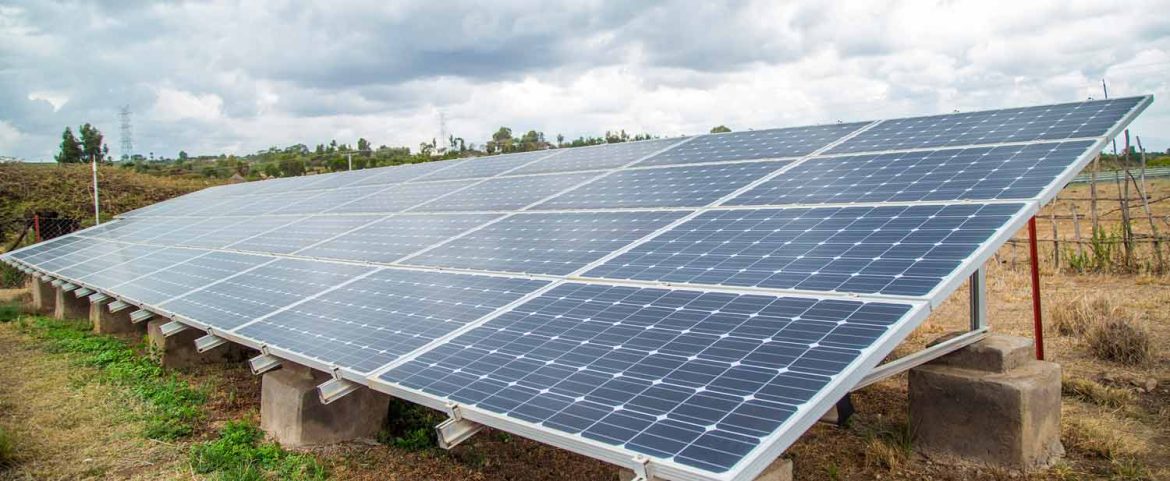
Chad has reached financial close on two hybrid solar power plants with a combined capacity of 30 MWp and 8 MWh of battery storage, backed by a €37.9 million financing package from development finance institutions, in a transaction that highlights both the opportunity and the financing constraints facing renewable energy investment in the Sahel. Developed by independent power producer Qair at Gassi and Lamadji near N’Djamena, the projects will supply electricity to Chad’s national grid under a 20-year power purchase agreement with state-owned utility Tchadelec.
The African Development Bank said on September 25 that the projects had reached financial close and that the first disbursement had been made, allowing construction to move forward. The financing was arranged and mobilised by the AfDB Group with participation from Proparco, the Sustainable Energy Fund for Africa and the Green Climate Fund. An €8 million partial risk guarantee jointly issued by the African Development Fund and the GCF supports a letter of credit covering Tchadelec’s payment obligations under the power purchase agreement.

The structure matters because the central challenge for renewable energy investment in markets such as Chad is not simply the availability of sunlight. It is the ability to convert a technically viable project into an investment that lenders can finance over a long period while managing currency, utility credit and political risks. In this case, the guaranteed mechanism is designed to address one of the risks most closely watched by investors: whether the electricity buyer can meet its contractual payment obligations.
According to Proparco, the French development finance institution and the AfDB are each providing about €15 million in loans. SEFA, which is managed by the AfDB, is contributing €6 million through reimbursable grants, while Proparco and the French Development Agency are providing additional support. The wider financing package totals €37.9 million.
The projects will connect to N’Djamena’s 90-kilovolt electricity network. Their battery systems are intended to help manage the injection of solar power into the grid, an increasingly important consideration as African electricity systems incorporate larger volumes of variable renewable generation. Proparco said the two plants will be connected to the capital’s 90 kV loop and incorporate 8 MWh of battery storage.
For Chad, the investment comes against a severe electricity-access deficit. World Bank data show that only 13.4% of the population had access to electricity in 2024, leaving the country among the least electrified economies in Africa. Chad also has substantial solar resources, with global horizontal irradiation ranging from about 5.8 kWh per square metre per day in the south to 6.8 kWh in the North, but those resources remain relatively underused in the electricity system.
The gap between potential and infrastructure is particularly important in N’Djamena. Earlier World Bank assessments described the capital’s power system as heavily dependent on liquid-fuel generation, with an installed capacity of about 150 MW at the time and persistent constraints on available supply. The utility has also faced financial and operational limitations that make investment in new generation and network infrastructure difficult.
That context gives the Gassi and Lamadji projects a significance beyond their 30 MW capacity. They represent an attempt to add renewable generation to an electricity system where reliability, affordability and access remain fundamental development constraints. For households, businesses and public institutions, improved electricity supply can affect operating hours, refrigeration, communications, health services and the cost of running small enterprises. The World Bank has previously documented how limited electricity access constrains economic activity in Chad, while its more recent energy-access programme has sought to expand both grid and off-grid solar solutions.
The projects also sit within two larger African energy initiatives. The AfDB’s Desert to Power programme aims to develop 10,000 MW of solar generation across the Sahel, while Mission 300 seeks to accelerate electricity connections across Africa. The Chad transaction therefore provides a practical example of the type of project required if regional targets are to move from commitments into physical infrastructure.
For investors, however, the transaction also illustrates why Africa’s renewable energy expansion cannot be separated from financial architecture. Solar modules and batteries are increasingly commercially available, but project deployment still depends on bankable power purchase agreements, credible utilities, predictable regulation, transmission infrastructure and mechanisms that reduce risks that private lenders cannot absorb on their own.
This is particularly relevant across the Sahel, where countries face a combination of weak electricity systems, limited fiscal space, high perceived investment risk and significant climate vulnerability. Development finance institutions can therefore play a different role from simply providing capital. Guarantees, concessional instruments and project-preparation support can help redistribute risks sufficiently to bring private developers and commercial lenders into markets that might otherwise remain outside conventional investment mandates.
The Chad transaction also points to a broader shift in how renewable projects are being designed. Battery storage is increasingly becoming part of the infrastructure required to make solar generation compatible with national grids rather than an optional addition to generation capacity. In systems where grid flexibility is limited, storage can help manage fluctuations in renewable output and improve the quality of power delivered to the network.
Yet storage does not resolve the wider infrastructure challenge. The economic value of new generation depends on the ability of transmission and distribution systems to carry electricity to consumers and on utilities being financially capable of maintaining those networks. For Chad and other low-access markets, the investment equation therefore extends from generation to grid expansion, metering, collections and institutional reform.
The financing structure also raises a broader question for African energy markets: how far can blended finance be scaled beyond individual transactions? A single guarantee can make one project bankable, but Africa’s electricity deficit requires thousands of projects across countries with very different levels of political, currency and utility risk. Replicating the model will depend on whether development institutions can standardise risk-sharing mechanisms while maintaining sufficient flexibility to respond to country-specific conditions.
For public finances, that distinction is important. Renewable projects can reduce exposure to volatile fuel costs over time, but long-term power purchase agreements can also create obligations for state-owned utilities and governments. The quality of those contracts, the financial health of the off-taker and the transparency of contingent liabilities will therefore remain important to determining whether renewable investment strengthens or adds pressure to public balance sheets.
For the Sahel, where climate pressures and development needs increasingly intersect, the investment case is consequently broader than emissions reduction. Reliable electricity is a prerequisite for industrial activity, digital services, water systems, health facilities and agricultural value chains. The World Bank’s energy access programmes in Chad have similarly combined grid expansion with standalone solar and storage solutions, reflecting the need for multiple technologies and financing channels rather than a single model.
The Gassi and Lamadji projects will not resolve Chad’s electricity deficit on their own. Their importance lies instead in demonstrating how a relatively modest renewable-energy project can be structured around long-term contracting, battery storage, development finance and risk guarantees. If such structures can be replicated while strengthening utilities and transmission systems, they could help shift renewable energy investment in the Sahel from isolated projects towards a more durable infrastructure market.
For Africa, that is ultimately the more significant test. The continent has some of the world’s strongest solar resources but continues to face a large gap between renewable-energy potential and investable electricity infrastructure. Chad’s latest transaction shows that closing that gap will require not only more generation, but also financial structures and public institutions capable of making clean power projects credible to investors over the long term.


