


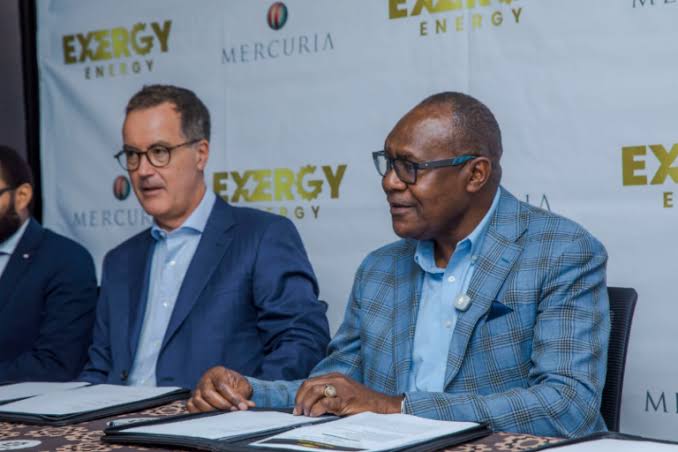
Zambia’s electricity sector is attracting a fresh wave of private capital after global energy and commodities group Mercuria signed a $250 million financing agreement with Africa-focused energy investor Exergy to support power generation and transmission projects in Zambia and the wider Southern African region. The deal, signed in Lusaka on September 25 and subject to regulatory approvals, will finance projects being developed through Exergy subsidiaries Lunzua Power Company and Lusitu Transmission and Distribution Company, as Zambia seeks to expand generation, strengthen its grid and deepen its role in regional electricity trade.
The transaction is significant because it combines capital for generation with investment in the networks needed to move electricity to industrial and commercial users. Exergy also operates Kanona Power Company, which is involved in electricity trading and balancing surplus and deficit positions. The companies have not publicly disclosed how the $250 million will be divided between individual projects, nor the precise financing structure. Several projects in the pipeline are already under development.
The financing comes as Zambia’s power market is undergoing a structural shift away from a system dominated by state-owned generation and utility infrastructure towards greater participation by independent power producers, private financiers and electricity traders. According to Zambia’s Ministry of Energy, installed generation capacity increased from 3,100 megawatts in 2021 to 4,576 MW in 2026, an addition of 1,476 MW over the period. Solar capacity expanded particularly quickly, rising from 88 MW to 841 MW.

That expansion has been accompanied by regulatory changes intended to make the electricity market more accessible to private developers. The Electricity (Open Access) Regulations, introduced in 2024, allow eligible electricity producers and consumers to use transmission and distribution networks on a non-discriminatory basis. The framework also enables independent power producers to participate more directly in electricity trading. According to the Energy Regulation Board, the reforms are intended to encourage investment in generation, including renewable energy, while improving consumer choice and supply reliability.
Zambia has also introduced an Energy Single Licensing System designed to reduce duplication between regulatory agencies and shorten the time required to obtain licences and permits for power projects. The Ministry of Energy said the system was intended to improve coordination and response times and create a more efficient process for investors seeking to develop energy infrastructure.
The increased regulatory activity is reflected in the number of agreements entering the market. According to the Energy Regulation Board’s 2025 annual report, the regulator approved 135 electricity supply and purchase agreements in 2025, compared with 70 in 2024. It also authorised construction permits for 1,593.6 MW of new generation capacity, with solar photovoltaic projects accounting for 73% of that capacity.
The acceleration of investment is partly a response to Zambia’s recent electricity crisis. The country’s heavy dependence on hydropower exposed the economy to the effects of the 2023-24 drought, when low water levels sharply reduced generation and contributed to prolonged load-shedding. The World Bank estimates that hydropower accounts for more than three-quarters of Zambia’s installed capacity and that the 2024 drought reduced available power by roughly one-third. Mining, which consumes about half of national electricity, received priority, while households, small businesses and public services faced significant supply disruptions.
The crisis has given diversification and transmission investment a greater economic importance. Zambia’s electricity access rate was about 53.6% in 2024, according to World Bank data, meaning that almost half of the population still lacked access to electricity. The access gap is particularly pronounced in rural areas, where grid infrastructure remains limited.
For businesses, the issue is not simply whether generation capacity increases but whether electricity can be delivered consistently and at a cost that supports investment. Zambia’s mining sector, agriculture, agro-processing and manufacturing industries all depend on predictable power supplies. Power shortages can raise operating costs through diesel generation, disrupt production schedules and weaken the competitiveness of businesses that depend on electricity-intensive processes.
This makes the transmission component of the Mercuria-Exergy transaction particularly relevant. Additional generation capacity has limited economic value if transmission networks cannot move electricity to where demand is concentrated. Zambia is simultaneously pursuing cross-border infrastructure intended to strengthen regional power trade. The Zambia-Tanzania Interconnector, for example, is designed to connect the Southern African Power Pool with the Eastern Africa Power Pool, allowing electricity to move more efficiently between the two systems.
The regional dimension is becoming increasingly important as Southern Africa confronts a combination of growing electricity demand, constrained transmission networks and climate-related risks to hydropower. Zambia’s position between Southern and Eastern Africa gives it an opportunity to become a more important trading and transmission hub, provided the physical infrastructure and market rules develop together.
The Southern African Power Pool has already seen increased trading activity, but transmission constraints remain a limitation. Zambia’s Ministry of Energy said in March that matched electricity volumes in the SAPP competitive market were approaching 2,000 GWh in the financial year, compared with about 1,000 GWh the previous year, while roughly 800 GWh remained constrained by transmission limitations.
Other cross-border projects reinforce the same direction. In July, the World Bank announced a $43 million grant for the Zambia-Malawi Interconnector, which forms part of a broader 192-kilometre, 400-kilovolt corridor intended to strengthen electricity trade and reliability between the two countries. For Zambia, deeper regional electricity markets could provide an additional buffer against domestic supply shocks. The Zambia-Tanzania connection, for instance, is intended to allow Zambia to export electricity when domestic generation is strong and import power during periods of drought or supply shortages. That flexibility is increasingly relevant as climate variability creates greater uncertainty for hydro-dependent power systems.
The challenge will be ensuring that private investment translates into commercially viable projects without creating new financial or regulatory pressures. Open access requires transparent wheeling arrangements, predictable tariffs, credible settlement mechanisms and sufficient network capacity. The Energy Regulation Board has been developing implementation tools covering trading, system operation, metering, balancing and participation agreements, highlighting the institutional work required to make the open-access market function effectively.

The financing model also points to a broader shift in how African energy infrastructure may be funded. Zambia has historically relied heavily on public investment, development finance and state-backed utility procurement. The Mercuria-Exergy transaction introduces a large commercial capital commitment from a global energy trading group into an integrated platform spanning generation, transmission and power trading. If projects are delivered successfully, the structure could demonstrate how private capital can participate across several parts of an electricity value chain rather than financing generation assets in isolation.
That distinction matters for Zambia’s industrial ambitions. The government has set a target of reaching 10,000 MW of electricity supply by 2031, while seeking to expand mining, agriculture, manufacturing and other productive sectors. Mercuria said its financing of Exergy’s project pipeline is intended to contribute to that objective and strengthen Zambia’s position in regional power trade.
The immediate test, however, is execution. The $250 million agreement remains subject to regulatory approvals, and details of the individual projects and allocation of capital have yet to be disclosed. Zambia’s recent experience demonstrates that generation capacity, transmission infrastructure, market regulation and climate resilience have to advance together. More private capital can expand the pool of financing available to the sector, but its economic value will ultimately depend on whether projects reach completion, connect to the grid and deliver reliable electricity to the businesses, communities and regional markets that need it.


