


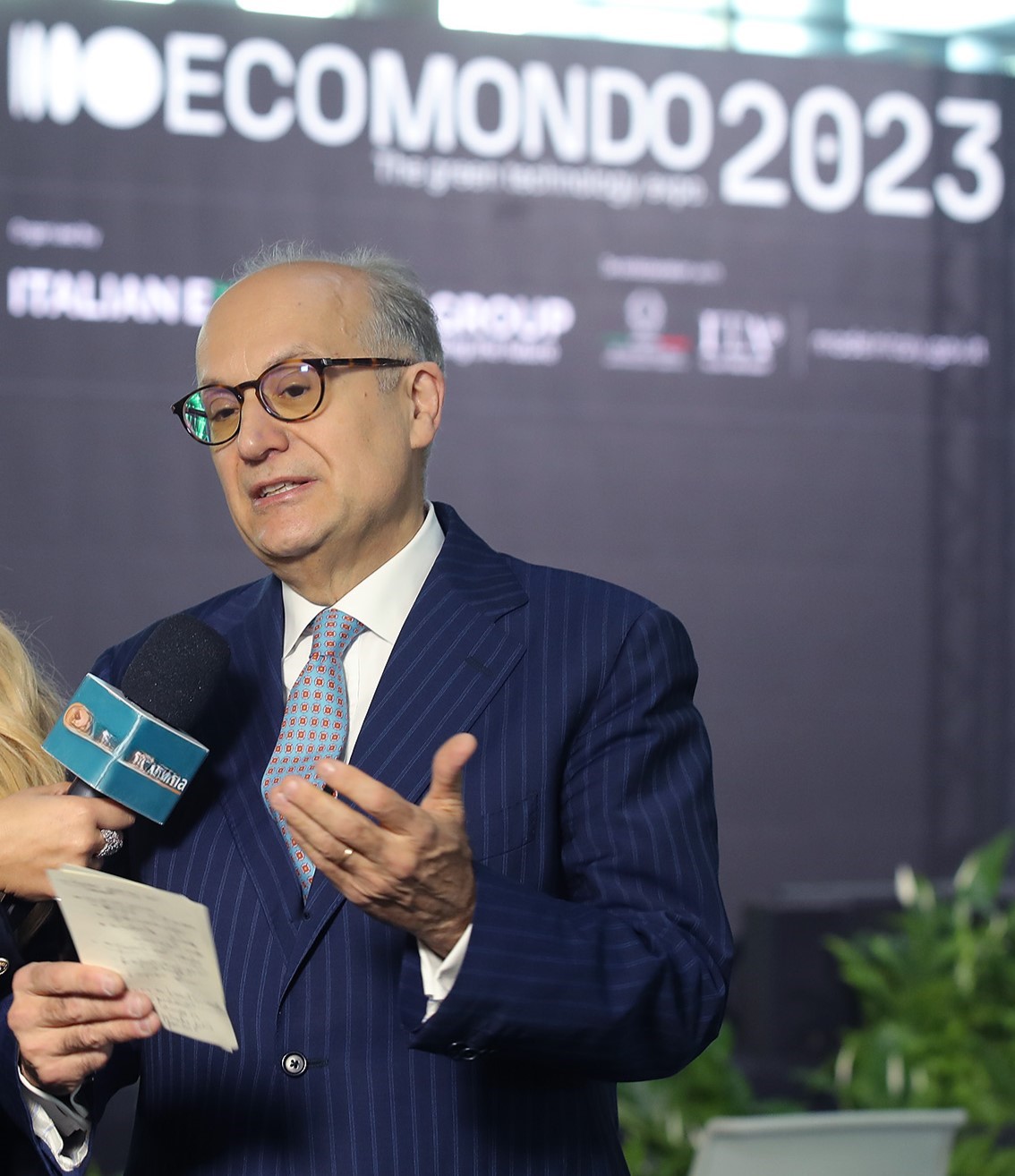
Europe’s circular economy transition is increasingly being shaped by questions that extend beyond the continent’s borders, from access to critical raw materials and resilient water systems to sustainable agriculture, industrial decarbonisation and the financing of new technologies. These issues will feature prominently at Ecomondo 2026 in Rimini, Italy, where more than 70 conferences and workshops are expected to bring together policymakers, researchers, companies, investors and international institutions to examine how the circular economy can move from policy commitments to industrial implementation.
The 29th edition of the Italian Exhibition Group event will take place from November 3 to 6 at the Rimini Expo Centre, with a programme organised by Ecomondo’s International Technical Scientific Committee chaired by Professor Fabio Fava. A significant part of the programme will focus on international cooperation across the Mediterranean and with Africa, reflecting the increasingly interconnected nature of Europe’s resource, energy and environmental transition.
The focus is significant for Africa because the continent sits at the centre of several markets that are becoming strategically important to Europe’s green industrial ambitions. Critical minerals, renewable energy, agricultural resources, water, waste management and circular manufacturing are increasingly linked to discussions about supply-chain security and economic resilience.
One of the sessions at Ecomondo, titled “EU-Africa Strategic Corridors to a mutually beneficial cooperation for critical raw materials”, will examine how Europe and African countries can develop stronger partnerships around minerals required for industrial and energy technologies. The session is being organised with the University of Turin, the European Commission’s Joint Research Centre, Italy’s Ministry of Environment and Energy Security and Ministry of Enterprise and Made in Italy.
The discussion comes as European policymakers seek to diversify supplies of critical raw materials while African governments are under increasing pressure to capture more value from the continent’s mineral resources. The policy question is therefore moving beyond extraction towards processing, infrastructure, technology transfer and industrial development. For African economies, the expansion of circular approaches could also create opportunities to recover materials from end-of-life products rather than relying exclusively on primary extraction.
That issue will be examined through Ecomondo’s broader focus on waste electrical and electronic equipment and batteries. The conference “Circular Economy in Action: e-waste and waste batteries best practices”, organised with ERION, will consider European approaches to recovering critical raw materials from discarded products and reducing dependence on imported materials.
The relevance to African markets is considerable. Rapid growth in telecommunications, consumer electronics, renewable energy and electric mobility is increasing the volume of electronic products entering African economies. At the same time, formal collection, recycling and material-recovery systems remain uneven across the continent. Building stronger circular systems could reduce environmental risks while creating new markets for collection, refurbishment, recycling and secondary raw materials.
Water will form another major bridge between Europe, the Mediterranean and Africa. Ecomondo’s international programme includes discussions on water resilience, basin governance, emerging contaminants, circular water use and smart infrastructure. A session titled “Water resilience in and beyond Europe: Euro-Mediterranean cooperation, innovation and global leadership” will examine international cooperation involving Water Europe, Imperial College London and other European and Mediterranean institutions.
For Africa, where water stress is increasingly affecting cities, agriculture, industry and energy systems, the emphasis on resilient water infrastructure has direct economic implications. Investment in wastewater treatment, water reuse, digital monitoring and efficient distribution networks is increasingly becoming part of the broader infrastructure challenge rather than a narrow environmental issue.
The same approach will underpin Ecomondo’s discussions on soil health and regenerative agriculture. Sessions on soil restoration, bioplastics, bioenergy, agricultural biotechnology and the bioeconomy will explore how natural resources can be managed as productive assets while reducing pressure on ecosystems.
The programme’s Africa component will receive its most direct focus through the sixth edition of the Africa Green Growth Forum. Organised in collaboration with the Task Force implementing Italy’s Mattei Plan, Confindustria Assafrica & Mediterraneo and RES4Africa, the forum will examine sustainable development partnerships between African countries and European institutions and companies.
A central session, titled “The Mattei Plan: dialogue between institutions and the private sector for Africa’s sustainable development. Water and agriculture for inclusive and resilient value chains”, will focus on water and agriculture. Those sectors are particularly important to Africa’s development prospects because they connect food security, employment, industrialisation, climate resilience and rural incomes.
The discussion also reflects a broader shift in the nature of Europe-Africa economic relations. African governments are seeking investment that supports local processing, employment and industrial capacity, while European institutions and businesses are increasingly interested in resilient supply chains, new markets and access to strategic resources. Circular economy cooperation could provide a framework through which these interests overlap.
Finance will be another important part of the programme. Ecomondo and the Italian Sustainable Investment Forum will examine the role of corporate transition plans in managing ESG risks and improving competitiveness. Other sessions will address bankability, investment models and financing for sectors including water services and the bioeconomy.
For African businesses, access to transition finance remains a critical constraint. Many companies operating in waste management, renewable energy, sustainable agriculture and resource efficiency face commercially viable markets but struggle to obtain long-term capital at affordable rates. The development of investment models that can translate environmental performance into bankable projects could therefore determine how quickly circular-economy solutions scale across emerging markets.
The conference will also examine circularity in sectors with large employment and industrial footprints. Textiles will feature prominently through discussions on reuse, repair, ecodesign, extended producer responsibility and digital product passports. Construction and infrastructure will be addressed through sessions on urban mining and circular building models, while plastics will be considered through the lens of resource efficiency and new European regulatory requirements.
These developments are relevant to African exporters and manufacturers because European circular-economy rules increasingly influence the requirements attached to products entering European markets. Traceability, ecodesign, recycled content, producer responsibility and environmental information are becoming commercial considerations alongside conventional quality and cost requirements.
For African producers, the adjustment could require investment in data systems, resource efficiency, recycling infrastructure and supply-chain traceability. For European companies operating in Africa, it could also reshape sourcing relationships and create demand for local circular-economy services.
Cities will be another focus of the Ecomondo programme. Sessions on healthy cities, circular city-making and smart circular cities will examine how digital technologies, sustainable infrastructure and new governance models can improve urban resilience. This has particular relevance for Africa, where rapid urbanisation is creating growing demand for waste services, water infrastructure, affordable housing, transport and energy.

The programme will also address natural-risk management, land restoration, forestry, marine ecosystems and the blue economy, illustrating how circularity is increasingly being applied across entire economic systems rather than treated as a waste-management concept.
The 15th edition of the States General of the Green Economy, taking place alongside Ecomondo on November 3 and 4, will provide an additional policy platform for discussions on Europe’s green transition. The event is organised by the Foundation for Sustainable Development in collaboration with Italy’s Ministry of Environment and Energy Security and promoted by the National Council for the Green Economy.
The breadth of Ecomondo 2026 reflects a wider change in the circular economy debate. The issue is no longer limited to recycling rates or waste reduction. It increasingly encompasses industrial competitiveness, resource security, international trade, infrastructure investment, climate resilience and the ability of companies to manage regulatory change.
For Africa, that shift presents both risks and opportunities. European demand for critical minerals and sustainable products could create new investment markets, but tighter environmental and traceability requirements could also increase compliance costs for African exporters. The outcome will depend partly on whether cooperation includes technology transfer, skills development, local processing and access to finance.
Ecomondo’s Africa and Mediterranean focus therefore comes at a strategically important moment. As Europe seeks greater resource security and African economies seek industrialisation and higher-value participation in global supply chains, circular economy partnerships could become an increasingly important part of the relationship.
The test will be whether discussions around circularity translate into investment, infrastructure and industrial capacity. For Africa, the opportunity is not simply to supply Europe with raw materials for its green transition, but to build domestic value chains around those resources while developing the systems needed to use materials, water, energy and land more efficiently.


