


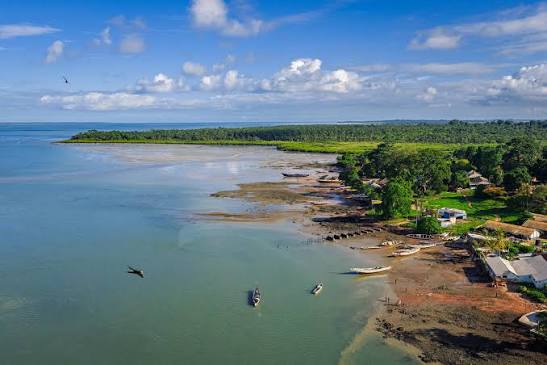
Guinea-Bissau has launched a 30-month climate-readiness programme aimed at strengthening the country’s ability to assess climate risks and convert that evidence into investment-ready projects, as the Coastal West African economy seeks to overcome institutional and financing constraints that have limited its ability to attract funding for adaptation. The RESIslands initiative, funded by the Green Climate Fund (GCF) and implemented by the United Nations Economic Commission for Africa (UNECA), is supporting Guinea-Bissau and eight other members of the African Island States Climate Commission (AISCC) with risk assessment, institutional capacity and climate project pipeline development.
The initiative comes as Guinea-Bissau faces rising exposure to sea level rise, coastal erosion, saltwater intrusion, changing rainfall patterns and flooding. Those risks are closely connected to the structure of the economy, where agriculture and fisheries remain important sources of employment, food security and household income, while cashew production is a major source of export earnings. The World Bank has described the country as having the highest natural capital per capita in West Africa but also significant development constraints, including high poverty, limited infrastructure, low electricity access and heavy dependence on cashews.

The RESIslands launch in Bissau on October 6 was followed by technical consultations on October 7 and 8 to examine existing climate initiatives, institutional needs and possible investment priorities. According to the programme’s initial assessment, 17 existing initiatives have been inventoried and 10 preliminary project concepts identified. These cover early warning systems, coastal resilience, agriculture, water security, fisheries, urban resilience and renewable energy for essential services. The concepts remain subject to national validation, further development and subsequent financing decisions.
That distinction is important in a country where the gap between identifying climate needs and preparing projects capable of attracting finance remains substantial. Climate funds and development finance institutions generally require credible assessments of climate risks, defined beneficiaries, environmental and social safeguards, implementation arrangements, financial structures and measurable outcomes before projects can move towards funding. Strengthening those capabilities can therefore address one of the less visible constraints on Africa’s climate finance flows: the shortage of projects that are sufficiently prepared to enter formal investment pipelines.
The RESIslands programme is backed by a broader GCF readiness project worth about $4.94 million over 30 months and covering nine AISCC members: Cabo Verde, Comoros, Equatorial Guinea, Guinea-Bissau, Madagascar, Mauritius, São Tomé and Príncipe, Seychelles and Tanzania, including Zanzibar. The programme is intended to strengthen institutional capacity for climate risk assessment and multi-hazard disaster management across the participating countries.
For Guinea-Bissau, improving the quality and availability of climate information has direct economic implications. The country’s Nationally Determined Contribution identifies significant gaps in surface climate observations and hydrological monitoring, while previous adaptation priorities have included coastal protection, agriculture and water resources. Early warning systems and better agricultural climate information can help public agencies and farmers make decisions around planting, water management and disaster preparedness, although their economic value depends on whether the information reaches users in a form they can act on.
The need for stronger project preparation is also evident in Guinea-Bissau’s financing requirements. Its updated NDC estimated that about $664 million would be required for mitigation between 2021 and 2030, with significant additional adaptation needs across fisheries, ocean ecosystems, energy, water, health, infrastructure and disaster risk management. The NDC identified concessional finance and climate funds as important sources of funding because of the country’s limited fiscal capacity and underdeveloped financial sector.
More recent IMF analysis reinforces the constraint. The Fund estimates that Guinea-Bissau received about $18 million a year in climate finance in 2019, well below the scale of investment identified in its climate plans. It also notes that political and institutional weaknesses, limited financial resources and an underdeveloped financial sector constrain implementation, while climate shocks could impose significant long-term economic costs if additional adaptation investment is not made.
The financing challenge is particularly relevant because climate resilience in Guinea-Bissau cannot be separated easily from economic diversification. Agriculture accounts for between 30% and 50% of GDP and provides income for about 85% of the population, according to recent World Bank analysis. The Bank estimates that improvements in productivity, storage, processing, transport and market access could unlock nearly $30 million a year in additional value across the rice and cashew sectors. Climate resilience therefore affects not only environmental outcomes but the productivity of one of the country’s most important economic systems.
Coastal and marine systems present a similar intersection between environmental and economic risk. Guinea-Bissau’s mangroves, coastal areas and Bijagós archipelago support fisheries, agriculture and food security, while rising seas and saltwater intrusion create risks for communities and productive assets. In June, the Least Developed Countries Fund, managed by the Global Environment Facility, approved $10 million for a seven year initiative focused on strengthening resilience in vulnerable coastal and urban areas.
The country’s climate-finance pipeline is therefore beginning to develop through several complementary channels. In July, the United Nations Development Programme issued a request for proposals to develop investment-ready climate adaptation concept notes and climate finance pathways for Guinea-Bissau. RESIslands adds a regional layer by strengthening risk information, institutional capacity and project preparation across the African island states.

For public finances, better preparation could improve the country’s ability to access grants and concessional resources rather than relying predominantly on domestic borrowing for investments that may not generate immediate financial returns.


