


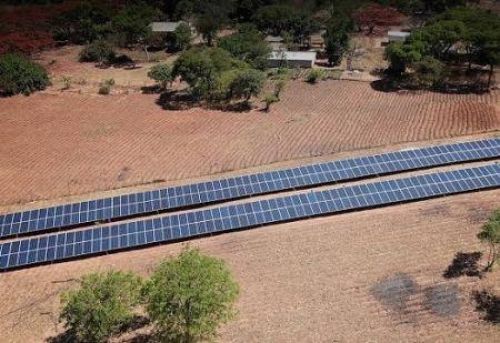
Fortis Green Renewables Investment Management and Zeitinger Invest have made an equity investment in GRIPS Energy Group to expand its commercial and industrial solar power and battery storage business across Africa, targeting acquisitions in Senegal, Botswana, Zambia and Uganda as the continent’s distributed solar market gains momentum.
Announced on 13 October 2026, the investment will support the acquisition of operational energy assets and the development of new projects. The investors have not disclosed the transaction’s value or the capacity of the assets targeted for acquisition. GRIPS aims to build a portfolio exceeding 100 megawatts (MW) of solar and storage capacity by 2030, positioning the company to serve businesses seeking alternatives to costly or unreliable electricity supplies.
The transaction comes as distributed solar becomes an increasingly significant part of Africa’s energy expansion. According to the Global Solar Council’s Africa Market Outlook for Solar PV 2026–2029, the continent installed 54% more solar capacity in 2025 than in 2024, while distributed systems accounted for an estimated 44% of newly installed photovoltaic capacity. The council cautions that distributed installations remain undercounted in official statistics, reflecting the difficulty of tracking rooftop, commercial and other decentralised systems.

GRIPS develops, finances, builds, owns and operates renewable energy systems for commercial and industrial customers. Its model allows businesses to access solar power and, where required, battery storage through pre-financed arrangements rather than bearing the full upfront cost of purchasing and installing equipment. Depending on the project, such arrangements can include power purchase agreements, leases or lease-to-own structures.
For manufacturers, agricultural processors, mining companies and other electricity-intensive businesses, the model addresses a practical operational challenge: how to secure more predictable power without diverting substantial capital from core business activities. On-site solar can reduce exposure to grid interruptions and diesel generation, while batteries can store electricity for use when solar production falls or demand rises. The extent of these benefits depends on system design, customer consumption patterns, financing terms and the reliability of the wider electricity network.
Carsten Jung, chief investment officer of GRIPS Energy Group, said the investment would provide growth capital and strategic expertise to accelerate expansion in the company’s target markets. The planned acquisitions could allow GRIPS to expand its operating portfolio while adding new developments, although the companies have not identified the individual assets or outlined a country-by-country allocation of capital.
The four target markets offer different operating conditions for distributed energy investment. Senegal provides a West African base for commercial solar deployment, while Botswana, Zambia and Uganda offer opportunities to serve businesses with differing electricity demand profiles and power-sector constraints. Expanding across several countries may diversify the group’s market exposure, but it also requires the company to manage distinct regulatory systems, customer credit risks, currency conditions, grid arrangements and project-development requirements.
Zambia and Uganda, in particular, have growing commercial and industrial electricity needs linked to manufacturing, agriculture and processing. In these settings, the financial case for solar and storage is not determined by technology costs alone. Investors and customers must assess the cost of grid electricity, the frequency and duration of outages, the price of backup generation, the availability of suitable sites and the ability of businesses to meet long-term contractual payments.
The investment also reflects a financing opportunity within Africa’s energy transition. Large utility-scale solar projects can attract substantial capital, but commercial and industrial installations often require a portfolio approach: aggregating multiple projects and customers to create sufficient scale for institutional investors. Financing operational assets alongside new developments can potentially combine existing cash flows with future growth, though returns will depend on asset performance, contract quality and the cost of capital.
Fortis Green Renewables already has exposure to Africa’s commercial and industrial renewable energy sector, including through Spark Energy Services. Its investment in GRIPS extends that exposure into a business focused on acquiring and developing solar and storage assets across multiple markets. Fortis Green describes its investment approach as providing flexible capital to renewable energy assets at development, construction and operational stages.
For Zeitinger Invest, the transaction brings another investor into a sector where financing structures can influence how quickly distributed energy systems are deployed. The investors have not disclosed their respective equity contributions, the ownership structure following the transaction or the financial return targets associated with the investment.

GRIPS’ ambition to exceed 100 MW by 2030 provides a measure against which its expansion can be assessed over the coming years. However, the target alone does not establish how much capacity is currently operating, how much will come from acquisitions or how much will be developed from new projects. The absence of disclosed transaction and asset-level figures also limits an assessment of the investment’s immediate scale.
The Global Solar Council’s findings suggest that distributed systems are already an important component of Africa’s solar growth, even if official figures do not fully capture their deployment. The council’s outlook anticipates further expansion in both utility-scale and distributed markets, placing greater importance on financing models that can serve businesses and other consumers outside conventional large power projects.
For GRIPS, the next test will be converting new equity into operating capacity across its target markets while maintaining project quality and commercial discipline. The investment’s longer-term significance will depend not only on whether the company reaches its 100 MW ambition, but also on how reliably its assets supply electricity, whether customers achieve viable power costs and whether the business can sustain growth beyond the initial capital injection.
As distributed solar becomes more prominent in Africa’s electricity mix, transactions such as this one highlight the role of private investment in financing infrastructure closer to where power is consumed. The key measure will be whether the capital translates into functioning assets and dependable electricity for businesses that need it.


