


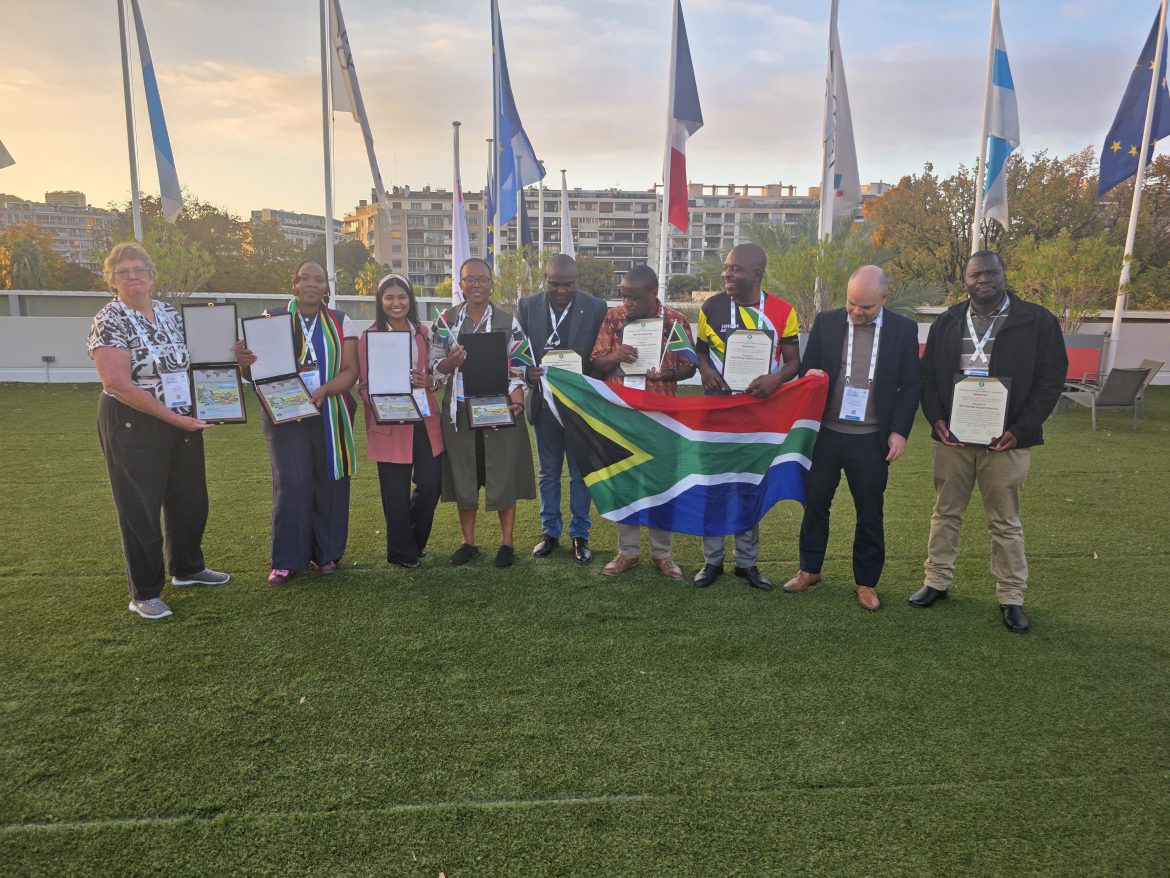
South Africa has received five awards at the 26th International Commission on Irrigation and Drainage (ICID) conference in Marseille, France, including recognition for four irrigation structures and an award for the country’s national irrigation committee, highlighting the role of water infrastructure, research and collaboration in strengthening agricultural resilience.
The awards, announced on 14 October 2026, recognised the South African National Committee on Irrigation and Drainage (SANCID), researchers and public institutions working to improve the management of water for agriculture. The four structures added to the ICID’s World Heritage Irrigation Structures register are Bulshoek Dam, Nqweba Dam, Upper Van Stadens Dam and the Vaal Barrage Structure. SANCID also received the award for best-performing National Committee, ahead of competing committees from Iran, Indonesia, Malaysia and Thailand, according to the National Research Foundation (NRF).
Dr Zanele Ntshidi, manager of the Arid Lands Node at the South African Environmental Observation Network (NRF-SAEON) and an executive member of SANCID, was part of the South African delegation. The awards recognise work intended to advance the efficient use of agricultural water and contribute to food and water security at a time when climate variability and pressure on water resources are increasing the demands on agricultural systems.

The four newly recognised structures represent different parts of South Africa’s irrigation history. The ICID’s World Heritage Irrigation Structures programme identifies historic irrigation and drainage infrastructure with technical, cultural or operational significance. The register is intended to document how such systems developed, preserve knowledge about their design and management, and draw attention to their continued relevance to water management. The designation is separate from UNESCO’s World Heritage listing.
For South Africa, the recognition connects historical infrastructure with a contemporary policy challenge: ensuring that water systems continue to support agriculture while the country manages constrained water resources and ageing infrastructure. Irrigation systems require ongoing maintenance, sound operational management and planning that accounts for changing rainfall patterns and demand. Historic recognition does not in itself guarantee infrastructure performance, but it can help preserve knowledge about the systems and the role they have played in agricultural development.
The award to SANCID also highlights the importance of coordination across institutions. The committee brings together stakeholders involved in irrigation and drainage and represents South Africa within the international commission. Researchers and representatives from NRF-SAEON, the Water Research Commission, the Agricultural Research Council, the University of the Free State and the Department of Agriculture received the awards on behalf of the country.
Dr Ntshidi attributed the result to cooperation across disciplines and organisations. “This achievement is a testament to the power of collaboration and strong partnerships. By bringing together diverse stakeholders, expertise, and resources around a shared vision, we were able to maximise our collective impact and achieve this desirable result,” she said.
That cooperation matters because agricultural water management spans research, infrastructure, policy and farm-level decisions. Scientific evidence can help determine when and how much water crops need, while agricultural researchers can assess the effects of irrigation methods on yields and resource use. Public agencies and water institutions are responsible for the wider systems and rules within which farmers operate. Coordination between these groups can help turn research into practical improvements, although the results ultimately depend on implementation, funding and the capacity to maintain infrastructure.
At the conference, Ntshidi presented research titled Long-term research on water and food security: Empowering female emerging farmers to grow food that feeds nations. The work focused on climate-smart agriculture and building climate-resilient, food-secure communities, with particular attention to supporting emerging women farmers.
The focus on women farmers adds a livelihoods dimension to the award-winning delegation’s work. Access to suitable irrigation, timely information and practical agricultural support can influence the ability of emerging farmers to manage variable weather and maintain production. However, the benefits of climate-smart approaches depend on whether farmers can access water, equipment, finance, knowledge and markets. Research must therefore be connected to the economic and institutional conditions that shape agricultural decisions.
South Africa’s water challenges make these questions particularly important. Agriculture relies on the availability and reliability of water, while urban demand, industrial activity and environmental requirements also place pressure on shared resources. Climate change adds uncertainty through shifts in rainfall, higher temperatures and more frequent or severe drought conditions in some areas. Efficient irrigation can improve the productivity of water use, but it cannot fully compensate for weak infrastructure, inadequate maintenance or poor allocation and management.
SANCID’s strategic objectives align with South Africa’s Vision 2030 and the National Water Resource Strategy, with an emphasis on sustainable irrigation water management. The priorities include improving agricultural output through smarter irrigation, supporting economic growth while managing stressed water infrastructure, and reducing the risks that water scarcity poses to energy production and quality of life.

The connection between water, food and energy is especially significant. Water is required for crop production and many industrial processes, while energy is needed to pump, treat and distribute water. Constraints in one system can affect the others, increasing costs for farmers, businesses and households. More effective planning therefore requires water management to be considered alongside agricultural development, energy security and infrastructure investment.
The international recognition provides visibility for South African research and institutional collaboration, but the longer-term measure of progress will be the extent to which the work improves water-use efficiency and agricultural resilience. That includes whether research reaches farmers, whether irrigation infrastructure is maintained and whether public agencies can apply evidence to investment and resource-allocation decisions.
The awards also place South African experience within a wider international discussion about how irrigation systems can support food production under growing water constraints. By combining recognition of historic infrastructure with research into climate-smart farming, the delegation has drawn attention to both the legacy of water management and the need to adapt it to changing conditions.
For South Africa, the challenge now is to convert international recognition into practical gains: more resilient farming systems, better use of scarce water, stronger support for emerging farmers and sustained investment in the infrastructure on which food security depends.


