


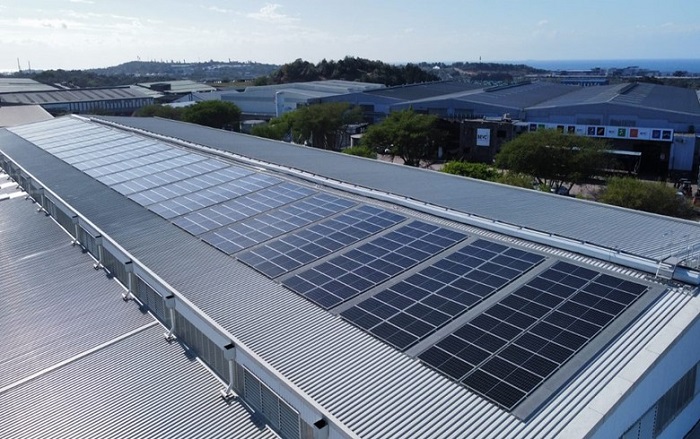
South African commercial solar investor Jaltech plans to invest R500 million ($27.5 million) to acquire underperforming solar and battery systems installed by businesses during the country’s load-shedding crisis, seeking to convert emergency power investments into long-term electricity cost savings as companies face rising tariffs.
The strategy targets thousands of commercial installations that were designed primarily to keep businesses operating during power cuts, rather than to minimise electricity expenditure. Jaltech plans to purchase these systems, fund the technical upgrades needed to improve their performance and enter into power purchase agreements (PPAs) with the original owners, who would continue buying electricity from the upgraded assets at an agreed tariff.
The company’s approach reflects a change in South Africa’s commercial energy market. During periods of prolonged load-shedding, businesses invested heavily in rooftop solar panels, inverters and battery storage to protect production, preserve revenue and reduce dependence on the national grid. As electricity supply conditions have improved, the financial performance of those installations has come under greater scrutiny, particularly as electricity tariffs continue to rise.
“During load shedding, companies became desperate to keep their operations running, and this led to the biggest solar rush globally,”said Matthew Cruise, an energy analyst at Jaltech. He said many systems were not designed around potential savings, leaving businesses with installations that may not match their actual consumption patterns or make optimal use of electricity tariff structures.
The issue is not necessarily a lack of solar capacity, but how that capacity is configured and used. A system designed to provide backup power during outages may have a different technical and financial profile from one intended to reduce electricity bills. Panel capacity, inverter configuration, battery size, operating schedules and the timing of a business’s electricity demand can all influence the savings a system delivers.

For example, a business that consumes most of its electricity during daylight hours may benefit from a different system configuration from one whose demand peaks in the evening. Battery storage can shift solar-generated electricity to periods when it is more valuable, but batteries also increase upfront costs and must be sized against the customer’s actual demand and tariff structure. An oversized system can tie up capital without generating equivalent savings, while an undersized installation may leave a business relying heavily on grid electricity.
Jaltech’s model is intended to address these challenges without requiring businesses to finance the improvements themselves. Under the proposed arrangement, Jaltech acquires the existing solar and battery assets and covers the cost of upgrading them. The original owner receives proceeds from the sale and signs a PPA under which it purchases electricity from Jaltech at an agreed rate.
The arrangement could release capital that businesses have tied up in energy infrastructure while transferring responsibility for system optimisation to a specialist owner. Instead of funding new equipment or technical work directly, customers would pay for electricity under the new agreement. The financial outcome for each business would depend on the purchase price, the upgrade required, the contracted tariff and the performance of the system after refurbishment.
Jaltech says it has already acquired and refinanced hundreds of solar assets across South Africa and that these transactions have saved companies millions of dollars in power costs. The company describes itself as one of the country’s largest commercial solar owners. However, the latest investment announcement does not specify how many systems the R500 million programme is expected to acquire, the total generating capacity involved or the average level of savings anticipated for participating businesses.
The strategy also creates a potential secondary market for commercial solar infrastructure. Rather than treating existing installations as fixed assets that must be operated in their original configuration, investors can assess whether the systems can be purchased, technically improved and managed under a different commercial arrangement. If the model proves scalable, it could support more active ownership and financing of distributed energy assets in South Africa.
The economic case comes against a backdrop of continued pressure on electricity costs. Eskom’s approved average tariff increase for customers supplied directly by the utility was 8.76% for the 2026/27 financial year, effective from 1 April 2026. Municipal customers were scheduled to implement an average increase of 9.01% from 1 July 2026. The impact on individual businesses varies according to tariff category, consumption patterns and municipal arrangements, but the increases reinforce the importance of managing electricity expenditure.
For energy-intensive businesses, the cost of electricity affects operating margins, product pricing and investment decisions. Manufacturers, retailers, agricultural operators and property owners may have different demand profiles, but all need to assess whether their energy arrangements deliver reliable power at a competitive cost. Optimising an existing solar system can therefore be a financial management decision as much as an engineering exercise.
There are, however, risks to consider. Businesses selling their systems must assess whether the proceeds adequately compensate them for the original investment and how the new PPA compares with their current electricity costs. They also need to understand contract duration, tariff escalation, maintenance responsibilities and what happens if a system underperforms. For Jaltech, the economics will depend on accurately valuing acquired assets, identifying cost-effective upgrades and ensuring that contracted electricity revenue supports the investment.

Technical assessments will be particularly important because installations differ in age, equipment quality, maintenance history and suitability for optimisation. Some systems may require relatively modest adjustments, while others could need substantial replacement or redesign. The commercial viability of each acquisition will depend on whether the expected improvement in performance justifies the additional capital required.
The shift also has implications for the wider distributed energy sector. South Africa’s solar boom created a large base of privately owned generation assets, but the next phase of the market may depend less on installing new panels alone and more on improving how existing systems perform. Asset acquisition, refinancing, storage optimisation and long-term power contracts could become increasingly important tools for businesses seeking to manage electricity costs.
Jaltech’s R500 million commitment will test whether that opportunity can be developed at scale. Its success will depend on the number and quality of assets it can acquire, the savings its upgrades deliver and whether businesses find the resulting power purchase agreements financially attractive.
The underlying question for South African companies is changing. During the height of load-shedding, the priority was to keep operations running. With electricity costs still rising, the challenge is to ensure that the infrastructure installed during that emergency now delivers measurable value. Jaltech is betting that improving existing systems, rather than simply building more, can help businesses make that transition.


