


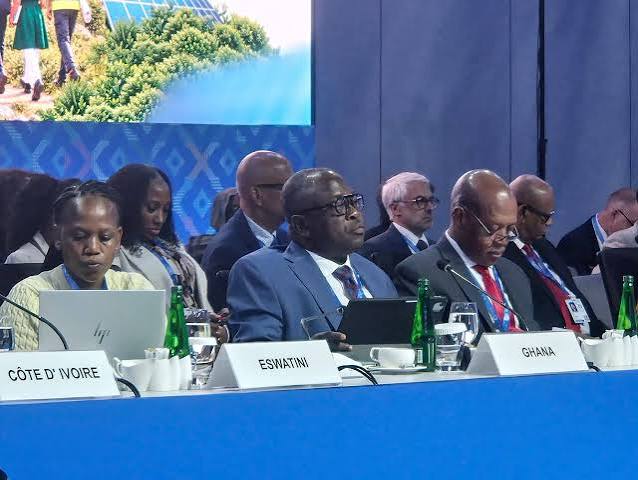
Ghana has called on international financial institutions and development partners to protect access to affordable climate finance for vulnerable countries undertaking debt restructuring, warning that efforts to restore fiscal stability could undermine investment in climate resilience if borrowing costs remain high. Seidu Issifu, Ghana’s Minister of State for Climate Change and Sustainability, made the appeal at the 17th Vulnerable Twenty (V20) Ministerial Dialogue in Bangkok, held alongside the 2026 IMF and World Bank Annual Meetings, as Ghana faces an estimated $9.3 billion requirement for climate mitigation and adaptation.
According to Modern Ghana, Issifu argued that countries undertaking difficult fiscal reforms should not be penalised through continued restrictions on concessional finance or unfavourable assessments of their creditworthiness. He called for transition financing arrangements with longer repayment periods, phased pricing and clearer pathways for countries to regain sustainable access to international capital markets after restructuring.

The appeal highlights a financing challenge facing climate-vulnerable economies across Africa: debt restructuring may help restore fiscal sustainability, but it does not automatically create the resources needed to adapt infrastructure, protect livelihoods or transform energy systems. Where borrowing remains expensive, governments can struggle to finance climate programmes at the same time as they meet debt obligations and maintain essential public services.
Issifu also called for more transparent sovereign credit ratings that reflect improvements in economic fundamentals following restructuring. He proposed debt-for-resilience conversions, climate-resilient debt clauses in new lending agreements and debt sustainability assessments that account for resilience investment as a contributor to long-term economic growth. These measures, if adopted and structured effectively, could help countries manage climate shocks without immediately increasing pressure on public finances.
The Minister urged members of the V20, a group of climate-vulnerable economies, to build support for establishing the proposed Fund and called on the Group of Seven and Group of Twenty economies to back the initiative. He also advocated doubling the number of V20 direct-access entities accredited to the Green Climate Fund by 2027, with the aim of improving vulnerable countries’ ability to access climate finance through national and regional institutions.
The proposals reflect a wider concern about the conditions under which climate finance reaches developing economies. Access to funding is not determined solely by the scale of climate risks or the cost of adaptation. Credit ratings, debt sustainability assessments, institutional capacity and the terms attached to financing can all influence whether governments can secure capital at a manageable cost. For countries recovering from debt distress, these conditions can affect the timing and scale of investment in flood protection, water infrastructure, agriculture and energy systems.
At a separate Climate Vulnerable Forum and V20 Global Parliamentary Group Dialogue in Bangkok on October 15, Issifu called for climate finance that is accessible, affordable, predictable and aligned with national development priorities, according to GhanaWeb. He argued that climate action should contribute to employment, food security and energy security, while urging legislators to strengthen budget alignment, public expenditure oversight and policy continuity across political cycles.
He cited the Vulnerability to Viability Compact, Climate Prosperity Plans and the V20 Lifeline Fund as mechanisms intended to help mobilise resources. He also called on parliamentarians to support the transition from policy commitments to bankable projects and actual investment. The emphasis on legislative oversight reflects the importance of connecting climate financing to national budgets, project delivery and measurable economic outcomes.
Ghana’s financing needs illustrate the scale of the challenge. The Financial Stability Review 2025, prepared by the Financial Stability Council, estimates that the country requires approximately $9.3 billion for climate mitigation and adaptation, according to the Ghana News Agency. The review warns that climate risks could reduce gross domestic product by between 8% and 30% by mid-century if mitigation measures are not effectively implemented. It also projects that annual flood-related losses could double to around $200 million by 2050.
Those risks extend into the financial system. Climate-related damage can weaken borrowers’ ability to repay loans, reduce the value of exposed assets and increase liabilities for insurers. Disruption to agriculture, transport and commercial activity can also affect public revenue and investment returns. Climate finance therefore has implications beyond environmental programmes, influencing financial stability, infrastructure performance and the resilience of economic activity.
The fiscal pressure is compounded by the cost of servicing debt. ActionAid’s 2026 report, Debt Fuels the Climate Crisis: How the Finance Flows, found that 54 climate-vulnerable countries spent $304.8 billion on debt servicing in 2026, compared with $12.3 billion on climate action, according to reporting by the Ghana News Agency. The figures illustrate the imbalance between debt obligations and climate spending across the countries examined, although they should not be interpreted as Ghana-specific expenditure figures.
For African governments, the wider concern is how to fund resilience without undermining fiscal recovery. Debt service competes with spending on health, education, social protection and infrastructure, while climate-related losses can increase demands on those same budgets. When governments delay preventive investment, they may face higher reconstruction and emergency-response costs after floods, droughts or other extreme events. The scale and timing of those costs vary by country, but the underlying financing problem is particularly difficult where public borrowing remains constrained.
Ghana’s energy transition adds another dimension. The Ministry of Energy and Green Transition estimates that achieving net-zero emissions by 2070 will require more than $500 billion, while the country aims to raise renewable energy to 10% of installed capacity by 2030. Seth Mahu, the Ministry’s Director of Renewable Energy and Green Transition, has said the transition could support energy security, affordability, industrial development and employment if implemented effectively.
Meeting those objectives will require investment in generation, transmission, distribution and the systems needed to integrate renewable power into the electricity supply. It will also require financing structures that reflect the long investment horizons and revenue profiles of energy infrastructure. If capital is too expensive or available only on short repayment terms, projects may become more costly to deliver, placing additional pressure on electricity tariffs, public guarantees or government budgets.
The question is not simply how much capital Ghana can attract, but how it can finance the transition without adding unsustainable debt. Concessional loans, guarantees, private investment and other blended financing arrangements can play different roles, depending on project risks and the capacity of public institutions to manage them. Their contribution will depend on the cost of capital, the allocation of risks and whether investments generate reliable economic and financial returns.
Debt-for-resilience conversions and climate-resilient debt clauses could offer additional options, but neither is a substitute for sufficient grant and concessional funding. Debt conversions depend on negotiated terms and credible arrangements for directing fiscal savings towards agreed objectives. Resilience clauses can provide temporary relief when specified climate events occur, but their value depends on the triggers, eligibility conditions and repayment obligations set out in lending agreements.
Ghana’s call also raises questions about how sovereign risk is assessed. If credit ratings and debt sustainability frameworks fail to recognise the economic benefits of resilience investment, governments may face difficulty justifying spending that reduces future losses but does not generate immediate revenue. However, incorporating climate resilience into financial assessments would require transparent methodologies and reliable evidence that investments can reduce risks or improve long-term economic performance. The objective would be to improve the assessment of fiscal risks, not to discount debt sustainability constraints.
The institutional capacity to access international climate funds is another part of the equation. Increasing the number of accredited direct-access entities could give more national and regional institutions a route to climate finance, but accreditation alone does not guarantee funding. Institutions also need project preparation capacity, robust financial controls, effective procurement systems and the ability to monitor environmental and development outcomes. Strengthening these capabilities could help reduce the distance between international commitments and investment delivered on the ground.
Ghana is scheduled to host the National Climate and ESG Policy Summit on October 27, where discussions are expected to cover ESG disclosure requirements, climate risk in financial services and sector-specific transition obligations. These issues connect climate finance to the governance of public and private capital, including how financial institutions assess exposure to climate risks and how businesses account for transition costs.
For Ghana and other African economies, the central challenge is to align debt management, climate policy and development finance rather than treat them as separate agendas. Fiscal reforms can improve the foundations for investment, but their development benefits may be limited if countries emerging from restructuring cannot access affordable capital for essential resilience measures. As climate risks increasingly affect infrastructure, agriculture, energy supply and financial stability, the terms on which countries borrow for adaptation and transition will shape both their fiscal outlook and their capacity to sustain economic growth.

The outcome of Ghana’s proposals will depend on whether international partners translate calls for fairer financing into practical changes in lending terms, credit assessment, debt instruments and access to climate funds. For climate-vulnerable countries, the test is whether debt restructuring can restore financial stability while preserving the capacity to invest in resilience, rather than leaving governments with less room to respond to the shocks that threaten their economies.


