
The number of commercial carbon capture and storage (CCS) projects operating worldwide has reached 113, as governments and industry expand the transport infrastructure, storage hubs and financing frameworks needed to reduce emissions from hard-to-abate sectors. The latest Global Status of CCS report from the Global CCS Institute shows that operational projects have more than quadrupled since 2021, marking a shift towards connected carbon management systems rather than isolated capture facilities.
The report, published ahead of the United Nations Climate Change Conference COP31, records approximately 68 million tonnes per annum (Mtpa) of operating capture capacity. A further 56 Mtpa of capacity is under construction, which could raise annual operating capacity above 100 million tonnes when those projects enter service. The additional capacity remains dependent on construction, commissioning and operational delivery, rather than representing emissions reductions already achieved.
Since the Sleipner carbon storage project began operating in Norway in 1996, more than 400 million tonnes of carbon dioxide have been stored underground through CCS projects globally. The technology is being used in industries including hydrogen and ammonia production, fertiliser manufacturing, cement, natural gas processing and liquefied natural gas. However, the Institute says a substantial expansion of capacity will be required if CCS is to contribute meaningfully to global climate targets.

The report identifies the expansion of transport and storage infrastructure as one of the sector’s most consequential developments. Around one in three projects tracked by the Institute is associated with carbon dioxide transport or storage, reflecting the growing need to connect industrial emitters with suitable geological storage sites. These projects can provide shared infrastructure for multiple facilities, potentially reducing the need for every industrial operator to develop a separate pipeline and storage system.
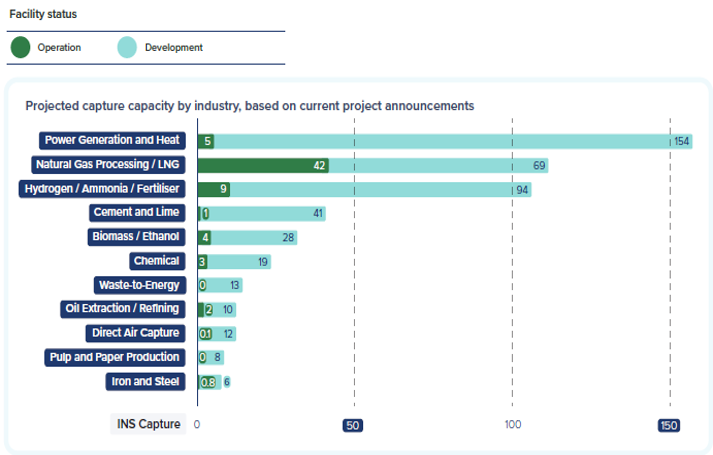
Projected capture capacity by industry, based on current project announcements
Carbon capture involves separating carbon dioxide from industrial emissions or other sources, while storage entails transporting the gas to geological formations where it can be injected and contained over the long term. Depending on the project, carbon dioxide can move through pipelines or specialised vessels before reaching a storage site. The development of these interconnected systems introduces a different set of commercial and regulatory requirements, including infrastructure access, transport standards, storage liability, monitoring and verification.
The Americas, led by the United States, account for 48 Mtpa of operating capture capacity, according to the supplied report findings. The region’s project base includes industrial facilities and initiatives linked to power generation. Rising electricity demand from artificial intelligence and data centres is also creating renewed interest in carbon capture for power production. However, the climate value of such projects depends on the emissions profile of the electricity source, the proportion of carbon dioxide captured, the energy required to operate capture equipment and the permanence of storage.
Europe is developing a model in which emitters in one country can access transport and storage infrastructure in another. The region’s CCS project pipeline could reach 141 Mtpa if projects proceed as planned, although that figure includes developments at different stages and should not be confused with existing operating capacity.
One example is the Northern Lights project in Norway, a cross-border carbon transport and storage venture owned by Equinor, Shell and TotalEnergies. The project is designed to receive carbon dioxide captured from industrial facilities, transport it by ship and store it beneath the North Sea. Yara’s ammonia facility in the Netherlands is among the industrial sources connected to this emerging market, illustrating how emissions from one country can be managed through infrastructure located in another.
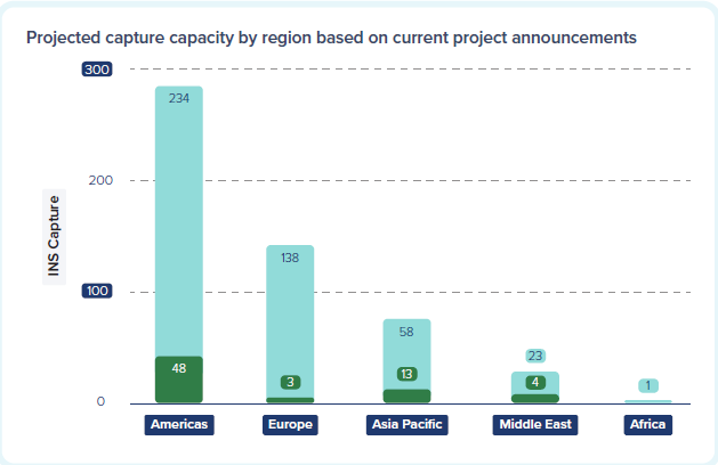
Projected capture capacity by region based on current project announcements
The European model depends on coordinated investment, cross-border agreements and rules governing the movement and permanent storage of carbon dioxide. It also requires sufficient demand from industrial emitters to justify costly infrastructure. Where multiple companies share transport and storage facilities, costs can potentially be distributed across a wider customer base, but projects still need predictable revenues and clear rules on responsibility if storage sites fail to perform as intended.
Canada is also moving towards integrated carbon management systems that link industrial facilities with shared transport corridors and storage hubs. The Global CCS Institute’s latest report highlights cooperation between the Canadian federal government and Alberta on carbon pricing, carbon contracts for difference, project approvals, transport infrastructure and Indigenous participation. These policy tools are intended to improve the investment conditions for projects whose construction costs are high and whose returns depend partly on long-term regulatory certainty.
Across Asia, China is moving beyond individual demonstration projects towards more integrated systems covering industrial decarbonisation, transport infrastructure and offshore storage. Australia, Indonesia, Malaysia and Singapore have also continued developing relevant policies and regulations, while India has announced funding to support CCS. The Institute argues that stronger policy frameworks will be needed to convert these developments into a new wave of projects.
Policy development is also advancing in the Middle East, including through Abu Dhabi’s General Policy on Carbon Capture. The region’s industrial base, oil and gas infrastructure and potential geological storage resources are supporting efforts to establish carbon management projects. Nevertheless, the commercial viability of each development will depend on the cost of capture, available storage capacity, regulatory arrangements and demand from industrial customers.
In Africa, CCS activity remains at an earlier stage, with feasibility studies and cross-border collaboration forming part of the emerging project landscape. The Global CCS Institute has identified opportunities for countries to assess geological storage resources, build technical capacity and explore regional cooperation. Its 2025 Africa CCUS Forum highlighted Egypt’s potential to leverage existing oil and gas infrastructure and studies examining possible carbon storage opportunities that could support links with Europe and the Middle East. Source: Global CCS Institute.
South Africa and Kenya have also featured in early-stage carbon management activity. In South Africa, the Council for Geoscience and Mzansi Exploration, Drilling and Mining have undertaken work associated with a carbon capture, utilisation and storage pilot. In Kenya, direct air capture initiatives have been explored alongside proposals for larger-scale carbon removal and storage. These activities differ in technology and maturity, and pilot work or feasibility studies should not be interpreted as evidence of established commercial storage networks.
For African economies, the emerging global market raises questions about where carbon management infrastructure could be technically and commercially viable. Cement, fertiliser, chemicals, natural gas processing and some industrial energy applications may offer opportunities where emissions are difficult to eliminate through electrification or efficiency measures alone. Countries with suitable geological formations and existing industrial infrastructure could potentially assess shared storage hubs or cross-border arrangements, but these opportunities require detailed geological appraisal, environmental safeguards, regulatory clarity and credible demand.

Financing remains a central challenge. CCS projects require substantial upfront capital for capture equipment, pipelines, shipping, injection facilities and long-term monitoring. In markets where carbon prices are low or uncertain, companies may struggle to justify investment without government incentives, long-term contracts or other mechanisms that create predictable revenue. The experience of established markets suggests that technical capability alone is insufficient: policy and infrastructure must develop together.
Jarad Daniels, Chief Executive Officer of the Global CCS Institute, said the sector’s expansion increasingly depends on systems rather than standalone projects. He argued that policy, financing and connected infrastructure must work together to strengthen investment confidence and establish the business case for CCS as demand grows for lower-carbon materials and electricity.
The growth of CCS also raises questions about how carbon management fits into broader decarbonisation strategies. Capture and storage can address some emissions from industrial processes, but it does not remove the need to improve energy efficiency, expand renewable electricity and reduce fossil fuel use where alternatives are available. The overall climate contribution depends on the emissions avoided across a project’s lifecycle, including the energy consumed during capture, transport and storage.
With 113 commercial projects operating globally and additional capacity under construction, the sector is entering a phase in which the availability of shared infrastructure and dependable commercial arrangements could influence how quickly it expands. For Africa, the priority will be to determine where CCS offers a credible role in industrial decarbonisation, while ensuring that early investments are supported by reliable evidence, transparent regulation and long-term financial planning.