


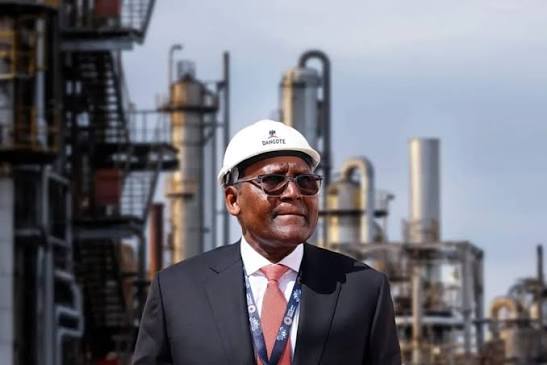
Nigerian industrialist Aliko Dangote has acquired a 24.76% stake in Kenya Pipeline Company (KPC) for approximately KSh42.5 billion (US$327.2 million), strengthening his position in East Africa’s petroleum distribution infrastructure as he advances plans for a US$16 billion refinery in Lamu, Kenya. The transaction brings together two strategically important parts of the regional fuel supply chain: refining capacity and the infrastructure used to transport petroleum products to inland markets.
Dangote confirmed the acquisition at the Financial Times Africa Summit in London on 21 October 2026, identifying his group as the buyer behind a major block transaction involving 4.5 billion KPC shares on the Nairobi Securities Exchange (NSE). The purchase makes him one of the pipeline operator’s largest shareholders, although the precise corporate entity within his business group that completed the transaction has not been publicly identified in the reports available.
The acquisition follows Kenya’s partial privatisation of KPC, through which the government offered 65% of the company’s shares to investors in early 2026. The company began trading on the NSE in March, as the government sought to raise capital for infrastructure development while retaining a stake in the strategic petroleum transport business. The subsequent sale of shares held by public institutions has raised questions among some lawmakers about the terms of the transactions and the management of public investment.

KPC operates a pipeline network of approximately 1,300 kilometres, moving petroleum products from the coastal port of Mombasa towards inland depots and markets. Its infrastructure is central to Kenya’s fuel distribution system and supports supply routes serving neighbouring countries, including Uganda and other parts of the wider East and Central African region. The network provides a strategic connection between imported petroleum products arriving at the coast and consumers across the hinterland.
For Dangote, the investment offers exposure to infrastructure that could become increasingly important if his planned Lamu refinery proceeds to commercial operations. The proposed facility, launched in September 2026, is designed to process up to 700,000 barrels of crude oil per day, with operations targeted for 2030. The project is intended to supply petroleum products to Kenya and regional markets, potentially changing how some East African economies source refined fuels.
According to reporting by the Financial Times, Dangote has also outlined plans to invest approximately US$1.5 billion in expanding Kenya’s pipeline network. Taken together, the refinery and pipeline investments point towards an integrated model spanning crude processing, storage, transportation and distribution. Such integration could give the group greater control over the logistics required to move fuel from a refinery to regional markets, although the commercial and operational arrangements for linking the proposed refinery to KPC have not been fully disclosed.
The scale of the Lamu project makes the distribution question particularly significant. A refinery with a planned capacity of 700,000 barrels per day would require reliable access to crude supplies, storage, port infrastructure and routes capable of moving large volumes of finished products. Its commercial performance would also depend on demand across the region, the competitiveness of its products against imported fuels, and the ability to transport supplies efficiently to customers.
Kenya and several neighbouring economies continue to rely heavily on imported refined petroleum products. A large regional refinery could provide an alternative source of supply and potentially reduce the foreign exchange spent on imports from markets outside the continent. It could also create opportunities for associated services, storage facilities, transport, engineering and industrial development.
However, additional refining capacity does not automatically translate into lower prices at the pump. Retail prices also reflect crude oil costs, refining margins, financing expenses, taxes, distribution charges, exchange rates and competition among suppliers. The benefits to consumers would depend on whether locally or regionally refined products can be delivered at competitive prices and whether those savings are passed through the supply chain.
The proposed refinery’s scale also raises questions about market concentration. If Dangote’s group becomes both a major refining operator and a significant shareholder in the infrastructure used to transport petroleum products, its position could influence the competitive conditions faced by other fuel suppliers. A minority shareholding does not, by itself, establish control over KPC’s operations. Nevertheless, the company’s governance arrangements, access rules and commercial practices will be important in determining whether competing suppliers continue to receive fair access to essential infrastructure.
Pipeline networks are strategic assets because they can offer a more efficient means of moving large volumes of petroleum products than road transport alone. Where infrastructure is difficult or expensive to duplicate, the terms on which different suppliers access it can affect their costs and ability to compete. Kenya’s regulatory framework and KPC’s operating policies will therefore have a central role in ensuring that the new ownership structure does not translate into preferential treatment for a particular supplier.
The acquisition has also intensified scrutiny of the government’s partial privatisation of KPC. Kiharu Member of Parliament Ndindi Nyoro has alleged that public institutions and pension funds were pressured to purchase shares during the initial public offering before selling holdings to a private investor. He has questioned the financial terms and timing of the subsequent transactions. These allegations have not been established as fact, and the claims should be distinguished from the confirmed share acquisition.
The central issue is whether the transactions were conducted transparently and in the financial interests of the institutions involved. Public pension funds invest on behalf of members and beneficiaries, making the valuation, timing and rationale for any sale important questions of fiduciary responsibility. Clear disclosures on the sellers, transaction prices and applicable approvals would help investors assess the deal and the wider privatisation process.
The transaction also comes as Kenya considers whether to take a stake in the proposed Lamu refinery through its national infrastructure fund. Such participation could give the government a direct financial interest in a major industrial project, but it would also require clarity on public-sector exposure, financing arrangements, risk allocation and expected returns. The refinery faces additional challenges, including disputes over land and environmental concerns that could affect implementation timelines and local communities.

For Lamu County, the refinery could create demand for construction labour, technical skills, logistics and supporting businesses. Those opportunities will depend on how the project is financed and implemented, the extent of local procurement and employment, and the management of environmental and social impacts. The planned investment must also be assessed against the long-term implications of building a large fossil-fuel processing facility at a time when energy systems are changing and climate-related policies are influencing investment decisions.
Dangote’s KPC acquisition forms part of a wider expansion of his group’s energy interests beyond Nigeria, where its existing refinery has become a major player in the country’s petroleum market. The strategy reflects an effort to combine industrial production with the infrastructure needed to distribute products across borders. In East Africa, however, the success of that approach will depend not only on completing the refinery and expanding pipeline capacity, but also on regional demand, cross-border logistics, financing and competition.
For Kenya, the investment presents both an industrial opportunity and a governance test. A stronger supply chain could improve fuel logistics and create a new source of refined products for regional markets. But the public benefits will depend on transparent ownership arrangements, fair access to infrastructure, effective oversight and evidence that greater integration produces efficiencies rather than simply concentrating market power.
The longer-term question is whether the combination of refining and distribution infrastructure can lower the cost and improve the reliability of petroleum supply across East Africa. That outcome is not guaranteed by the size of the investment alone. It will depend on how the assets are operated, how markets are regulated and whether the economic benefits reach consumers and businesses beyond the companies controlling the supply chain.


