


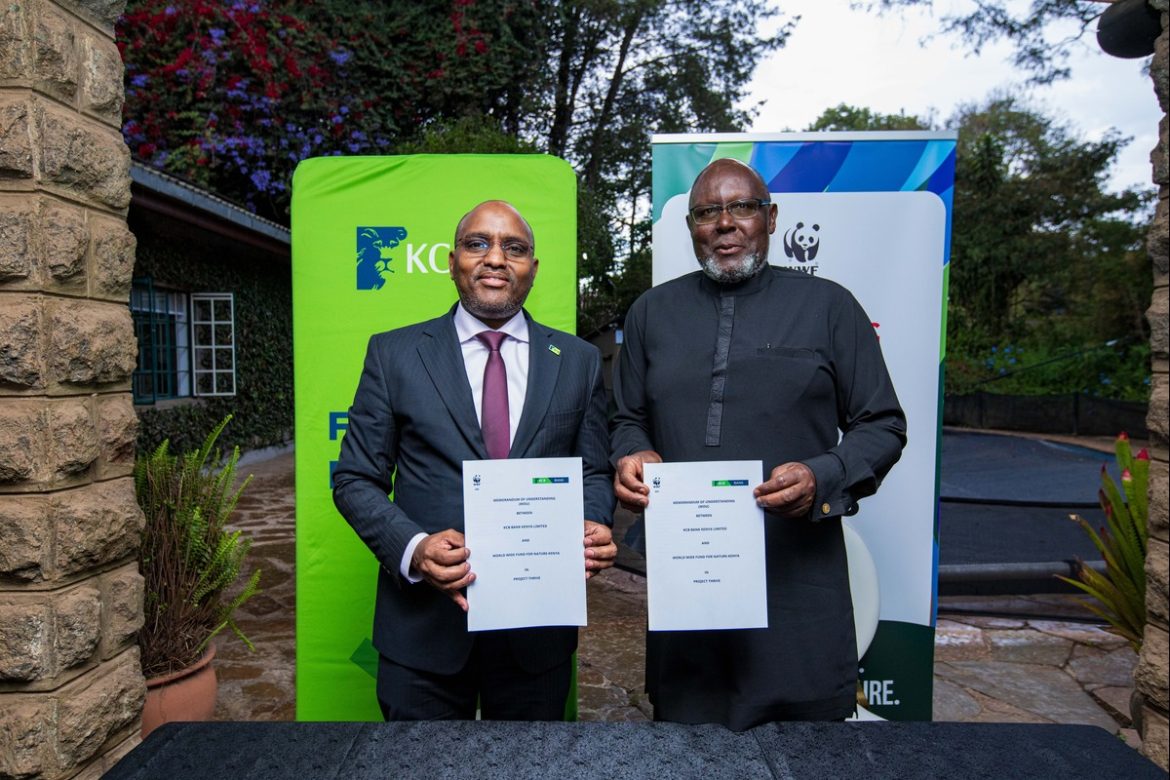
KCB Group has partnered with WWF-Kenya to direct financing towards nature-based businesses, landscape restoration and sustainable livelihoods through its Sh10 billion ($77 million) Green Climate Fund facility, as Kenya’s financial sector faces growing pressure to incorporate climate and nature-related risks into investment and lending decisions.
Announced in Nairobi on 23 October 2026, the partnership will focus on developing bankable nature-positive projects, strengthening environmental, social and governance (ESG) practices and mobilising public and private capital for conservation and climate resilience. The agreement also covers tree growing, landscape restoration, clean cooking, solar power for institutions and the development of ESG frameworks and reporting systems.
The partnership comes as WWF-Kenya marks 10 years as an autonomous national office and seeks to expand collaboration with corporate Kenya. The organisation says it has supported the restoration of more than 278,000 hectares of forests, wetlands, riverbanks and rangelands since 2020, while mobilising more than $132 million in sustainable investments over the past seven years.

“This is the scale of impact that must now be accelerated through stronger partnerships with Kenya’s corporate sector,” said Jackson Kiplagat, WWF-Kenya’s chief executive. He said the challenge was to build an economy in which nature is integrated into investment and development decisions, connecting conservation with enterprise and finance.
The agreement signals an effort to link Kenya’s conservation priorities with the capital, financial expertise and risk-management systems of commercial banks. While conservation has traditionally relied heavily on public budgets, grants and development assistance, partnerships with financial institutions could help expand the range of projects capable of attracting investment. The central test will be whether proposed initiatives can demonstrate credible environmental outcomes, viable business models and measurable benefits for local communities.
WWF-Kenya’s programme spending has increased from just over Sh600 million in the 2017 financial year to Sh1.6 billion in the 2026 financial year, reflecting the expansion of its conservation activities since becoming a national office in 2016. The organisation’s growing programme portfolio also increases the importance of securing predictable funding for restoration, community enterprises and long-term ecosystem management.
For Kenya, the potential economic case for nature-positive investment extends beyond wildlife protection. Forests and wetlands help regulate water flows, protect catchments and support agricultural production, while healthy rangelands underpin pastoral livelihoods. Coastal and inland ecosystems also sustain fisheries, tourism and other businesses. Degradation can impose costs on households, companies and public institutions through reduced water availability, declining productivity and greater exposure to climate-related shocks.
However, directing finance towards conservation requires more than identifying environmentally beneficial activities. Projects must be structured to attract capital, establish clear revenue or repayment models where appropriate, and account for environmental and social risks. Some restoration and community conservation initiatives generate public benefits that cannot easily be captured as commercial returns, making grants, concessional finance, guarantees or blended-finance structures important alongside conventional lending.
The partnership’s emphasis on developing bankable nature-positive projects therefore addresses a central challenge in sustainable finance: turning conservation priorities into investment proposals that meet the requirements of financial institutions without compromising ecological objectives. The announcement does not specify how much of the Sh10 billion facility will be allocated to projects under the partnership, the financing instruments to be used or the expected timeline for deployment. These details will be important in assessing the scale of capital that ultimately reaches conservation and community enterprises.
The inclusion of clean cooking and institutional solar power broadens the partnership beyond landscape restoration. Clean cooking initiatives can reduce dependence on polluting fuels, while solar installations can help institutions manage electricity costs and improve access to reliable power. Their environmental and social benefits will depend on project design, affordability, maintenance and the ability of intended users to sustain the investments over time.
The agreement also builds on earlier work between KCB and WWF-Kenya on incorporating nature-related risks into the lending and investment decisions of financial institutions. WWF-Kenya has undertaken similar work with the Kenya Bankers Association, reflecting wider efforts to bring environmental considerations into the financial sector’s assessment of borrowers and investments.
This work is becoming more relevant as banks assess how environmental degradation and climate change could affect loan performance, collateral values and business continuity. Businesses that depend on water, agricultural inputs, forests or other natural resources may face operational and financial risks when those resources deteriorate. Financial institutions that do not adequately assess such exposures could overlook risks embedded in their loan portfolios.
The Central Bank of Kenya issued Guidance on Climate-Related Risk Management in 2021, directing commercial banks and mortgage finance companies to integrate climate-related considerations into governance, strategy, risk management and disclosure. In April 2025, the regulator also released the Kenya Green Finance Taxonomy and Climate Risk Disclosure Framework to help financial institutions classify environmentally sustainable economic activities and improve climate-related disclosures.
Although climate and nature risks overlap, they are not identical. Climate risk management focuses on the financial effects of physical climate impacts and the transition to a lower-carbon economy. Nature-related risk assessment also considers dependencies on ecosystems and the consequences of biodiversity loss, pollution and ecosystem degradation. The KCB-WWF partnership could help strengthen the practical capacity of financial institutions to assess these wider exposures, provided the work translates into lending policies, due diligence and measurable reporting.
WWF-Kenya’s growing corporate engagement is also reflected in its three-year partnership with Old Mutual Holdings to restore 100 hectares of degraded Chepalungu Forest. Such partnerships can bring together conservation expertise, private-sector resources and local participation, although their long-term effectiveness depends on the survival of restored vegetation, continued land stewardship and the quality of monitoring.
Kenya’s conservation financing needs are substantial, and corporate partnerships are unlikely to replace public funding or international development support on their own. Their contribution will depend on whether they mobilise additional capital, improve the quality of investment decisions and support projects that would otherwise struggle to secure financing. Transparent reporting will be essential to distinguish commitments from actual disbursements and hectares targeted for restoration from areas where ecological recovery has been demonstrated.
The rights and economic interests of communities will also matter. Nature-based enterprises can support income generation through activities such as sustainable agriculture, beekeeping, ecotourism and the production of seedlings, but benefits are not automatic. Projects need clear arrangements for community participation, access to resources, benefit-sharing and accountability to ensure that conservation investments strengthen livelihoods rather than restrict them unfairly.

WWF’s work in Kenya dates back to 1962. One of its early conservation initiatives came in 1973, when it raised funds to purchase 37,000 acres of land that was subsequently handed to the government to expand Lake Nakuru National Park. The organisation’s current partnership with KCB reflects a different stage in the conservation agenda, in which financial institutions and private businesses are being asked to play a more direct role in financing environmental protection.
For KCB, the initiative offers an opportunity to connect green finance with projects that address environmental risks and support sustainable economic activity. For WWF-Kenya, it provides a route to deepen corporate engagement and develop a pipeline of investable conservation initiatives. The broader outcome will depend on how the partnership allocates capital, measures results and ensures that environmental improvements are accompanied by durable economic benefits.
As Kenya seeks to strengthen climate resilience and protect the natural systems that support its economy, the partnership illustrates the growing importance of aligning financial decisions with ecological realities. Its significance will ultimately be measured not by the size of the facility alone, but by the amount of financing deployed, the quality of projects supported and the lasting outcomes for ecosystems and communities.


