


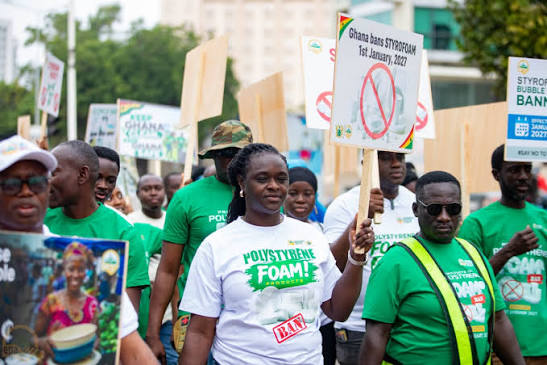
Ghana’s Environmental Protection Authority (EPA) has begun extending its nationwide ban on polystyrene foam products to regional markets, warning manufacturers, importers, traders and food vendors that enforcement will start on January 1, 2027, without an extension for businesses seeking to recover their investments. The campaign, launched in Damongo in the Savannah Region on October 26, marks a test of whether the government can translate its plastic pollution policy into effective regulation across local markets, food businesses and supply chains beyond Accra.
The ban, announced in May, covers the production, importation, distribution, sale and use of expanded polystyrene products, commonly known as Styrofoam or takeaway packs. According to the EPA, the prohibited products include disposable food containers, cups and plates, insulation and ceiling materials, foam mattresses and packaging materials. Products intended for medical, scientific, laboratory and diagnostic use are exempt from the directive.

The policy follows President John Dramani Mahama’s announcement during the 2025 World Environment Day celebrations and forms part of Ghana’s broader efforts to reduce plastic pollution. However, the transition from a national directive to enforcement across the country will depend on the ability of regulators, local authorities and businesses to manage a change in packaging supply and consumption before the deadline.
At Damongo, EPA Chief Executive Nana Ama Browne Klutse urged households, schools, food vendors and businesses to shift towards alternatives such as plantain leaves, reusable containers and biodegradable packaging. According to MyJoyOnline, the authority has also rejected requests from manufacturers and importers for additional time to recover investments in machinery and raw materials. The EPA has warned that unsold prohibited products could be confiscated and destroyed once enforcement begins.
The implementation plan places considerable responsibility on regional and district institutions. Savannah Regional Minister Salisu Be-Awuribe said the regional coordinating council, district assemblies, EPA officers, police and customs officials would work together to enforce the directive. Vehicles transporting prohibited products could be turned back at checkpoints after the deadline, according to MyJoyOnline.
The regional campaign reflects the practical challenges of regulating waste in a country where much of the packaging used by informal food businesses is purchased through local wholesalers and distributors. Enforcement will therefore require more than inspections at major commercial centres. District authorities will need to monitor smaller markets, food stalls, restaurants and transport routes, while ensuring that traders understand which products are prohibited and which alternatives remain available.
The environmental rationale is linked to the scale of Ghana’s plastic waste problem. The Auditor-General’s 2024 performance audit on plastic waste disposal estimated that the country generates about 840,000 tonnes of plastic waste annually, with approximately 9.5 per cent recycled. Much of the remainder is littered, dumped in drains or burned. Polystyrene foam presents particular challenges because its lightweight structure, contamination and limited recycling opportunities can make collection and recovery difficult.
For local authorities, discarded packaging contributes to drainage blockages and the costs associated with waste collection and flood management. The EPA has also raised concerns about the potential effects of plastic waste on wildlife, including animals in and around Mole National Park. Reducing polystyrene waste could help limit these pressures, although the extent of the benefit will depend on compliance and the availability of effective waste collection systems.
The ban also introduces an immediate cost question for small businesses. Food vendors rely on takeaway packaging that is inexpensive, readily available and suitable for transporting hot meals. Alternatives may involve higher purchase costs, different storage requirements or changes to how food is prepared and delivered.
A vendor in Accra’s Adabraka area, Comfort Boadi, told Graphic Online that she might increase meal prices by GH¢5 to account for the cost of replacement packaging. She cited foil-lined packs priced at GH¢100 for 25 units and black polypropylene containers costing GH¢70 for 40. She also said plantain leaves must be purchased daily and can lose freshness. These costs illustrate how a regulation intended to reduce environmental damage may affect small businesses operating on narrow margins.
The financial implications extend beyond vendors. Packaging suppliers and manufacturers will need to adjust inventories, sourcing and production, while food businesses may pass some of the additional costs to consumers. The effect on prices will depend on the availability of substitutes, competition among suppliers and whether reusable packaging systems can be established at scale.
The EPA has acknowledged the need to promote affordable alternatives and has directed its regional office to engage stakeholders. The authority is also developing a district-level reward system for compliance and a take-back system for recyclable polyethylene terephthalate, or PET, plastics. These initiatives could support broader waste management efforts, but they do not remove the need for reliable collection, sorting and recycling infrastructure.
A further risk is that the ban could shift demand towards other disposable plastics rather than reduce waste overall. The directive targets polystyrene foam, not every form of single use packaging. If vendors replace foam containers with disposable plastic products that are also difficult to collect or recycle, the environmental gains may be limited. The outcome will depend on the materials used, their durability, local waste systems and whether alternatives are reused or discarded after a single meal.
The policy also raises questions about the balance between enforcement and transition support. The EPA has ruled out extending the deadline for manufacturers, but the availability of affordable packaging and the capacity of district authorities to monitor compliance will influence how smoothly the change takes place. Businesses that cannot source suitable alternatives may face higher operating costs, supply disruptions or penalties, while consumers could experience price increases.
Ghana’s experience has implications for other African countries seeking to regulate plastic pollution. Across the continent, rapid urbanisation, informal food trade and limited waste collection capacity have made disposable packaging a persistent challenge for municipalities. Restrictions on specific materials can reduce pollution, but their effectiveness depends on accessible alternatives, clear regulation and enforcement systems that operate beyond major cities.

The regional outreach therefore marks an important stage in Ghana’s implementation process, but the decisive test will begin when the ban takes effect. The government will need to establish whether prohibited products have been removed from supply chains, whether vendors can obtain affordable replacements and whether district institutions can enforce the rules consistently. The policy’s environmental and economic impact will ultimately depend on whether Ghana reduces the volume of discarded packaging or simply changes the material entering its waste system.


