


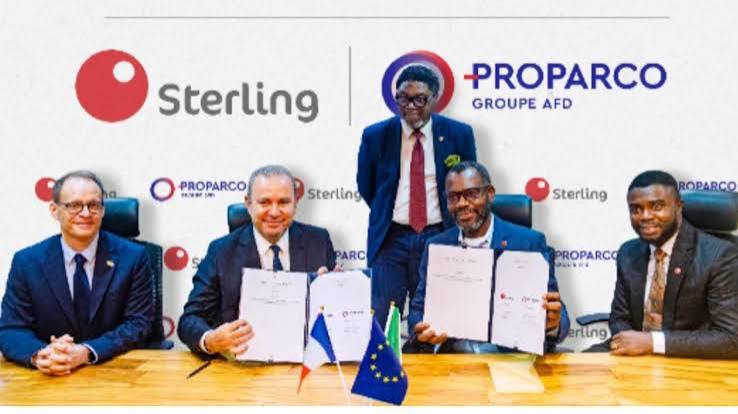
Proparco, the private-sector financing arm of the French Development Agency (AFD) Group, has extended a $30 million credit line to Nigeria’s Sterling Bank, directing most of the facility towards renewable energy projects as the country seeks to address one of the world’s largest electricity access gaps while strengthening financing for agricultural enterprises.
Announced in November 2026, the facility allocates $24 million to renewable energy investments, primarily off-grid solar solutions, while the remaining $6 million will support small and medium-sized agricultural businesses. The arrangement brings together two areas of Nigeria’s development financing needs: expanding access to reliable electricity and improving the availability of capital for businesses operating across the agricultural value chain.
The renewable energy allocation comes as Nigeria continues to face a substantial electricity access challenge. According to the World Bank’s Tracking SDG7 2026 report, approximately 87 million people in the country lacked access to electricity in 2024, representing the largest national electricity access deficit globally. Beyond the population without formal connections, unreliable supply from the national grid continues to constrain households and businesses that are already connected.

For many communities and enterprises, the limitations of grid infrastructure have increased the importance of decentralised energy systems. Off-grid solar solutions, including standalone systems and mini-grids, offer an alternative for households and businesses that are underserved by conventional electricity networks. Commercial and industrial solar installations also provide businesses with an opportunity to reduce their exposure to inconsistent grid supply and the costs associated with alternative sources of power.
However, expanding these solutions requires more than technological availability. Access to affordable financing remains a significant determinant of whether households and businesses can acquire solar equipment and whether energy companies can expand their operations. The $24 million allocation through Sterling Bank is therefore significant not only because of the capital involved, but also because it channels development finance through a domestic financial institution with an existing presence in the Nigerian solar market.
Sterling Bank has already been financing the acquisition of solar equipment by households and businesses. In March 2026, the lender received a separate $13 million loan through the UGEAP programme, managed by Cygnum Capital, to support household solar systems, mini-grids, and commercial and industrial solar installations. The new Proparco facility adds to this financing activity, potentially strengthening the bank’s capacity to support a broader pipeline of decentralised renewable energy investments.
The two facilities also reflect the growing role of domestic banks in connecting international development capital with local energy markets. While international lenders, development finance institutions and climate-focused investors remain important sources of funding, local financial institutions can provide an additional channel through which capital reaches businesses and consumers. Their knowledge of domestic markets, lending relationships and financial infrastructure can help address some of the barriers that prevent smaller enterprises and energy providers from accessing investment.
This is particularly relevant in Nigeria, where the renewable energy market includes companies operating across different segments, from solar home systems and mini-grid development to equipment distribution and commercial installations. Many of these businesses require financing to purchase inventory, expand distribution networks, develop projects and offer payment arrangements that make solar technologies more affordable to end users.
The International Energy Agency (IEA), in its 2025 report Financing Electricity Access in Africa, highlighted the challenges associated with the continent’s dependence on international funding. According to the agency, reliance on external capital can make it more difficult for smaller companies, many of them African-owned, to secure the financing needed to expand. The report emphasised the importance of mobilising greater investment from local financial institutions to strengthen the financing ecosystem for electricity access.
The Proparco-Sterling Bank arrangement reflects this financing approach, although the extent to which it will address the wider funding gap will depend on how effectively the credit line is deployed. The availability of capital through a local bank does not automatically guarantee that smaller solar companies or underserved households will benefit. Lending terms, risk assessment, the financial capacity of borrowers and the bank’s ability to identify viable projects will influence the facility’s reach.
The agricultural component introduces a second development priority. Of the total $30 million, $6 million has been earmarked for small and medium-sized agricultural businesses, a segment that plays a significant role in Nigeria’s food production, processing, distribution and rural employment. Such enterprises often face difficulties accessing affordable credit, particularly when they lack collateral, have limited financial records or operate in value chains exposed to seasonal production and market risks.
Access to finance can help agricultural businesses invest in equipment, improve processing capacity, strengthen storage and distribution systems, and manage working capital requirements. However, the impact of the allocation will depend on which enterprises qualify for financing and whether lending conditions reflect the operating realities of agricultural businesses.
The combination of renewable energy and agricultural financing also points to the economic links between the two sectors. Reliable electricity can support irrigation, cold storage, food processing and other activities that determine agricultural productivity and the quality of produce reaching markets. For small enterprises operating in rural areas, decentralised solar power can reduce dependence on diesel generators and improve the reliability of productive operations.

Nevertheless, the two allocations serve different financing needs and should be assessed according to their respective outcomes. In the energy sector, relevant measures will include the number of households and businesses gaining access to electricity, the capacity of solar systems financed, and the reliability and affordability of the resulting supply. For agricultural enterprises, the performance of the facility will be reflected in access to credit, business expansion, productivity and the capacity to sustain operations.
Nigeria’s electricity access challenge cannot be resolved through a single financing facility. It requires investment in generation, distribution, transmission and decentralised energy infrastructure, alongside policies that support private-sector participation and improve the financial viability of energy projects. Yet the mobilisation of domestic financial institutions is an important part of this equation, particularly as African markets seek to reduce the constraints associated with limited access to long-term capital.
For Sterling Bank, the Proparco credit line expands its role in financing businesses at the intersection of energy access and agricultural development. For Proparco, it provides another route for deploying development finance through a Nigerian financial institution. The broader test will be whether the capital translates into viable projects, stronger local businesses and improved access to essential services.
As Nigeria works to close its electricity access gap and strengthen its agricultural economy, the ability of domestic banks to mobilise and distribute finance will remain central to the scale and sustainability of these investments.


