


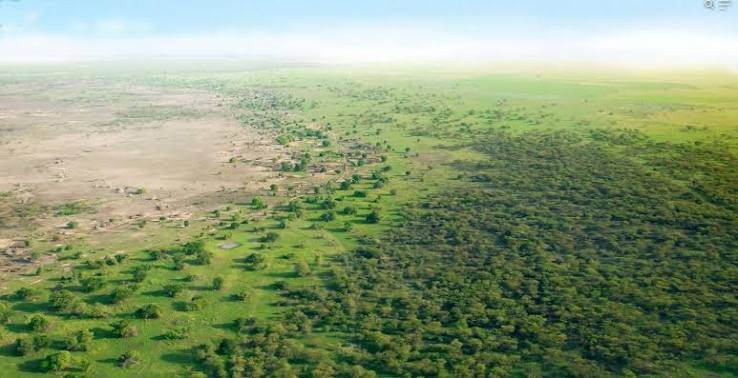
Algeria is expanding its Green Dam restoration programme across 4.7 million hectares of steppe land as rising temperatures, unreliable rainfall and land degradation increase pressure on agricultural production, water resources and rural livelihoods. The initiative, spanning 13 provinces and 183 municipalities, was highlighted at the COP17 biodiversity summit in Yerevan as part of the country’s wider efforts to restore ecosystems, protect biodiversity and strengthen climate resilience.
Known as the Barrage Vert, the Green Dam stretches across Algeria’s Northern steppe belt, forming an ecological buffer between the Sahara Desert and the country’s more productive agricultural regions. The programme aims to expand its overall intervention area from approximately 3.7 million hectares to 4.7 million hectares, building on an initiative first launched in the 1970s to combat desertification and protect land from advancing degradation.

Algeria relaunched the programme in Djelfa in October 2023 after earlier implementation phases encountered challenges associated with drought, inadequate maintenance and changing land use. The renewed effort reflects a broader shift in restoration policy, moving beyond tree planting towards a landscape management approach that combines vegetation recovery with soil conservation, water mobilisation, pasture management, infrastructure development and economic activities for local communities.
The scale of the programme gives it significance beyond environmental restoration. Approximately 7 million people live across the wider intervention area, where livelihoods depend heavily on agriculture, livestock and the productivity of increasingly fragile land. For these communities, the condition of the steppe affects household incomes, food production, grazing availability and the cost of sustaining rural economic activity.
According to Algeria’s General Directorate of Forests, the revised programme prioritises plant species adapted to local soil conditions and increasingly dry climates, including carob, olive and pistachio trees. Authorities are also involving young people and small enterprises in planting, maintenance, monitoring and related restoration activities, with the intention of creating economic opportunities alongside environmental rehabilitation.
In Khenchela province, a 909-hectare olive-growing area has been placed under the care of young farmers. Another intervention replaced a planned forage crop with prickly pear following consultations that incorporated community knowledge and commercial experience. Such adjustments illustrate how restoration programmes can respond to local conditions rather than relying exclusively on standardised planting plans.
The approach also reflects a broader challenge facing African land restoration initiatives: the difference between planting vegetation and establishing ecosystems that can survive. Tree numbers and hectares treated provide measures of implementation, but they do not necessarily demonstrate that land has recovered. Survival rates, soil conditions, water availability, grazing pressure and long-term maintenance determine whether restoration delivers lasting ecological and economic benefits.
Algeria’s steppe regions face particularly difficult conditions. Higher temperatures and irregular rainfall can weaken natural regeneration, increase irrigation requirements and intensify competition for water between agriculture, households and ecosystems. Forest fires and overgrazing add to the pressure, while degraded soils can become less productive and more vulnerable to erosion.
These conditions raise the cost of restoration. Species that survive under current conditions may face greater heat and water stress over the life of a project, while failed planting can require additional investment in replacement and maintenance. Consequently, the Green Dam’s performance will depend partly on whether restoration methods are adapted to changing climatic conditions and supported by sufficient water and technical resources.
Algeria is also linking the programme to its national biodiversity commitments. At COP17, the government presented its National Biodiversity Strategy and Action Plan for 2025-2030, which contains 24 national objectives and 93 implementation measures aligned with the Kunming-Montreal Global Biodiversity Framework.
The country reported 24 protected areas covering marine, forest, mountain, steppe and desert ecosystems, alongside more than 27,000 recorded plant and animal species. These assets form part of a broader biodiversity policy intended to strengthen ecosystem protection while addressing the pressures affecting natural resources.
The National Seed Bank is another component of that strategy. By conserving genetic resources and botanical heritage, Algeria is seeking to protect plant material that could support future restoration and adaptation efforts. For the Green Dam, access to species suited to local soils and drought conditions could become increasingly important as heat and water scarcity affect the viability of planting programmes.
Connecting seed conservation with field restoration may also improve the ability to replace failed plantings and maintain genetic diversity. However, the benefits will depend on whether conservation facilities, research institutions and restoration agencies can coordinate their work and translate scientific knowledge into practical decisions at project sites.
Financing remains a central consideration. Algeria used COP17 to call for stronger international support, technology transfer and capacity building for developing countries implementing biodiversity agreements. The appeal reflects a wider challenge for African governments, which must finance environmental restoration alongside infrastructure, healthcare, food security and employment priorities.
Large restoration programmes require spending over extended periods, while their benefits often emerge gradually. Planting, monitoring, maintenance and community engagement all carry costs, and insufficient funding for later stages can undermine initial investment. For governments facing competing fiscal demands, the ability to demonstrate measurable economic and ecological returns will therefore influence how restoration programmes are sustained.
The Green Dam’s economic value will depend in part on whether local communities can benefit from rehabilitated land without increasing pressure on fragile ecosystems. Fruit production, forage, sustainable forest products and restoration-related employment could provide income opportunities and strengthen incentives to protect restored areas.
However, commercial activity also introduces risks. Expanding agriculture or production in water-stressed landscapes could increase demand for scarce resources, while poorly managed grazing or harvesting could reverse ecological gains. The balance between economic use and ecosystem recovery will require decisions based on local water availability, land conditions and community needs.
For that reason, programme monitoring will need to extend beyond the number of hectares treated. Vegetation survival, soil recovery, water use, biodiversity outcomes and household benefits would provide a clearer assessment of whether restoration is improving ecological conditions and supporting livelihoods. Reliable data would also help authorities identify interventions that require adjustment before degradation becomes more difficult or expensive to reverse.
The implications extend across Africa, where desertification and land degradation affect agricultural productivity, rural employment and food systems. The Sahel, the Horn of Africa and parts of Southern Africa face related pressures from rainfall variability, drought, soil erosion and competing demands for land and water. In these regions, degraded landscapes can weaken household resilience and increase the economic costs of maintaining agricultural production.
Algeria’s programme offers a case for examining how restoration can be integrated with rural development and climate adaptation. Its combination of ecological rehabilitation, local enterprise, seed conservation and public investment reflects the need to address environmental degradation through institutions and economic systems, rather than treating it solely as a planting exercise.
The programme’s longer-term viability will depend on financing arrangements, technical capacity and the participation of communities whose livelihoods are directly affected by land management decisions. It will also depend on whether restoration targets remain aligned with the climatic conditions and resource constraints of the steppe.

For African governments, the central issue is how to maintain restored landscapes while managing the economic pressures that contribute to degradation in the first place. Algeria’s Green Dam will ultimately be assessed not by whether it creates a continuous green corridor, but by whether the land remains productive, biodiversity is protected, water is used sustainably and communities can secure livelihoods without exhausting the natural resources on which they depend.


