


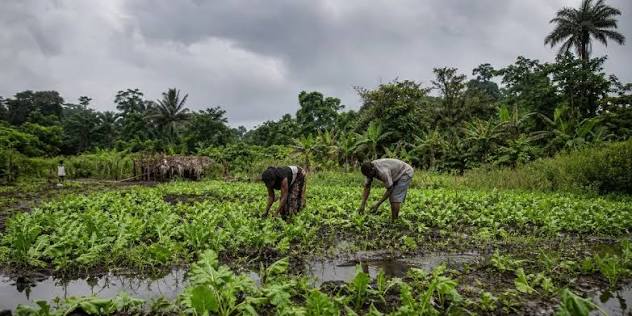
Changing rainfall patterns are disrupting waterleaf production in Southern Nigeria, damaging smallholder farms, reducing market supplies and increasing the cost of a vegetable widely used in household diets and traditional soups. Farmers in Calabar, Cross River State, have reported substantial crop losses following prolonged rainfall and flooding between July and September 2026, highlighting how increasingly unpredictable weather is affecting agricultural livelihoods, local food markets and the resilience of Nigeria’s food system.
The disruption is particularly visible in Calabar, where waterleaf is cultivated by small scale farmers and supplied to markets, households and restaurants. Enono Koka, a 33-year-old farmer, told Mongabay that much of her crop had died after weeks of heavy rain in August and September, leaving only a small number of plants suitable for harvesting. Nearby, farmer Joy David Okon returned to her farm in September to find waterlogged planting beds overrun with weeds, with newly planted waterleaf stems struggling to develop.

Their experiences reflect a growing difficulty for farmers who depend on rainfall to sustain production but face increasingly uneven distribution of precipitation. Although annual rainfall has declined in some parts of Nigeria in recent years, coastal areas such as Calabar and Lagos have experienced persistent downpours and flooding, creating conditions that can damage crops even when total rainfall is lower.
Waterleaf, scientifically known as Talinum fruticosum, is among the vegetables widely consumed in Nigeria, particularly in the Southern states. It is commonly used in dishes such as edikang ikong and afang soup, often alongside fluted pumpkin leaves and other vegetables. Its importance extends beyond household nutrition, providing income for smallholder farmers, market traders and food businesses that depend on regular supplies.
The crop is generally propagated through seeds or stem cuttings, with cuttings commonly taking at least 30 days to mature. While waterleaf can tolerate a range of temperatures and soil conditions, prolonged soil saturation can interfere with root function and plant growth. Its ability to withstand varying moisture conditions does not eliminate its vulnerability to extreme weather.
Research published in the journal crops in September 2026 examined waterleaf responses to drought and waterlogging under controlled greenhouse conditions. The study found that both conditions reduced leaf area and photosynthesis, with the effects more severe under drought. Leaf area declined by 1.9 times under waterlogging and 3.8 times under drought, according to Agricultural Scientist Efoo Bawa Nutsukpo, who participated in the research.
The findings indicate that waterleaf production faces risks from both excessive rainfall and prolonged dry periods. In coastal farming areas, heavy rainfall can leave planting beds saturated, while the dry season can reduce soil moisture and increase the need for irrigation. Farmers therefore face a production cycle in which neither abundant rainfall nor its absence guarantees stable yields.
The implications are particularly important for Nigeria’s smallholder agricultural sector, where many farmers have limited access to irrigation, drainage infrastructure, climate information and affordable production technologies. Rainfall remains a primary source of water for smallmscale cultivation, making changes in its timing and intensity difficult to manage without additional investment.
According to the Mongabay report, waterleaf farmers in Calabar have increasingly experienced persistent rainfall that weakens leaves and damages stems. Some growers have also raised concerns about synthetic fertilisers and other agricultural chemicals, which they believe can make stems more brittle under adverse conditions. The crop has traditionally been cultivated using decomposed manure, although some farmers have turned to synthetic inputs in an effort to accelerate growth and improve leaf quality.
The production losses are already affecting market availability. Traders in Calabar have reduced the quantities they purchase as supplies become less reliable, while consumers face higher prices for smaller bunches. One vendor, Anthony, said his weekend sales had previously generated about 60,000 naira before the recent shortage, but declining supplies and customer resistance to higher prices have weakened business.
The pressure is also affecting food businesses. Restaurant Operator Margaret Ibok told Mongabay that the cost of waterleaf had increased from about 3,000 naira to 8,000 naira for the quantities she purchased, raising the cost of preparing traditional soups. She said one pot of soup could now require about 30,000 naira in expenses, leaving little room to recover costs through sales.
Read also: https://news.mongabay.com/list/africa
For households, the shortage is changing food choices. Consumers who regularly purchase waterleaf for traditional dishes have begun substituting other meals as prices rise. The impact extends to related vegetables, including fluted pumpkin and Gnetum africanum, whose sales can decline when waterleaf-based dishes become more expensive or less available.
These changes illustrate how climate-related crop losses can move through local food systems. Reduced farm output affects traders and restaurants, while higher prices influence household purchasing decisions. For farmers, lower yields can reduce income and leave less capital available for replanting, fertiliser, labour and other production costs.
Nigeria’s wider agricultural exposure to flooding provides further context. The United Nations Food and Agriculture Organization reported that the 2024 floods affected nearly one million hectares of farmland across 29 states, while flooding in 2022, following heavy rainfall and the release of water from Cameroon’s Lagdo Dam, damaged an estimated 569,251 hectares of cropland. These events demonstrate the scale of agricultural disruption that can occur when rainfall, river flows and water management systems combine to overwhelm farming areas.
The country has expanded its use of rainfall forecasts and early warning systems following major flood events. However, the experience of waterleaf growers in Cross River suggests that national forecasts do not always translate into effective farm-level planning. Nigeria’s meteorological agency had forecast normal to below-normal rainfall in coastal states, including Cross River, for the August to October period, while farmers reported persistent heavy rainfall during the same season.
The difference between forecast conditions and local experience highlights the importance of timely, location-specific climate information. For smallholders, the value of forecasts depends on whether they can use them to adjust planting schedules, prepare drainage systems, protect crops or secure alternative water supplies. Without practical access to those measures, improved climate information may not prevent losses.
The economic pressure is also compounded by rising input and transport costs. Farmers and traders must move produce to markets while managing fuel, labour and production expenses. When harvest volumes decline, those costs can become more difficult to recover, particularly for growers with limited access to credit or savings.
Nigeria’s food price pressures make the disruption consequential beyond the waterleaf market. The country’s annual food inflation rate rose from 8.9% in January to 19.6%, according to figures cited by Mongabay from the National Bureau of Statistics. Although waterleaf shortages are only one part of the food system, the episode shows how weather-related supply disruptions can add to the cost of maintaining household diets and operating food businesses.
Scientists say improved water management could help stabilise production. Nutsukpo recommended better drainage and raised planting beds where necessary to reduce the effects of prolonged saturation. Such measures could allow farmers to remove excess water more efficiently during heavy rainfall, although their effectiveness would depend on soil conditions, farm layout and access to materials and labour.
Controlled environment agriculture could also reduce exposure to rainfall variability by allowing crops to grow under more regulated conditions. However, greenhouse systems and other technology-intensive approaches require capital, infrastructure and technical skills that remain beyond the reach of many smallholders. Their adoption is therefore likely to be limited unless financing, training and suitable technologies become more accessible.
For Nigeria, the challenge is to strengthen agricultural resilience without imposing costs that small scale producers cannot absorb. Investment in drainage, water storage, irrigation, extension services and local climate information could help farmers manage both excess rainfall and dry season shortages. The design of those investments will matter, particularly in coastal communities where flooding and water availability can vary sharply across locations.
The implications extend across Africa, where smallholder farmers supply much of the food consumed in domestic markets and remain exposed to rainfall variability. Climate-related disruptions to vegetables and other perishable crops can affect rural incomes, urban food prices and the viability of informal trading networks. The effects are often felt first by farmers and consumers with limited financial buffers, but can also reach restaurants, processors and local businesses.
Waterleaf’s experience also underscores the importance of treating climate adaptation as a food system and economic issue. The crop is not simply a farm product: it supports household meals, agricultural income and local commerce. When production becomes unreliable, the effects move across those connected activities, increasing the cost of food and reducing the ability of small businesses to maintain sales.

As farmers in Calabar wait for more favourable conditions before replanting, the immediate concern is the next growing cycle. Longer term resilience will depend on whether water management, climate information and affordable agricultural support can help producers respond to both flooding and drought. For Nigeria’s smallholders, the central challenge is no longer only how much rain falls, but whether its timing and intensity allow crops, livelihoods and local food markets to remain stable.


