


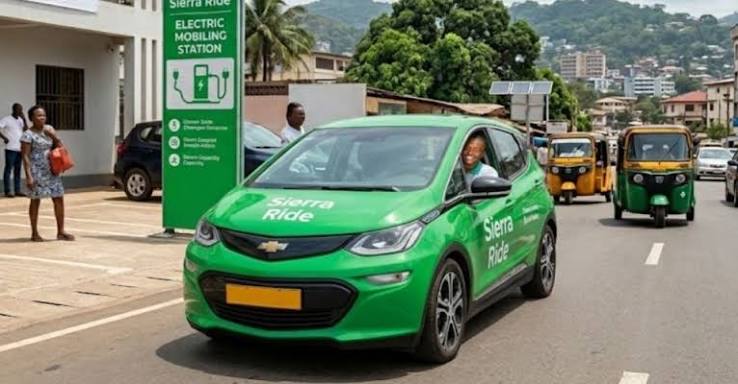
Sierra Leone is investing $1.5 million in a pilot electric transport service in Freetown, combining 50 electric vehicles with solar-powered charging infrastructure, digital payments and training for 100 drivers as the government seeks to create employment and test a locally financed model for cleaner urban mobility. The initiative, known as Sierra Ride, is being developed by the Ministry of Youth Affairs in partnership with the United Nations Development Programme (UNDP) and the Armed Forces Technical Education Centre, with public development financing increasing from $1 million in 2025 to $1.5 million in 2026.
The project places government financing at the centre of an emerging electric mobility market, covering vehicle development, shipment and customs clearance, charging stations, GPS tracking, a booking application, mobile money integration and driver training. The government is also facilitating land for charging facilities, making the programme a test of whether public institutions can coordinate the infrastructure, skills and financing required to operate an electric transport service in a country with limited electricity access.

According to UNDP, Sierra Ride is intended to create employment opportunities for young people and women while establishing a greener transport service in the capital. The pilot’s design, which provides 50 vehicles for 100 trained drivers, suggests a shared operating arrangement rather than individual vehicle ownership for every participant. Its longer-term economic value will depend on how drivers are recruited, how earnings are distributed and whether the service can cover its operating costs without continued public support.
The investment comes as African governments face the challenge of introducing electric mobility in markets where vehicle ownership, charging infrastructure and access to reliable electricity remain limited. While electric vehicles can reduce fuel consumption and local exhaust emissions, the transition requires more than importing vehicles. Operators need affordable financing, dependable charging, maintenance services, spare parts and a business model capable of generating sufficient revenue to keep vehicles in service.
Sierra Ride’s public financing structure is therefore significant. By covering early development and infrastructure costs, the government is absorbing some of the risks that may discourage private lenders and investors from entering a relatively untested market. If the fleet demonstrates reliable operations, transparent revenue collection and competitive costs, the programme could provide information for banks, leasing companies and local investors considering financing additional vehicles.
However, public investment alone will not establish a sustainable market. The pilot will need to demonstrate how much each vehicle earns, how frequently it operates, the cost of charging and maintenance, and how long vehicles remain available for service. Without reliable operating data, it will be difficult to determine whether the model can expand commercially or whether its financial viability depends on subsidies.
For drivers, the immediate opportunity is access to employment and a route into commercial transport. Priority for women could broaden participation in a sector where vehicle ownership, access to finance and safety concerns have often restricted entry. Yet the benefits will depend on recruitment and vehicle allocation being transparent, and on drivers retaining sufficient income after charging, maintenance, insurance and platform fees.
The arrangement also raises questions about ownership and risk. Drivers will need clear contracts covering accidents, vehicle downtime, battery degradation, repair costs and responsibility for imported components. If those obligations are not properly defined, the financial burden could fall on participants whose earnings are least able to absorb unexpected expenses.
Passengers, meanwhile, will judge the service largely through affordability, availability and reliability. Electric vehicles generally have lower energy and maintenance costs than comparable petrol vehicles, but those savings do not automatically translate into lower fares. Vehicle financing, battery replacement, charging infrastructure and operational expenses can influence pricing over the life of the fleet.
Digital booking and mobile money integration could improve convenience and provide a more transparent record of transactions. GPS tracking may also support fleet management and passenger safety. However, a service that relies exclusively on digital payments could exclude commuters who use cash or face unreliable connectivity and transaction charges. Maintaining accessible payment options will be important if the project is intended to serve a broad urban market.
Electricity remains one of the programme’s most significant constraints. Sierra Leone has limited access to reliable power, and charging infrastructure must operate within a system that faces substantial investment requirements. The World Bank’s Sierra Leone National Energy Compact estimates that 36% of the population has access to electricity and sets a target of 78% by 2030, supported by an estimated $2.2 billion investment requirement.
Solar-powered charging could reduce the fleet’s dependence on grid electricity and limit exposure to power interruptions and tariffs. Yet the commercial performance of the charging network will depend on generation capacity, battery storage, equipment maintenance, site security and the availability of power during periods of reduced solar output. Rainy-season conditions could also affect charging reliability if facilities lack adequate storage or backup arrangements.
The location and capacity of charging stations will influence how efficiently vehicles operate. Drivers need to know where they can recharge, how long charging takes and whether facilities can accommodate demand during peak periods. If charging hubs become congested or unavailable, vehicles could spend more time idle, reducing driver earnings and passenger confidence.
Vehicle affordability presents another challenge. Public co-financing may lower the initial barriers for drivers, but a larger market will require a viable leasing, ownership or repayment structure. Imported vehicles and components also expose operators to exchange rate movements, shipping costs and supply chain delays. Without access to spare parts and trained technicians, a relatively minor mechanical or software fault could leave a vehicle out of service for an extended period.
The project will therefore require investment in local technical capacity alongside transport infrastructure. Training mechanics to diagnose electric drivetrains, charging systems and battery-related faults could help reduce reliance on external service providers and support employment beyond driving. The Armed Forces Technical Education Centre’s participation provides an institutional channel for skills development, although the scale of training and its connection to future maintenance demand will determine how much local capacity is established.
The climate case will depend on how the vehicles are powered and what journeys they replace. Solar charging could reduce emissions associated with electricity generation, while replacing high use petrol or diesel vehicles could lower fuel consumption and local air pollution. However, the project’s overall environmental benefits will need to account for vehicle manufacturing, battery production, electricity use and the operational life of the fleet.
The International Energy Agency has highlighted the importance of total cost of ownership analysis and charging system integration when assessing electric mobility in African markets. Those considerations are relevant to Sierra Ride because the purchase price represents only part of the cost. Charging, maintenance, insurance, financing and vehicle utilisation will determine whether electric transport remains economically competitive over time.
For Sierra Leone, reducing dependence on imported petroleum could also have implications for foreign exchange demand and transport sector exposure to international fuel price movements. The size of that benefit will depend on how much conventional fuel the fleet displaces and whether electricity generation and vehicle operations remain affordable. A 50-vehicle pilot is unlikely to materially change national fuel demand, but it could generate operating evidence for future investment decisions.
The initiative also reflects a wider development challenge across African cities, where population growth and expanding transport demand are placing pressure on infrastructure and household budgets. Electric mobility could create new jobs in transport, charging, maintenance and digital services, but those opportunities will depend on whether local businesses and workers can participate in the supply chain rather than relying predominantly on imported equipment and external technical support.
For governments, the central question is whether limited public development finance can establish a market that private capital will later expand. Sierra Ride’s performance will depend on procurement quality, charging reliability, driver contracts, fare affordability and transparent reporting of operating results. Those measures will be important in determining whether the programme can move beyond a demonstration and support a larger fleet.
The pilot’s public value should ultimately be assessed through measurable outcomes, including vehicle utilisation, passenger numbers, driver earnings, fleet availability, charging costs, maintenance expenditure and fuel displaced. Reporting those results would help government and potential investors distinguish between the benefits of a subsidised launch and the economics of a commercially sustainable service.
Sierra Ride offers Sierra Leone an opportunity to test how electric transport can be financed and operated under constrained infrastructure conditions. Its wider relevance for Africa will depend not on the number of vehicles introduced, but on whether the project establishes a dependable charging system, creates durable employment, keeps fares accessible and produces evidence that locally financed electric mobility can operate beyond its initial public investment.


