


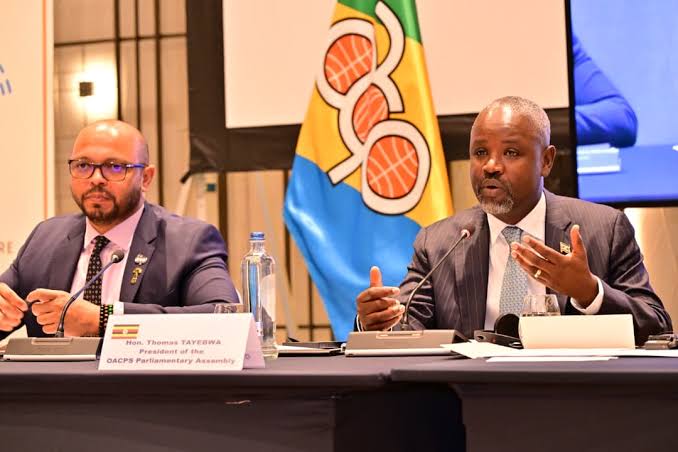
The Organisation of African, Caribbean and Pacific States (OACPS) has called for reforms to international climate financing arrangements that would allow vulnerable countries to respond to climate shocks without accumulating unsustainable debt, placing the issue at the centre of its November 9–13 parliamentary discussions with the European Union in Brussels. Led by Uganda’s Deputy Speaker of Parliament and OACPS Parliamentary Assembly President Thomas Tayebwa, the negotiations are examining how development finance, trade and climate cooperation can deliver practical benefits for member states facing rising adaptation costs and limited fiscal capacity.
The discussions come as African governments confront growing pressure to finance climate resilience while managing debt-service obligations, infrastructure deficits and competing demands for public spending. For many countries, the terms on which climate finance is provided are becoming as important as the amount committed, particularly where adaptation investments in water systems, agriculture, flood protection and early warning infrastructure do not generate direct financial returns.

At the 65th OACPS Parliamentary Assembly in Brussels, delegates agreed to make climate finance and climate justice central priorities in their engagement with European counterparts. Tayebwa argued that countries contributing relatively little to global emissions are experiencing disproportionate climate impacts, including drought, hunger, coastal erosion and rising sea levels. He called for countries responsible for a larger share of historical emissions to bear greater responsibility for financing responses to climate change.
According to the Uganda Broadcasting Corporation, Tayebwa said OACPS member states needed to ensure that climate commitments moved beyond political declarations and translated into financial support for affected communities. The organisation represents 79 countries across Africa, the Caribbean and the Pacific, giving its position a wider negotiating reach than an individual national appeal.
A central concern raised during the assembly was the reliance on loans to finance climate resilience. Dr James Murombedzi, Former Head of the United Nations Economic Commission for Africa’s Africa Climate Policy Centre, warned delegates that existing financing arrangements could deepen the debt burden of countries already experiencing economic losses from climate-related disasters.
In a presentation titled “Financing Climate Resilience Without Deepening Debt”, Murombedzi argued that grants should be prioritised for adaptation projects that do not generate direct revenue, while loans should be reserved for affordable, revenue-generating investments capable of supporting repayment. He also called for direct financing for loss and damage, stronger pre-arranged disaster financing mechanisms and climate-resilient debt clauses that would allow countries to temporarily suspend repayments following severe climate events.
The distinction is important for African public finances. Investments in irrigation, drought preparedness, coastal protection and early warning systems can reduce economic losses and protect livelihoods, but they do not always produce predictable cash flows from which governments can repay commercial or concessional loans. When these projects are financed primarily through borrowing, countries may face higher debt obligations without generating the revenues needed to service them.
The problem is particularly relevant for low income and climate-vulnerable economies, where repeated weather shocks can weaken agricultural output, disrupt transport infrastructure and reduce government revenue. Drought can increase food import requirements and place pressure on public spending, while floods can damage roads, bridges, power infrastructure and housing. Financing reconstruction through additional borrowing can further constrain investment in long-term resilience.
Murombedzi also highlighted the need to simplify access to climate finance, noting that smaller and less-resourced national delegations often struggle to participate effectively in international negotiations. He called for greater direct access to funding through national institutions, stronger technical capacity and more investment in public goods such as food security and early-warning systems.
The financing debate is also reflected in the joint climate statement issued by the European Union and OACPS ahead of COP31. Published on November 9, the document identifies six areas for cooperation: climate adaptation and resilience, access to climate finance, clean electrification and a just energy transition, climate data and scientific capacity, resilient food systems and ecosystems, and international ocean governance.
The statement supports the collective goal of mobilising at least $300 billion annually for developing countries by 2035, with developed countries taking the lead and contributions from other countries on a voluntary basis. It also backs efforts to triple adaptation finance by 2035 and calls for improved access to grants, highly concessional finance and funding for loss and damage.
However, the document does not establish a new financing facility or allocate additional funds to member countries. Instead, it sets out a shared political position and calls for existing commitments to be translated into projects and investment. Its effectiveness will therefore depend on subsequent funding decisions, the availability of project preparation support and the ability of national and regional institutions to access the proposed resources.
For African countries, the emphasis on grants and highly concessional financing has direct implications for the cost of climate adaptation. Governments need investment in water storage, climate-resilient agriculture, drainage systems, coastal protection and disaster preparedness, but the financial returns from these investments are often indirect. Grant based support can reduce pressure on national budgets, while concessional loans may be more appropriate for infrastructure projects with identifiable revenue streams.
The joint statement also identifies guarantees, risk-sharing arrangements and blended public private finance as instruments for mobilising investment while safeguarding debt sustainability. It proposes simpler access to climate funds, including direct financing through national and regional entities and faster accreditation processes. These provisions could help African institutions secure resources more efficiently, although their impact will depend on how they are implemented and whether funding reaches countries with the greatest vulnerability and weakest financing capacity.
The discussions also connect climate finance with trade and economic development. At the opening of the OACPS–EU Joint Parliamentary Assembly on November 10, Tayebwa called for a more equitable economic partnership that delivers investment, local value addition, skills development and employment across member states. He argued that cooperation between the two blocs should produce tangible economic benefits rather than remain centred on diplomatic commitments.
The Samoa Agreement provides the broader framework for political, economic and development cooperation between the EU and OACPS. Signed in November 2023 and provisionally applied from January 2024, it covers areas including sustainable development, trade, investment, climate action, human rights and peace and security. Faster ratification by member states remains among the issues raised during the Brussels discussions.
The connection between trade and climate finance is significant for African economies seeking to expand exports while adapting to changing international market requirements. Investments in resilient agriculture, energy infrastructure and industrial capacity can influence production costs, supply-chain reliability and the ability of businesses to meet environmental standards in overseas markets. However, countries with limited fiscal resources may struggle to finance these adjustments without more accessible external support.
The OACPS discussions have also brought forward the importance of stronger negotiating capacity. Murombedzi said smaller delegations often lack the technical resources and research capacity required to influence international climate negotiations. For African countries, this can affect their ability to assess financing proposals, shape rules and ensure that agreed commitments reflect national development priorities.
The debate is not confined to Africa. Delegates from Barbados, Chad, Mauritius and Jamaica also raised concerns about the relationship between climate vulnerability, debt and access to finance. Barbados Representative Dwight Sutherland pointed to the Bridgetown Initiative as a framework for reforming international financial arrangements, while Jamaica’s Representative Heroy Clarke questioned the use of loans to finance recovery from climate disasters. Chad’s Delegate, David Houdeingar Ngarimaden, cited changes in the Lake Chad basin as an example of the pressures facing communities dependent on natural resources.
The broader OACPS position reflects a common concern among developing economies: climate shocks can weaken the very public finances required to respond to them. Where governments must borrow to rebuild infrastructure after disasters, the cost of recovery can compete with spending on health, education and economic development. Financing arrangements that account for this exposure are therefore central to the long-term sustainability of public investment.

As the Brussels meetings continue through November 13, the challenge for both sides will be to translate the shared climate priorities into financing mechanisms that are accessible, predictable and appropriate to the needs of vulnerable economies. For African governments, the measure of progress will lie not only in the volume of climate finance announced, but also in whether its terms allow countries to strengthen resilience without undermining their capacity to fund other development priorities.


