


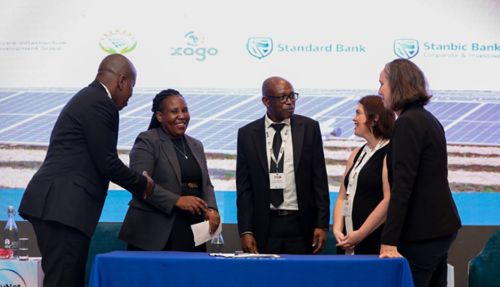
Standard Bank has been appointed as the mandated lead arranger for financing a planned 30 MW solar power plant in Zimbabwe’s Midlands Province, marking another step towards the development of privately financed renewable energy capacity in a country where many independent power projects have struggled to reach operation.
The financing arrangement for Vungu Solar was signed at the Zimbabwe-Zambia Energy Projects Summit (ZimZam), held in Zambia from 3 to 5 November 2026. The project is being developed by InfraCo, the project development arm of the Private Infrastructure Development Group (PIDG), in partnership with Energywise Equipment and Impala Power.
The appointment places the project closer to securing the capital required for construction. Vungu Solar has already obtained key regulatory and commercial commitments, including a government support agreement signed in June 2025 and a 25-year power purchase agreement with the state-owned Zimbabwe Electricity Transmission and Distribution Company (ZETDC) in January 2026.

PIDG committed US$1.5 million to the project in 2024, supporting its development ahead of the latest financing milestone. The involvement of Standard Bank is intended to help mobilise the additional funding needed to advance the project towards financial close.
Michiel Oosterhaven, InfraCo’s regional business development lead, said the project had progressed through a collaborative development process and that the appointment of the mandated lead arranger was expected to accelerate preparations for financial close. The appointment does not, however, mean that financing has been completed or that construction has begun.
The project’s progress comes against a challenging background for Zimbabwe’s independent power producer market. According to the country’s National Development Strategy for 2026–2030, only 48 of more than 170 registered independent power producers were operational in 2025. Together, these projects accounted for approximately 4% of electricity supplied to the national grid.
The gap between registered projects and those that have become operational highlights the difficulties of translating private-sector interest into electricity generation. Project development can involve several stages, including securing government approvals, negotiating power purchase agreements, arranging financing and meeting the requirements for construction and grid connection. Delays at any of these stages can prevent proposed generation capacity from contributing to national supply.
For Zimbabwe, the Vungu Solar project therefore represents more than an additional renewable energy proposal. Its ability to reach financial close and progress into construction will provide an indication of whether established contractual arrangements and development partnerships can help overcome some of the barriers facing privately developed power infrastructure.
The 25-year power purchase agreement with ZETDC is particularly important because it establishes a long-term commercial arrangement for the electricity generated by the plant. Such agreements can provide a basis for lenders to assess projected revenue and the project’s ability to service debt. However, the existence of a power purchase agreement alone does not guarantee that a project will secure financing or be delivered on schedule.
Standard Bank’s appointment also reflects the continued role of regional financial institutions in supporting energy investment across Southern Africa. The bank has been involved in renewable energy financing in several markets, including Zimbabwe’s neighbours, where governments and developers are seeking to expand generation capacity and diversify electricity supply.
On 2 November 2026, Standard Bank signed an US$86.2 million financing agreement with Solarcentury Africa. The facility could be expanded to US$370 million and covers solar projects in Zambia and other developments. The agreement illustrates the bank’s involvement in financing renewable energy projects beyond South Africa, although the scale and structure of the facility differ from the financing arrangement being developed for Vungu Solar.
In South Africa, Standard Bank has also supported wind and solar developments, including the 420 MW Koruson 1 complex. The bank reported that it mobilised 39.9 billion rand, equivalent to approximately US$2.16 billion, in renewable energy financing during 2025.
These activities point to the growing importance of commercial lenders in mobilising capital for energy infrastructure across the region. For markets where public resources are constrained, private financing can help support new generation capacity, provided that projects have credible revenue arrangements, manageable risks and the necessary regulatory and grid infrastructure.
Zimbabwe’s challenge, however, is not simply attracting developers or registering proposed projects. The limited number of operational independent power producers suggests that the country must also strengthen the conditions that allow projects to progress from development agreements to completed and connected power plants.
Vungu Solar has secured several important milestones, but its contribution to electricity supply will ultimately depend on reaching financial close, completing construction and connecting the facility to the grid. The distinction is significant in a market where a large pipeline of proposed independent power producers has yet to translate into operational capacity.

The next phase of the project will therefore be closely tied to the successful mobilisation of financing and the implementation of the agreements already secured. If delivered, the 30 MW plant would add privately developed solar generation to Zimbabwe’s electricity system and provide a further test of the country’s ability to convert renewable energy investment commitments into operating infrastructure.
The project’s importance extends beyond its 30 MW capacity. Zimbabwe’s National Development Strategy figures point to a substantial implementation gap between the number of registered independent power producers and the projects actually supplying electricity. Vungu Solar’s progress will therefore be judged not only by the financing it attracts, but by whether it reaches construction and begins delivering power.
Important clarification for publication: The project announcement dated 6 November 2026 identifies Standard Bank South Africa and Stanbic Bank Zimbabwe jointly as mandated lead arrangers. It also indicates that the banks intend to participate as lenders, with financial close targeted for 2027. This is more precise than describing Standard Bank as the sole arranger or implying that financial close is imminent.


