


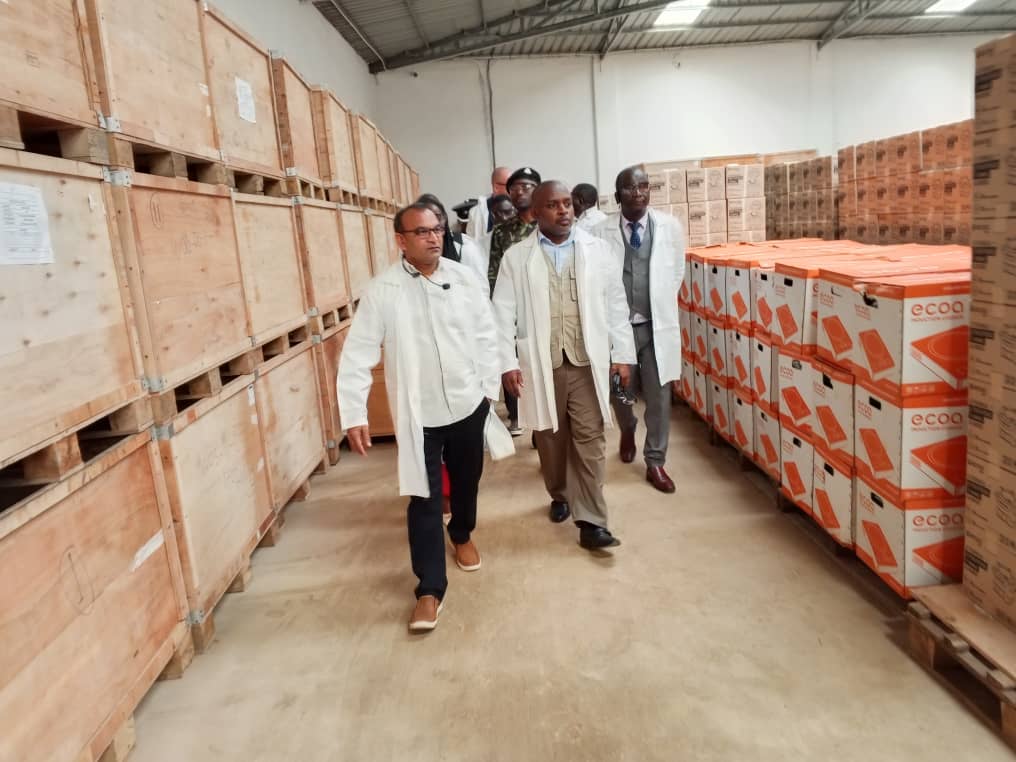
Malawi is using local clean-cooking manufacturing and carbon finance to expand access to more efficient household energy technologies, as the government seeks to translate its climate commitments into interventions that can reduce emissions while lowering energy costs and creating employment. The approach was highlighted on Aug. 12 when senior officials from Malawi’s Ministry of Natural Resources and Climate Change visited BURN Manufacturing’s facility in Njuli, near Blantyre, where the company has distributed more than 166,000 clean-cooking stoves and created 400 local jobs.
The visit, led by Deputy Minister Chipiliro Mpinganjira and Principal Secretary Dr Misheck Yagontha Munthali, placed the clean-cooking sector within a wider discussion about Malawi’s climate policy, industrial development and access to household energy. According to Malawi’s Ministry of Natural Resources, Mpinganjira said the company’s fuel-saving technologies could help address deforestation and carbon emissions while contributing to the local economy.
The development is relevant to Malawi’s updated Nationally Determined Contribution, which targets a reduction in greenhouse-gas emissions of up to 51% by 2040 compared with a business-as-usual trajectory. The target comprises a 6% unconditional reduction and a further 45% reduction conditional on international support and financing.

That distinction is important for understanding the economics of clean cooking in Malawi. The country’s higher climate ambition depends partly on access to external capital and technology, meaning that mechanisms capable of linking international climate finance with household-level interventions could become increasingly important.
Clean cooking is one of those interventions because household energy use sits at the intersection of climate, health, forests and household finances. Malawi remains heavily dependent on traditional biomass for cooking. The United Nations Development Programme has previously estimated that around 90% of the country’s population uses firewood and charcoal for energy and cooking, with implications for health, forests and climate emissions.
For households, the transition is not simply about replacing one stove with another. The economics depend on the price and availability of fuel, the efficiency of the technology, household income and whether the alternative can meet daily cooking requirements. Where cleaner and more efficient stoves reduce fuel consumption, the benefits can appear directly in household expenditure.
A customer visited by the government delegation in Ndirande, Blantyre, provided one example. Margaret Chirwa said the BURN ECOA Char stove reduced her daily fuel expenditure from about $3 to approximately $1 while allowing her to continue preparing three meals a day. She also reported less smoke exposure and fewer coughing problems among her children. Individual experiences cannot by themselves establish the impact of a national programme, but they illustrate why clean cooking occupies a different position from many other climate investments. The technology operates at household level, where energy costs and exposure to indoor air pollution are experienced directly, while the cumulative effect of millions of cleaner stoves can also contribute to national environmental objectives.
BURN’s Malawi operation provides an example of how those different objectives can be combined with domestic manufacturing. Since receiving a Letter of Authorisation from Malawi in September 2024, the company says it has distributed 166,235 clean-cooking stoves and established manufacturing and distribution operations in the country. It is also authorised to generate 3.5 million carbon credits from its Malawi clean-cooking activities, with the credits eligible under the Carbon Offsetting and Reduction Scheme for International Aviation, or CORSIA.
Carbon finance is significant because the upfront cost of expanding clean-cooking programmes can be difficult to recover solely through household sales, particularly in low-income markets. Carbon-credit revenues can potentially provide an additional stream of financing linked to verified emissions reductions, allowing project developers to subsidise technologies or expand distribution.
The model, however, depends on the integrity and durability of the underlying carbon projects. Credits need credible methodologies, monitoring and verification, while programmes must demonstrate that the claimed emissions reductions are real and appropriately accounted for. Malawi’s broader participation in international carbon markets therefore requires institutional capacity alongside private-sector investment.
The country’s NDC framework already identifies climate finance as an important component of implementation. According to the NDC Partnership, Malawi estimates that implementing its climate commitments through 2040 will require about $46.5 billion, including approximately $42 billion for mitigation and $4.5 billion for adaptation. Against that financing requirement, clean cooking represents a relatively decentralised form of climate investment. Rather than depending entirely on large infrastructure projects, programmes can distribute technologies directly to households while building local supply chains around manufacturing, sales, installation, maintenance and monitoring.
The employment component is therefore relevant. BURN’s reported 400 local jobs demonstrate that the clean-cooking market can generate economic activity beyond the point of household consumption. Local manufacturing can also create opportunities for technicians, logistics providers, distributors and other businesses involved in the supply chain.
The technology mix is also evolving. BURN has distributed more than 160,000 biomass stoves in Lilongwe, Mwanza and Blantyre, including units equipped with digital sensors, while piloting electric cooking technologies in Lilongwe and Blantyre. The emergence of electric cooking alongside improved biomass technologies reflects the reality that no single solution is likely to serve every Malawian household. Electricity availability, affordability, appliance costs and local cooking practices will influence adoption. In areas with reliable electricity, electric cooking can provide a pathway away from charcoal and firewood; elsewhere, efficient biomass technologies may remain an important transitional option.
This makes the policy environment particularly important. The government needs to ensure that carbon-financed programmes complement national energy and climate objectives rather than operate as isolated projects. It also needs reliable systems for measuring household adoption, fuel savings and emissions reductions if carbon finance is to remain credible.
Malawi’s experience also reflects a broader African challenge. The continent has a large clean-cooking deficit, with millions of households still dependent on traditional fuels. Addressing that gap requires a combination of public policy, private investment, consumer financing, technology development and international climate finance. The economic case extends beyond emissions. More efficient cooking technologies can reduce household expenditure on fuel, lower pressure on forests and potentially reduce time spent collecting firewood. Local manufacturing can retain some of the value created by the transition within African economies, while carbon markets can provide additional capital for scaling projects.
BURN’s target of distributing 2 million stoves in Malawi by 2030 would represent a substantial expansion from its current deployment. Reaching that level would require continued consumer uptake, manufacturing capacity, distribution networks, supportive regulation and access to carbon and other forms of climate finance.
The government’s engagement with BURN therefore highlights a broader question for Malawi’s climate strategy: how can international climate finance be converted into commercially viable programmes that deliver measurable benefits at household level while supporting domestic economic activity? For Malawi, the answer will depend partly on whether clean cooking can move beyond individual projects and become an integrated component of energy, climate and industrial policy. The country’s 51% emissions-reduction target is conditional in large part on international support, while its households face immediate challenges around energy affordability and access.
The clean-cooking sector sits directly at that intersection. If carbon finance can support credible emissions reductions, local manufacturing can create employment and efficient technologies can reduce household energy costs, the sector offers a practical example of how climate investment can connect environmental objectives with economic realities.
The longer-term test will be whether these benefits can be sustained at scale. For Malawi, expanding clean cooking is ultimately less about the number of stoves distributed than whether households continue using them, whether the technologies remain affordable and effective, whether carbon claims remain credible, and whether the resulting economic and environmental gains can be measured over time.


