


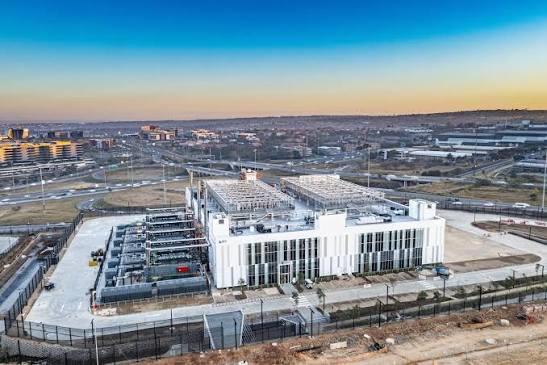
Africa’s data-centre electricity consumption is projected to rise from 2.55 terawatt-hours (TWh) in 2025 to 12.60 TWh by 2035, creating a growing market for power developers and infrastructure investors. However, the ability to convert that demand into bankable electricity sales will depend less on announced data-centre capacity than on tenant occupancy, actual power consumption and existing supply agreements at individual campuses, according to new research by Electron Intelligence.
The Africa Data Centre Power Outlook, released in November 2026, forecasts that electricity consumption will reach 6.95 TWh by 2030 before increasing further to 12.60 TWh in the base case by 2035. The expansion is being driven by cloud adoption, enterprise digitisation and growing requirements to store and process data locally. These trends are increasing the need for reliable electricity supply, placing data-centre operators and power providers under pressure to secure generation, grid connections and backup systems capable of supporting continuous operations.
The report estimates that average facility power demand across Africa will increase from 291 megawatts (MW) in 2025 to 1,438 MW by 2035, while the combined peak power requirement across individual sites is expected to reach 1,598 MW. The figures point to a substantial infrastructure opportunity, but the report cautions that announced information technology capacity should not be treated as an equivalent volume of electricity demand available to independent power producers.

South Africa is expected to dominate the continent’s projected expansion, accounting for 77% of the additional annual electricity consumption by 2035, equivalent to 7.77 TWh. Colocation operators, which provide shared data-centre infrastructure to multiple customers, are expected to account for approximately 90% of Africa’s demand growth over the same period.
The distinction between installed capacity and actual consumption is central to the report’s assessment of investment risk. Across operating facilities in 2025, average IT power draw was less than half of installed IT capacity. This means that near-term electricity demand is likely to grow as existing data halls attract more tenants and increase rack utilisation, rather than simply through the construction of additional buildings.
David Oni, Head of Research at Electron Intelligence, said developers and lenders should assess signed tenant commitments and actual rack loading instead of relying on master-planned campus capacity. The report argues that power infrastructure investment must be based on the electricity volumes facilities are likely to consume and pay for, rather than the maximum capacity they could eventually accommodate.
The development pipeline also presents different investment conditions across African markets. Of the 647 MW in announced additional IT capacity identified by Electron Intelligence, only 337 MW, or 52%, has a scheduled commissioning date by 2035. Even if those scheduled projects are delivered, the continent would require another 583 MW of unannounced IT capacity to meet the base-case demand forecast.
South Africa accounts for approximately 513 MW of this additional capacity requirement, indicating that further data-centre development will be needed to support its projected electricity demand. Kenya presents a contrasting position, with its identified development pipeline already exceeding the country’s forecast 2035 requirement. The difference suggests that developers and power investors cannot apply a uniform investment strategy across the continent. Market-level assessments of existing capacity, planned projects and customer demand will be essential in determining where additional electricity supply is commercially viable.
The cost of delivering reliable electricity is another factor shaping the market. Data centres require continuous power, meaning procurement decisions must account for the total cost of electricity delivered to a facility, including generation, transmission, backup systems and the infrastructure needed to maintain supply during disruptions.
To examine these costs, Electron Intelligence modelled different procurement arrangements for a standard 12 MW IT facility consuming 97 gigawatt-hours annually. In South Africa, supplementing utility electricity and on-site backup with wheeled solar power reduces the modelled cost of electricity by 11.5%, from US$126.78 per megawatt-hour (MWh) to US$112.19/MWh. The arrangement could generate estimated annual savings of approximately US$1.42 million for the facility.
The findings point to an opportunity for renewable energy developers to supply data centres through power purchase agreements and wheeling arrangements. However, the commercial viability of these projects will depend on grid connection capacity, municipal wheeling rules, transmission-use charges and industrial electricity tariffs. Access to renewable generation alone does not guarantee that power can be delivered at a competitive price or under contractual terms suitable for a data-centre operator.
Nigeria presents a different set of procurement economics, particularly for facilities that depend heavily on diesel generation. Electron Intelligence’s 10-year levelised generation cost model estimates standalone pipeline gas at US$144/MWh and compressed natural gas at US$172/MWh, compared with US$496/MWh for continuous diesel generation.
When a full-sized diesel backup plant is included, the modelled costs of gas-based supply increase to between US$200/MWh and US$228/MWh. Even with this backup provision, the arrangements represent a 54% to 60% reduction compared with continuous diesel generation. Where electricity accounts for 40% of a data centre’s operating expenditure, replacing continuous diesel with natural gas could reduce total facility operating costs by between 26.1% and 28.4%.
The potential savings nevertheless depend on reliable gas delivery infrastructure, facility utilisation and the regulatory framework governing electricity supply. Electron Intelligence identifies differences between state and federal electricity licensing in Lagos and Ogun as important considerations for developers. In South Africa, Kenya, Egypt and Morocco, the commercial case for alternative power procurement is shaped by wheeling regulations, transmission charges and industrial tariff structures.
These market differences reinforce the importance of assessing electricity supply at the level of individual facilities. A power project that is commercially attractive in one market may face different infrastructure, regulatory or contractual constraints in another. Beyond procurement costs, the report highlights the financial exposure created when developers commit capital before data-centre operators have secured sufficient customers. Electricity infrastructure serving large campuses can require substantial upfront investment in high-voltage substations, transmission connections and gas pipelines. Unlike generation assets that can sometimes be expanded in stages, some of these shared infrastructure investments cannot be built economically in small increments.
Electron Intelligence’s delayed-growth scenario illustrates the consequences of demand developing more slowly than expected. Under this pathway, Africa’s data-centre electricity consumption reaches 6.44 TWh in 2035, 49% below the base-case projection of 12.60 TWh. The cumulative difference between the two demand pathways over 2026–2035 amounts to 26.6 TWh, with approximately 80% of the shortfall occurring after 2030.
For power developers and lenders, the gap highlights the risk of building infrastructure around projected demand that may not materialise on schedule. Projects could face lower utilisation, delayed revenue and difficulty recovering the cost of dedicated connections or shared infrastructure.
Oni said first-phase power contracts should incorporate minimum purchase obligations, termination protections or options to redirect grid-wheeled electricity to other customers where tenant occupancy falls below expectations. Such provisions could help allocate demand risk between data-centre operators, power suppliers and infrastructure investors.

The report draws on power procurement records covering 177 operating facilities and 29 planned projects, alongside 10-year levelised cost of electricity and operating expenditure models, industrial tariff benchmarks for 2026 and project-level assessments across South Africa, Nigeria, Kenya, Egypt, Morocco, Angola, Côte d’Ivoire and Ghana.
Its findings indicate that Africa’s expanding digital infrastructure market could create significant opportunities for electricity generation, renewable energy procurement and grid investment. But the scale of the opportunity will depend on whether data-centre development translates into occupied facilities with contracted and measurable electricity consumption.
For investors, the distinction is increasingly important. Announced capacity may signal future infrastructure growth, but secured tenants, reliable power delivery and enforceable electricity contracts will determine whether that growth can support bankable energy projects.