


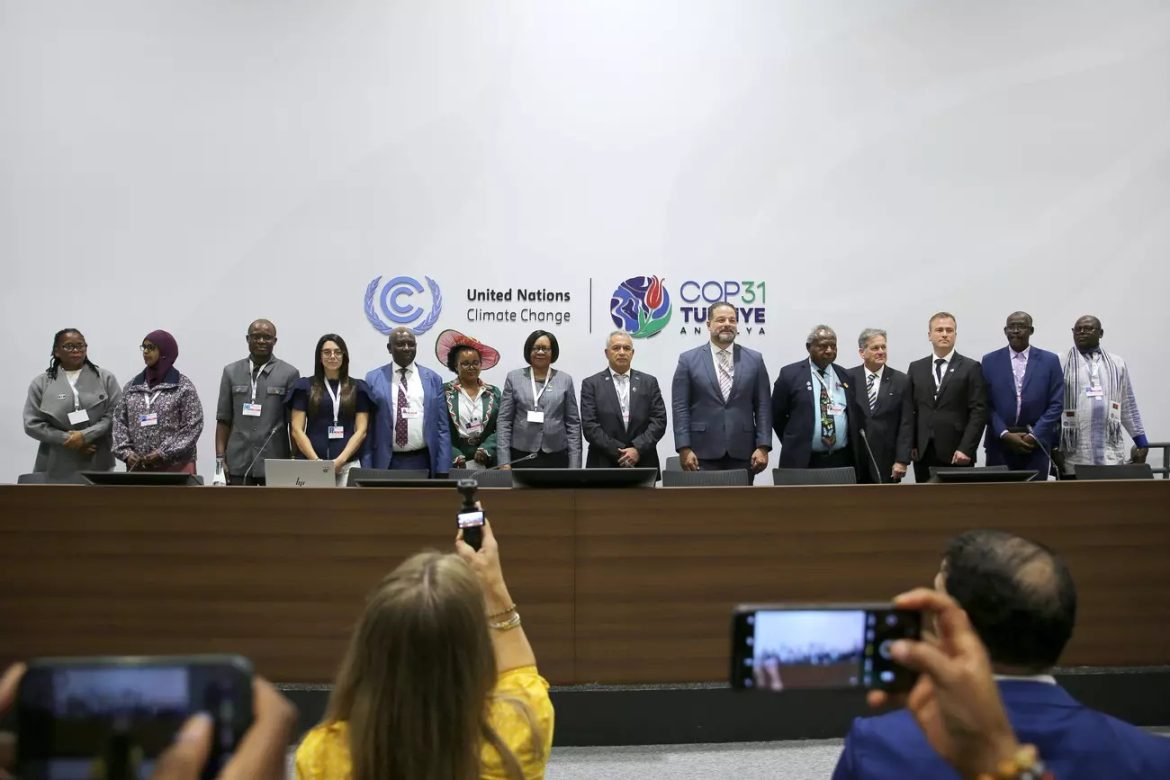
Twenty-five governments have launched the Wildlife for Climate Declaration at COP31 in Antalya, Türkiye, seeking to place the protection and restoration of wild animal populations within national climate strategies as scientific evidence points to wildlife’s role in sustaining carbon-rich forests, grasslands, wetlands and oceans. The initiative, unveiled on November 17, has the backing of 12 African countries, including Kenya, the Democratic Republic of the Congo, Zimbabwe, Zambia, Somalia and Madagascar, giving the continent a prominent role in an effort to connect biodiversity protection with climate mitigation, adaptation and economic resilience.
The declaration calls on parties to the United Nations Framework Convention on Climate Change to recognise wild animals as contributors to functioning natural carbon sinks. It urges governments to address overexploitation, protect and reconnect habitats, reduce pressure on ecosystems through more sustainable food systems, and incorporate wildlife into national climate and biodiversity plans. According to the International Fund for Animal Welfare, this is the first coordinated initiative by a group of governments at a UN climate conference to promote wildlife protection explicitly as part of climate action.
African endorsers include Burkina Faso, Burundi, the Democratic Republic of the Congo, The Gambia, Guinea-Bissau, Kenya, Lesotho, Madagascar, Somalia, Togo, Zambia and Zimbabwe. Their participation is economically significant because many of the continent’s productive sectors depend on ecosystems whose functioning is supported by wildlife. Forests influence rainfall and water flows, wetlands reduce flood risks, grasslands sustain livestock economies, and marine ecosystems underpin fisheries, tourism and coastal livelihoods.

The declaration moves beyond the conventional treatment of wildlife as primarily a conservation or tourism concern. Animals affect the capacity of natural systems to absorb and retain carbon through grazing, predation, seed dispersal, nutrient cycling and the modification of soils and sediments. Degradation of wildlife populations can therefore weaken ecological processes on which climate resilience and economic activity depend on.
The African forest elephant provides one of the clearest regional examples. By trampling smaller vegetation and dispersing seeds, elephants can create conditions in which larger, slower-growing and more carbon-dense trees thrive. According to the declaration’s supporting material, Congo Basin forests with elephants store about 7% more carbon than comparable forests without them. For countries in Central Africa, the loss of elephant populations could consequently affect not only biodiversity and tourism income but also the long-term integrity of forests increasingly presented as strategic assets in global carbon markets and climate-finance negotiations.
Research cited by the initiative estimates that protecting and restoring functional populations of nine terrestrial and marine wildlife groups could increase global carbon dioxide uptake by about 6.4 gigatonnes annually. The estimate comes from a 2023 study published in Nature Climate Change and illustrates the potential scale of the contribution, although converting ecological capacity into measurable climate outcomes will require stronger monitoring, credible baselines and safeguards against double counting.
More than 350 scientists from 47 countries have also supported a scientific consensus calling for governments to account explicitly for wild animals and their ecological functions in climate policies. That position challenges climate-planning systems that measure forests, wetlands and oceans largely through vegetation cover or stored carbon without assessing whether the animal populations required to maintain those ecosystems remain intact.
For African governments, implementation would require coordination across institutions that often operate separately. Environment ministries oversee wildlife and protected areas, while agriculture, forestry, fisheries, water and finance ministries manage sectors whose policies can determine the condition of the same ecosystems. Incorporating wildlife into nationally determined contributions, national adaptation plans and biodiversity strategies would require these agencies to share data, align investment priorities and establish consistent systems for measuring ecological and economic results.
The financing challenge will be substantial. Many African conservation authorities operate with constrained budgets, while protected areas face pressure from agricultural expansion, infrastructure development, illegal wildlife trade and conflicts between communities and animals. Governments must also balance ecological protection with demands for land, food production, energy access and employment. Unless climate finance covers these implementation costs and supports communities living alongside wildlife, the declaration risks remaining detached from the fiscal and social conditions shaping land-use decisions.
Zimbabwe’s environment, climate and wildlife minister, Evelyn Ndlovu, said the loss of wildlife also removes ecological processes that keep natural systems functioning. She described protection and restoration as climate measures and said Zimbabwe was prepared to cooperate with other governments in advancing the declaration.
The practical implications are particularly relevant in landscapes where communities bear the costs of conservation through crop losses, livestock predation or restrictions on access to land and natural resources. An effective climate framework would need to direct finance towards locally managed conservation, compensation arrangements, habitat connectivity and livelihood systems capable of reducing pressure on wildlife. Without credible benefit-sharing, the economic value attributed to ecosystems at the international level may not translate into incentives for the people responsible for maintaining them.
The initiative could also affect African participation in carbon and nature markets. Wildlife-related ecological functions may strengthen the integrity of forest and landscape projects, but they also add complexity to measurement and verification. Regulators and investors would need standards that distinguish scientifically supported climate benefits from projects that use biodiversity claims without demonstrating additional ecological outcomes.
Matt Collis, senior policy director at the International Fund for Animal Welfare, said the test would be whether political recognition leads to changes in national climate plans, investment and implementation. The declaration itself is not binding, and its impact will depend on whether governments establish funded programmes, regulatory measures and measurable responsibilities after COP31.

The initiative arrives as African negotiators press for more accessible adaptation finance and greater investment in ecosystems as natural infrastructure. At Africa Day during COP31, the African Union linked the protection of forests, wetlands, drylands, islands and coastal areas with water security, livelihoods and economic resilience. It also called for more predictable financing for adaptation and ecosystem-based approaches as the continent prepares for COP32 in Addis Ababa in 2027.
The Wildlife for Climate Declaration broadens that agenda by arguing that protecting habitats is insufficient if the animal populations that help those habitats function continue to decline. For African states, the central question is whether this recognition can produce investment that strengthens conservation institutions, supports communities and protects natural assets without adding administrative burdens to already constrained public systems.
Its significance will ultimately be measured through national budgets and land-use decisions rather than conference language. If wildlife protection is incorporated into climate planning with credible science, community safeguards and accessible finance, it could strengthen the resilience of ecosystems that support African agriculture, water systems, tourism and rural employment. Without those mechanisms, the declaration will have limited influence over the economic pressures driving habitat loss and species decline.


