


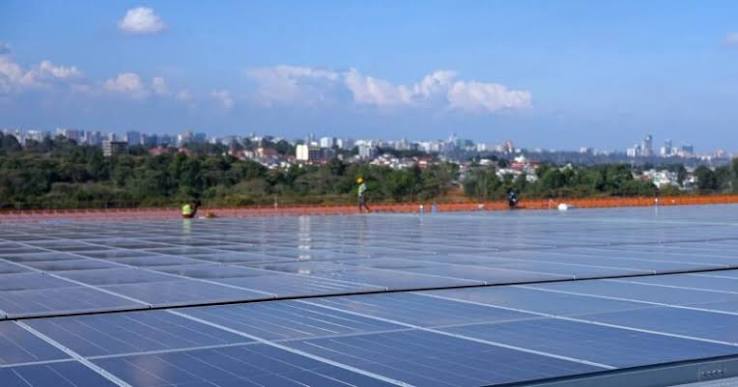
The installation provides a practical test of how African governments can integrate distributed renewable energy into major public infrastructure rather than treating clean power as a separate investment. Large convention centers carry substantial electricity requirements, from lighting and ventilation to audiovisual equipment, catering and communications systems, making the long-term cost and reliability of power an important part of their operating economics.
According to The Star, Acting Bomas of Kenya Chief Executive John Okidiang said the solar panels are expected to generate 3.5 MW, while battery storage will allow electricity produced during daylight hours to support different facilities within the complex. “We are going to generate 3.5 megawatts from the solar panels that are placed here, and we have sufficient storage for them,” Okidiang said.
That combination is significant. Solar generation alone can lower the amount of electricity a large facility draws from the grid during daylight hours, while storage gives operators greater flexibility over when that electricity is used. A separate project report said the solar-and-battery installation could store excess generation for evening use or during grid interruptions, providing an alternative to relying exclusively on conventional backup generation.

The scale of the energy system reflects the considerably larger footprint of the redeveloped Bomas complex. People Daily reported on November 16 that the facility covers more than 323,500 square metres and will include an 11,000-delegate convention arena, 35 meeting rooms, a 5,000-seat main auditorium, a 3,500-seat secondary hall, a 3,000-guest banquet hall and a presidential pavilion. The report put the project’s cost at KSh42 billion and said final interior works, external works and access roads were under way ahead of a December 2026 completion deadline.
The project’s price tag has also attracted scrutiny, underlining the importance of assessing its sustainability features alongside the wider economics of the development. A separate People Daily report cited a construction contract of about KSh41.9 billion and said subsequent reports had placed the overall cost at approximately KSh45.1 billion.
For public infrastructure of this scale, the relevant financial question is therefore not simply how much renewable capacity is installed, but whether that investment reduces operating expenditure and energy risk sufficiently over the life of the asset. The eventual savings will depend on factors including actual electricity consumption, battery capacity and degradation, maintenance costs, tariffs and the proportion of on-site solar generation that can be consumed directly.
The architecture has also been adapted to accommodate the renewable-energy system rather than treating the panels as an addition after construction. Kenya Defence Forces project officer Lieutenant Colonel Wilfrida Amondi said the design is based partly on the flat canopy of an acacia tree, with the broad roof providing space for solar panels. The facility will include an auditorium, convention hall, ballroom, meeting rooms and presidential area, alongside interpretation and teleconferencing infrastructure.
This matters beyond the Bomas complex because many of Africa’s cities are simultaneously confronting rising power demand, pressure on electricity infrastructure and the high capital requirements of urban expansion. Hospitals, universities, airports, offices, hotels and conference facilities are long-lived assets. Decisions made during construction can lock their energy consumption patterns and operating costs in for decades.
Distributed solar generation and storage offer one route for institutions to manage part of that exposure. At Bomas, the approach also illustrates how renewable electricity can increasingly become an infrastructure design consideration rather than a stand-alone climate project.
The commercial implications are particularly relevant for Kenya. The Bomas development is intended to expand Nairobi’s capacity in the meetings, incentives, conferences and exhibitions market, where reliable electricity, digital connectivity and operating efficiency are part of the infrastructure required to compete for international events.
The economics remain important, however. Public infrastructure expenditure must ultimately be weighed against alternative demands on government resources, while green design features do not by themselves establish value for money. The Bomas project’s capital cost has already become part of a broader debate over its scale. That means its solar installation will eventually need to be judged on measurable outcomes such as electricity generated, peak demand reduced, operating costs avoided and the performance of its battery system, rather than installed capacity alone.

The development nevertheless reflects a wider shift in Africa’s energy transition. Renewable technologies are increasingly being considered not only for expanding national generation capacity, but also for managing the operating economics of individual buildings and institutions.
For African governments facing tight fiscal space and large infrastructure deficits, that distinction matters. Integrating solar generation, storage and energy efficiency when major assets are designed can reduce their exposure to future electricity costs, but only where the additional capital expenditure is matched by credible maintenance, performance monitoring and lifecycle planning.
Bomas will therefore offer a useful case study. Its 3.5 MW solar system is relatively small compared with utility-scale power projects, but the significance lies in where the electricity will be produced and consumed: inside a major publicly backed urban infrastructure asset.
If the system delivers reliable generation and demonstrable operating savings, the lesson for other African infrastructure projects will be less about the size of the solar array than about designing energy resilience into public investment from the outset.


