

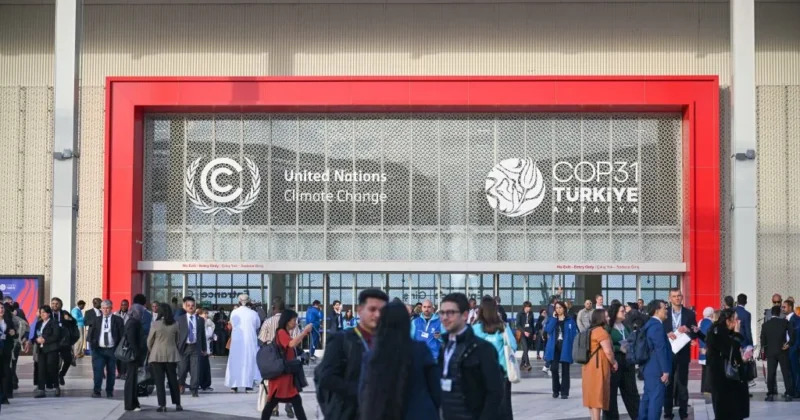
The COP31 negotiations in Antalya, Türkiye, ended without a major political agreement after disagreements over fossil fuel language and climate finance exposed persistent divisions between countries on the pace and financing of global climate action. The negotiations, which extended beyond their scheduled Friday conclusion into Sunday, produced a final text that drew objections from the European Union, Pacific island nations and developing countries concerned about the absence of explicit fossil fuel commitments and measurable adaptation finance provisions.
The outcome underscores the growing difficulty of translating international climate commitments into negotiated action as countries contend with worsening climate impacts, competing energy priorities and disagreements over the distribution of financial responsibilities. It also places renewed pressure on the international climate process following the COP28 commitment to transition away from fossil fuels and subsequent discussions on scaling finance for climate adaptation.
The absence of an agreed political text marked the first time since COP15 in Copenhagen in 2009 that a UN climate summit failed to adopt its overarching political agreement. The breakdown followed negotiations that continued nearly two days beyond their scheduled close, as delegations attempted to reconcile positions on fossil fuel transition, climate finance and the scope of the final decision.

At the centre of the dispute was the final draft presented to delegates in the early hours of Sunday. The text contained no direct reference to coal, oil or natural gas, nor a specific commitment to phase out fossil fuels. Instead, it included an indirect reference to the outcome of COP28 in Dubai, where countries agreed to transition away from fossil fuels in energy systems. That language had become a key point of contention in the negotiations, with countries divided over whether the Antalya decision should reinforce, accelerate or avoid explicitly restating the commitment.
The European Union rejected the proposed outcome, arguing that the omission undermined the ambition required to address climate change. Irish Minister Darragh O’Brien, representing the bloc, said the agreement did not go far enough, while countries including Panama and the Marshall Islands also criticised the draft over its limited response to the pace of global warming. The objections reflected a broader position among climate-vulnerable countries that the final text should contain a clearer pathway for reducing dependence on fossil fuels.
The disagreement had intensified as successive draft texts evolved during the conference. An earlier version contained multiple references to fossil fuels and options for strengthening the commitment made in Dubai. Those references were subsequently removed as negotiators attempted to secure consensus among nearly 200 participating countries. Oil-producing nations had opposed language that could establish stronger international pressure to reduce fossil fuel use, while other delegations argued that the agreement should preserve the direction established under previous climate decisions.
Saudi Arabia’s delegation defended the position of oil-producing countries, arguing that Arab states accounted for a limited share of historical greenhouse gas emissions and had participated in the negotiations in good faith. Russia also cautioned against what it described as overly rapid shifts away from fossil fuels, arguing that energy transitions should account for affordability and the risk of fuel poverty. These competing positions contributed to the difficulty of securing language acceptable to all parties.
The dispute over fossil fuels was accompanied by disagreements over financing for climate adaptation in developing countries. Adaptation finance is intended to support investments that help countries manage the effects of climate change, including flooding, drought, heat stress, coastal erosion and changing agricultural conditions. Many developing nations have argued that financial commitments from wealthier countries remain insufficiently defined and difficult to track.
At COP30 in Brazil, countries agreed to triple adaptation finance, but the COP31 draft did not establish a quantified delivery pathway, a clearly defined baseline or specific financial milestones to assess progress. The omission raised concerns among developing countries that the commitment could remain difficult to measure and enforce. Delegates from poorer countries had sought clearer financial obligations and mechanisms for monitoring delivery, particularly as climate impacts increasingly affect infrastructure, food production, livelihoods and public finances.
Mohamed Adow of Power Shift Africa criticised wealthy countries for failing to provide more concrete financial commitments, arguing that governments responsible for significant emissions should not continue arriving at climate negotiations without adequate resources to support vulnerable nations. The finance dispute reflected wider concerns about the relationship between climate responsibility, development priorities and the capacity of lower-income countries to respond to escalating climate risks.
The absence of a clear financing framework also carries implications for African governments, many of which are simultaneously pursuing economic development, infrastructure expansion, energy access and climate resilience. Adaptation investments in agriculture, water systems, urban infrastructure, transport, health and coastal protection often require sustained public expenditure and concessional financing. Without predictable international support, governments may face greater pressure to finance climate resilience through domestic budgets, borrowing or competing development programmes.
The negotiations were further complicated by the structure of the conference leadership. While Türkiye hosted the talks in Antalya, Australia led the official negotiations, a dual arrangement that observers said contributed to coordination challenges during the final stages. Australian Climate Minister Chris Bowen, who served as president of negotiations, described the discussions as taking place in an exceptionally difficult geopolitical environment, with countries maintaining positions that could not be reconciled.
The political impasse unfolded against a worsening climate outlook. COP31 was the first annual UN climate conference to formally address the prospect that the Paris Agreement’s 1.5°C warming threshold would be exceeded. The 2015 agreement established the objective of limiting global temperature increases to well below 2°C, while pursuing efforts to keep warming to 1.5°C above pre-industrial levels. However, national emissions reduction commitments remain insufficient to guarantee that the lower threshold will be achieved.
The prospect of overshooting 1.5°C has increasingly shifted climate discussions towards the consequences of exceeding the target, including the possibility of more severe climate impacts and the need for adaptation, resilience and potential temperature reversal strategies. COP31’s failure to establish a new overarching agreement leaves questions about how countries will collectively respond to that trajectory and whether existing commitments can be strengthened through national policies, sectoral initiatives and bilateral cooperation.
The breakdown also highlighted the continuing influence of geopolitical and economic considerations on international climate negotiations. Fossil fuel-producing economies continue to emphasise energy security, affordability and the role of hydrocarbons in economic development, while climate-vulnerable countries and advocates for stronger mitigation argue that continued reliance on fossil fuels increases the risks they face. Climate finance has emerged as another dividing line, with developing countries seeking greater certainty over funding while wealthier nations face domestic fiscal pressures and competing priorities.

Despite the failure to reach a political agreement, the conference was not without progress in other areas of climate cooperation. Negotiations and initiatives outside the overarching political decision continued across adaptation, energy transition, implementation, climate finance and other areas. However, the absence of a consensus text means that the summit did not deliver the broad political signal that many countries had sought to reinforce commitments made at previous COP meetings.
For Africa, the outcome leaves two interconnected challenges. The first is the uncertainty surrounding international support for adaptation, particularly for countries exposed to drought, flooding, heat and agricultural disruption. The second is the continuing debate over energy transition pathways, as African economies seek to expand electricity access, develop industrial capacity, attract investment and reduce emissions while navigating different national energy resources and economic priorities.
The failure to reach an agreement in Antalya also raises questions about the effectiveness of consensus-based climate negotiations in a period of increasingly divergent economic, political and energy interests. While the Paris Agreement and previous COP decisions remain the foundation of international climate cooperation, the inability to secure a new overarching decision highlights the gap between agreed ambitions and the political conditions required to advance them.
The outcome places greater emphasis on implementation beyond the negotiating rooms, including national climate policies, investment decisions, technology deployment, adaptation programmes and financing arrangements. Whether these efforts can collectively accelerate climate action will remain a central question as countries move towards the next round of international climate negotiations