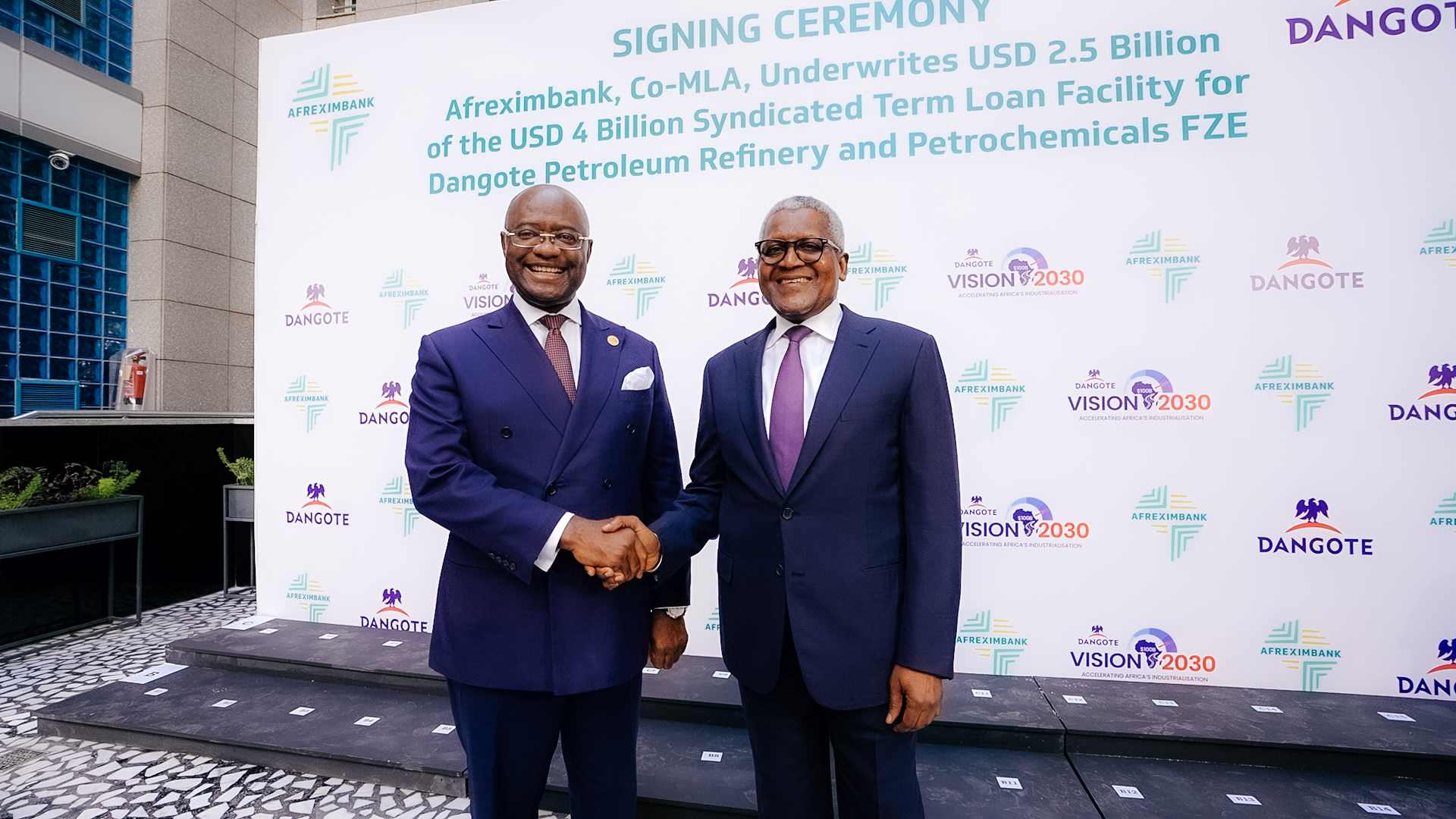

A deepening collaboration between the African Export-Import Bank and the Dangote Group is emerging as a defining test of how African financial institutions and industrial companies can jointly mobilise large-scale capital to expand production capacity across energy, agriculture and manufacturing, as the conglomerate targets annual revenues of US$100 billion by 2030 amid rising demand for locally produced fuels and industrial inputs across the continent.
The partnership moved into a new phase in late March with the underwriting of a US$2.5 billion facility as part of a broader US$4 billion syndicated term loan supporting the Dangote Petroleum Refinery and Petrochemicals, currently the largest refining complex in Africa with a capacity of about 650,000 barrels per day. The financing is intended to consolidate existing debt and strengthen the refinery’s financial position as operations scale up following the start of commercial production in early 2024.
The transaction coincides with the presentation of Dangote Group’s long-term expansion strategy, which outlines a two-phase growth programme spanning the remainder of the decade. Central to the plan is a significant increase in refining capacity to approximately 1.4 million barrels per day, alongside a fourfold expansion in fertiliser production from three million tonnes to 12 million tonnes annually.
The strategy also identifies new investments in logistics infrastructure, including pipelines and port facilities, as well as power generation, mining and data centres to support industrial operations and digital services.
Executives estimate that implementing the expansion programme will require at least US$40 billion in new investment over the next five years, placing the partnership with Afreximbank at the centre of efforts to secure long-term financing for projects that carry both commercial and strategic importance.
Since 2015, the bank has invested roughly US$15 billion in Dangote Group ventures, positioning the relationship as one of the largest sustained collaborations between a regional development finance institution and a private industrial group in Africa.
Read also: Morocco resets LNG strategy, signalling shift towards flexible gas investment models in Africa
Energy security remains a central driver of the investment strategy. Many countries across West and Central Africa continue to import refined petroleum products despite producing crude oil domestically, exposing national budgets to foreign exchange volatility and supply disruptions.
Expanding regional refining capacity is widely viewed by policymakers as a way to stabilise fuel supply chains, reduce import dependence and improve balance-of-payments positions, particularly during periods of global market disruption.
The refinery supported by Afreximbank is expected to supply refined fuels to multiple regional markets, potentially easing pressure on public finances in importing countries where fuel purchases account for a significant share of foreign currency expenditure.
Reliable access to refined petroleum products also supports transport systems, manufacturing activity and electricity generation, all of which depend on stable fuel supply to maintain economic output and manage inflationary pressures.
The planned expansion in fertiliser production carries parallel implications for agricultural productivity and food systems. Fertiliser availability remains uneven across several African markets, with supply shortages and price volatility contributing to lower crop yields and higher food prices.
Increasing domestic manufacturing capacity could reduce exposure to international supply disruptions while strengthening regional supply chains for essential agricultural inputs. The scale of these benefits will depend on distribution infrastructure, regulatory oversight and cross-border trade arrangements within regional markets.

The collaboration also reflects a broader shift in the financing landscape for large industrial projects on the continent. Historically, major infrastructure and manufacturing investments relied heavily on foreign lenders and export credit agencies.
Regional financial institutions are increasingly stepping into a leadership role in structuring complex transactions, particularly as global capital markets become more selective and borrowing costs remain elevated. This evolution is strengthening the capacity of African institutions to mobilise capital internally while retaining greater economic value within domestic markets.
The financing model underpinning the Afreximbank–Dangote partnership illustrates how development finance institutions are adapting to fiscal constraints faced by many governments. Public debt levels have risen across several African economies in recent years, limiting the ability of states to fund large infrastructure projects directly from national budgets.
Leveraging private investment supported by regional banks allows industrial expansion to proceed while distributing financial risk across multiple stakeholders, reducing pressure on sovereign balance sheets.
Infrastructure integration is another defining feature of the partnership. Large industrial operations require reliable transport networks, stable power supply and efficient logistics systems to remain competitive. Investments in pipelines, ports and energy infrastructure are therefore being designed to support production capacity while improving connectivity between industrial hubs and regional markets.
Such integration is expected to play an increasingly important role in supporting intra-African trade under the African Continental Free Trade Area, particularly in sectors where supply chains depend on timely delivery of fuel, fertiliser and industrial materials.
Read also: TotalEnergies’ Deep Water Orange Basin Oil Project under judicial scrutiny following eco-legal case
The scale of Dangote Group’s expansion plans also underscores the importance of regulatory stability and predictable market conditions. Investors and lenders typically require clear policy frameworks governing pricing, taxation and environmental compliance before committing capital to long-term projects.
Delays in approvals or changes in regulatory rules can increase project costs and discourage further investment, highlighting the need for coordinated planning between governments, financial institutions and private sector operators.
The significance of the collaboration extends beyond the immediate financing transaction. By combining regional capital mobilisation with private sector execution, the partnership is shaping a model for industrial development that aligns commercial investment with broader economic priorities, including energy security, food production and trade competitiveness.
Engage with us on LinkedIn: Africa Sustainability Matters