


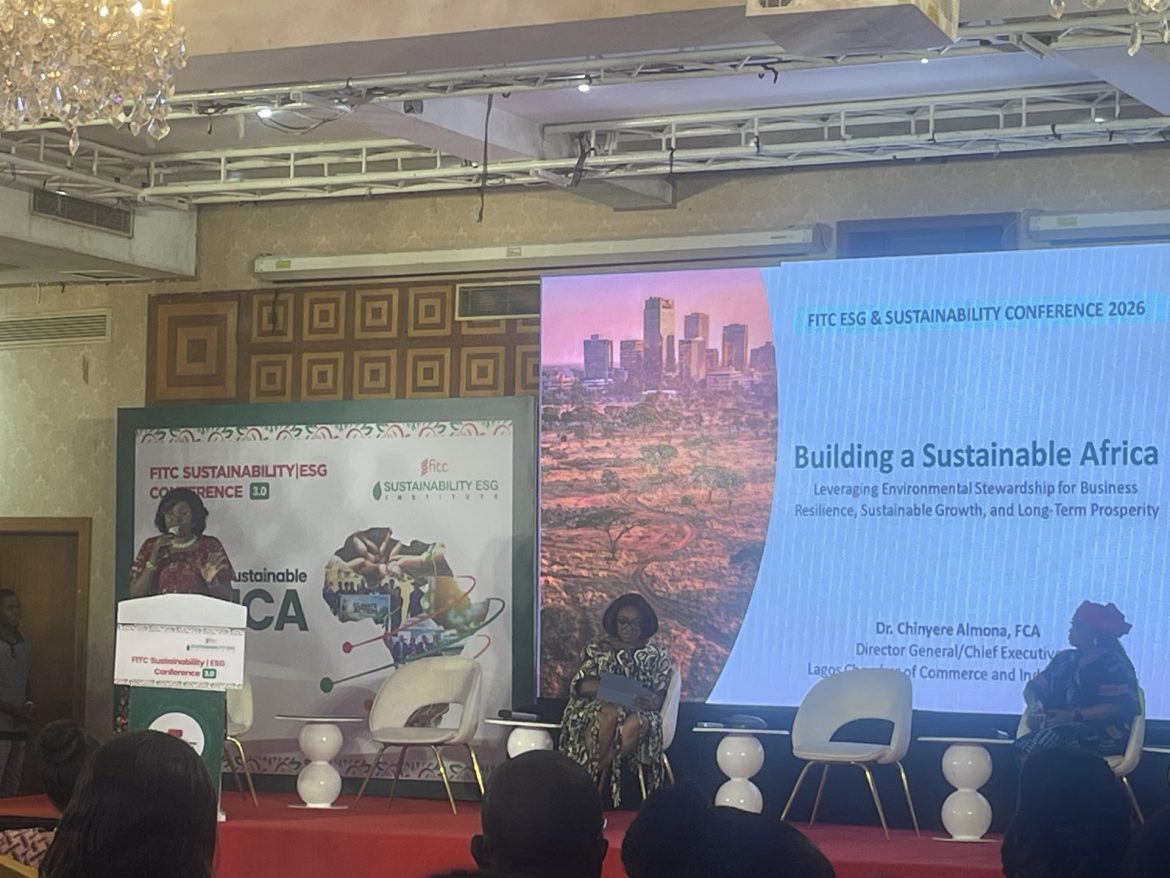
African businesses should reposition sustainability from a regulatory obligation to a long-term investment strategy as climate risks, tightening environmental disclosure requirements and changing investor expectations increasingly shape corporate competitiveness, according to Chinyere Almona, Director General of the Lagos Chamber of Commerce and Industry (LCCI). Speaking at the FITC Sustainability and ESG Conference 3.0 in Lagos, Almona argued that environmental resilience has become inseparable from financial performance, urging businesses to integrate sustainability into core corporate strategy to strengthen operational resilience and improve access to capital.
Her remarks come as businesses across Africa face mounting pressure from climate-related disruptions, evolving global sustainability standards and investor demand for credible Environmental, Social and Governance (ESG) performance. According to Almona, extreme weather events, rising temperatures, supply chain disruptions and geopolitical uncertainty are no longer peripheral risks but factors directly affecting production, infrastructure, operating costs and long-term business continuity. She pointed to recent flooding in Lagos as an example of how climate events can interrupt commercial activity, damage physical assets and increase costs for both the private sector and public institutions.
 The growing financial significance of climate risk reflects broader changes in global capital markets. Investors, lenders and development finance institutions are placing increasing emphasis on climate resilience, emissions management and governance standards when assessing corporate performance and investment opportunities. Companies that fail to demonstrate credible sustainability strategies may face higher financing costs, reduced investor confidence and greater difficulty accessing international capital markets. As sustainability reporting frameworks become more widely adopted, African firms seeking to participate in global value chains are likely to encounter stronger disclosure requirements from customers, financiers and regulators.
For African economies, these developments create both challenges and opportunities. Although the continent contributes less than four per cent of global greenhouse gas emissions, it remains among the regions most exposed to the economic consequences of climate change. Agriculture, energy systems, transport infrastructure and urban development are increasingly vulnerable to droughts, floods and changing weather patterns, placing additional pressure on public finances and private investment. According to Almona, these vulnerabilities also position Africa to play a larger role in the global transition towards low-carbon development by leveraging its renewable energy resources, agricultural potential and reserves of critical minerals required for clean energy technologies.
The business case for sustainability is becoming increasingly operational rather than reputational. Improving energy efficiency, reducing material waste, optimising water consumption and adopting cleaner technologies can lower production costs while improving resource productivity. These operational gains are particularly important in African markets where businesses frequently contend with high energy prices, infrastructure deficits and supply chain volatility. Integrating sustainability into business planning can therefore strengthen profitability while reducing exposure to climate-related disruptions.
The transition also has implications for industrial policy and economic competitiveness. Countries seeking to expand manufacturing, mineral processing and agricultural exports will increasingly need to demonstrate compliance with international sustainability expectations. European carbon border measures, corporate due diligence legislation and global sustainability disclosure standards are reshaping market access requirements for exporters, making environmental performance an increasingly important determinant of trade competitiveness. Businesses that invest early in emissions reduction, resource efficiency and transparent ESG reporting may therefore be better positioned to secure international contracts and attract long-term investment.
According to Almona, sustainability should not remain confined to compliance departments or corporate reporting functions. Instead, it should be embedded into governance structures, investment decisions and operational planning. Measuring environmental performance, investing in green technologies and strengthening corporate governance can improve business resilience while supporting broader economic transformation. She also emphasised that stronger collaboration between governments, businesses, investors and civil society will be necessary to accelerate Africa’s sustainability transition and address infrastructure and environmental constraints that individual organisations cannot resolve independently.
The importance of coordinated action is growing as African governments pursue industrialisation alongside climate commitments. Public investment in renewable energy, transport infrastructure, water systems and climate adaptation will require significant private sector participation. Businesses that align investment strategies with these priorities may benefit from emerging financing opportunities linked to sustainable infrastructure, climate adaptation and green industrial development. At the same time, policymakers face the challenge of creating regulatory environments that encourage investment while maintaining competitiveness across key sectors of the economy.
 For Africa, the sustainability transition increasingly represents an economic development agenda rather than solely an environmental objective. Building resilient infrastructure, improving energy efficiency and strengthening governance can enhance productivity, attract investment and reduce long-term fiscal risks associated with climate impacts. As global markets continue integrating climate considerations into investment and trade decisions, sustainability is becoming a central determinant of business performance, capital allocation and economic resilience.
Almona’s remarks underscore a broader shift taking place across African markets, where sustainability is increasingly viewed as a strategic component of corporate competitiveness. Businesses that integrate environmental performance into long-term investment planning are likely to be better positioned to manage operational risks, strengthen investor confidence and participate more effectively in an increasingly sustainability-driven global economy.


