


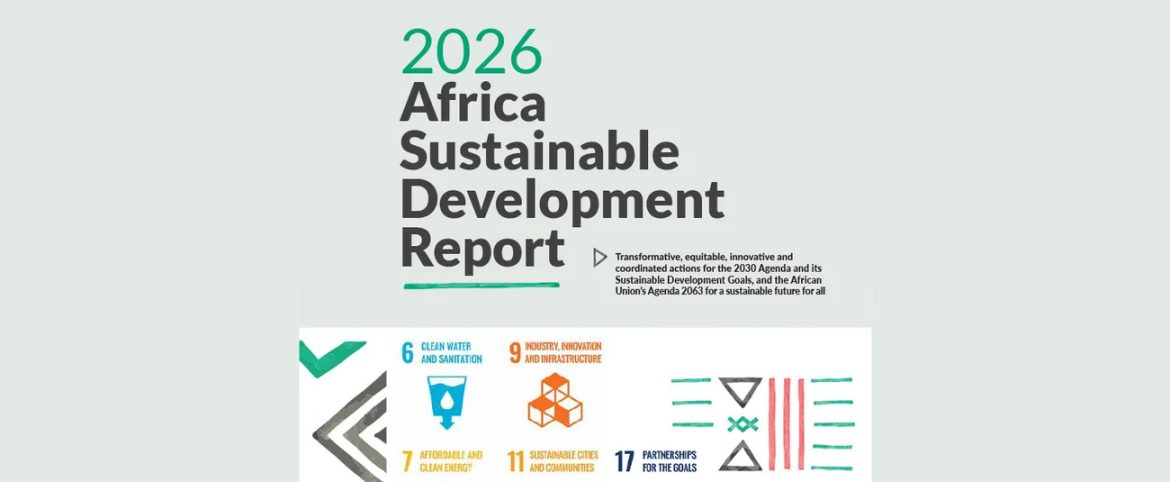
Africa has made measurable progress towards the Sustainable Development Goals, but the continent remains off the pace required to meet the 2030 targets, with financing shortages, debt pressures, climate shocks, weak institutional capacity and infrastructure gaps continuing to constrain development. The warning comes from the 2026 Africa Sustainable Development Report (ASDR), jointly produced by the African Union Commission (AUC), African Development Bank (AfDB), United Nations Development Programme (UNDP) and United Nations Economic Commission for Africa (ECA), which calls for more integrated investment and coordinated implementation across five areas critical to Africa’s structural transformation.
The report, launched in New York on July 15 on the margins of the 2026 High-Level Political Forum, is the ninth edition of the ASDR, which has been published annually since 2017. It remains the only report that systematically tracks Africa’s implementation of both the United Nations 2030 Agenda and the African Union’s Agenda 2063, providing a combined assessment of the continent’s progress towards global and regional development objectives.
The 2026 assessment focuses on Sustainable Development Goals 6, 7, 9, 11 and 17, covering water and sanitation, energy, industry and infrastructure, sustainable cities, and partnerships. The selection reflects the interconnected foundations of economic transformation: reliable water and energy systems, productive infrastructure, industrial capacity, resilient urban economies and the financial and institutional partnerships required to deliver them.
The report finds that Africa has recorded progress in 12 of the 17 SDGs, but the overall trajectory remains insufficient to achieve the goals by 2030. Financing shortfalls, limited institutional capacity and repeated climate and economic shocks have slowed progress and, in some areas, reversed earlier gains. The findings point to a development challenge that is increasingly less about the absence of policies and more about the ability of governments and institutions to finance, implement and monitor those policies at scale.
Water and sanitation illustrate the scale of the gap. Basic drinking-water access reached an estimated 81% of Africa’s population by 2023, but access to safely managed drinking water rose only from about 33% in 2015 to approximately 36% in 2023. Safely managed sanitation increased from roughly 24% to 30% over the same period, leaving an estimated 650 million people without basic sanitation services. The report also finds that only about one-third of domestic wastewater is safely treated across the continent.
Energy access remains an equally significant constraint on economic development. Electricity access increased from approximately 46% in 2015 to 53% in 2023, but nearly 600 million Africans still lacked electricity. Clean cooking access was even weaker, with only about 34% of the population using clean fuels and technologies in 2023. More than 970 million people remained dependent on traditional biomass and other polluting fuels.
The investment gap is particularly important. The report estimates annual investment in energy access at around $4 billion, substantially below what is required to achieve SDG 7 by 2030. Africa’s renewable energy capacity per capita was approximately 40 watts in 2023, compared with almost 480 watts globally, highlighting the distance between the continent’s renewable resource potential and the infrastructure required to convert it into affordable electricity.
The infrastructure and industrialisation picture is similarly uneven. Digital connectivity has advanced more rapidly than other elements of SDG 9, with 92.8% of Africa’s population covered by at least one 2G network in 2023. Yet manufacturing value added remains below 11% of GDP, compared with more than 16% globally. Infrastructure gaps in transport, energy and logistics continue to raise production and trade costs, while fewer than 20% of small-scale industries in many countries report access to formal credit.
This has direct implications for employment and structural transformation. Without stronger industrial capacity, infrastructure and access to finance, economic growth may struggle to generate enough productive employment for Africa’s rapidly expanding working-age population. The report therefore links progress on infrastructure and innovation with the broader need to create productive enterprises capable of integrating African workers and firms into regional and global value chains.
Urbanisation presents another pressure point. Approximately 45% of Africa’s population currently lives in urban areas, with the share projected to approach 60% by 2050. Yet an estimated 49.1% of urban residents lived in slums or informal settlements in 2022. Floods, heatwaves and other climate-related hazards are increasingly affecting cities, particularly vulnerable informal settlements, while inadequate data and weak coordination complicate urban planning.
The fiscal dimension cuts across all five goals. The report estimates that African countries have average tax-to-GDP ratios of around 16%, compared with more than 34% in OECD countries. More than 20 African countries are assessed as being at high risk of or already in debt distress, limiting the fiscal space available for investment in infrastructure, social services and climate resilience.
External financing is also becoming less predictable. The ASDR notes that net official development assistance could decline by between 9% and 17%, depending on the scenario, potentially reducing flows by as much as $35 billion from 2024 levels. Africa also accounts for less than 3% of global trade, while access to advanced technologies remains uneven. These pressures strengthen the case for improving domestic revenue mobilisation while securing more predictable and affordable international development finance.
The report consequently argues that incremental and fragmented interventions will not be sufficient. It calls for national development plans to be better aligned with continental and global agendas, stronger implementation capacity, clearer accountability and more rigorous monitoring, evaluation and learning systems. It also identifies regional cooperation as an important mechanism for achieving economies of scale in energy, infrastructure, trade and industrialisation.
This emphasis on implementation was reflected in remarks by ECA Executive Secretary Claver Gatete, who said Africa was at a decisive moment with less than five years remaining to achieve the SDGs. African Union Commission Deputy Chairperson Ambassador Selma Malika Haddadi similarly stressed the need to treat Agenda 2063 and the 2030 Agenda as complementary frameworks rather than separate development tracks.
For development finance institutions, governments and private investors, the report’s implications are practical. Closing Africa’s development gap will require more bankable infrastructure projects, stronger public investment management, improved domestic resource mobilisation, better data systems and financing structures capable of absorbing long-term capital. The report specifically highlights the importance of concessional finance, climate finance and long-term development capital, alongside debt sustainability measures, to restore fiscal space for investment.
The findings also place greater weight on regional integration. Cross-border energy systems, transport infrastructure and regional value chains can reduce duplication, expand markets and improve the economic returns of infrastructure investment. The African Continental Free Trade Area provides a framework through which stronger productive capacity and regional connectivity could translate into greater intra-African trade and industrialisation.
For Africa, the 2026 ASDR is therefore less a scorecard than a warning about the narrowing window for implementation. Progress remains possible, but the evidence suggests that the continent cannot rely on isolated projects or incremental improvements to close the gap before 2030. The central issue is increasingly one of execution: whether governments, development institutions and private-sector partners can align finance, institutions, data and regional cooperation around projects that produce measurable development outcomes.
With less than four years remaining to 2030, the report places a sharper question before African policymakers and their partners: not whether the continent has the right development frameworks, but whether those frameworks can now be translated into infrastructure, jobs, reliable services, climate resilience and productive investment at the scale required.


