


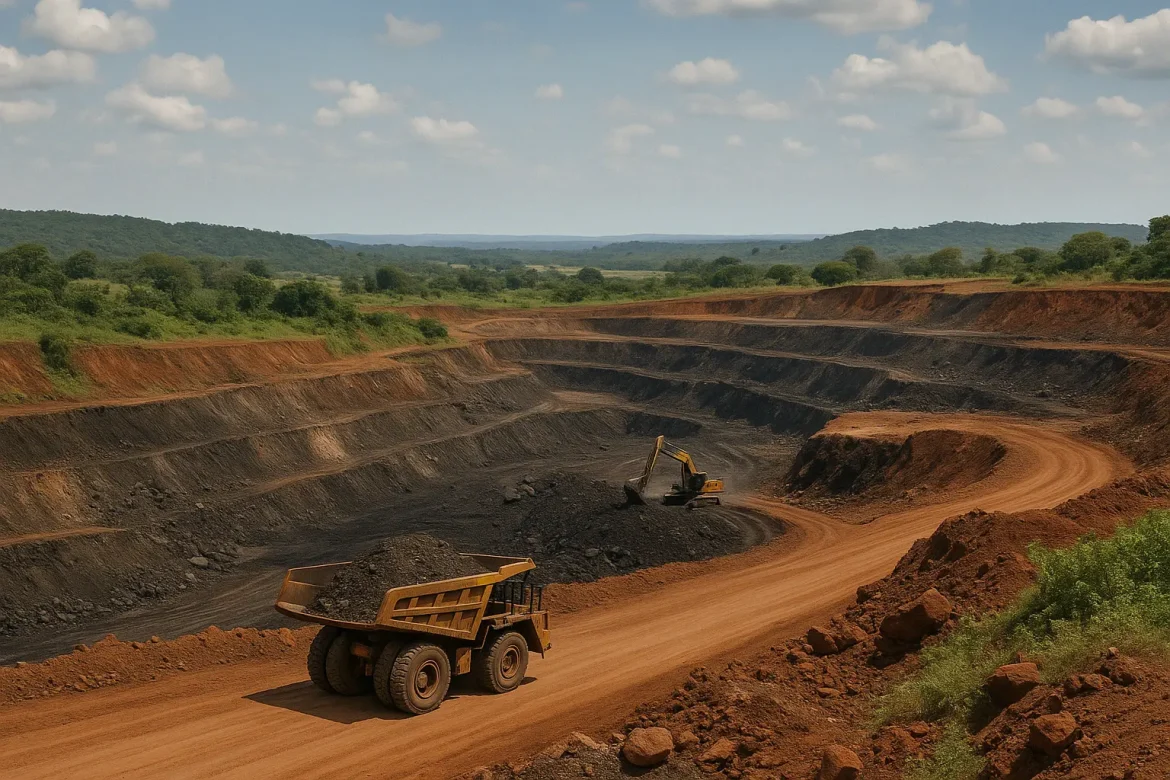
Africa’s accelerating role in supplying the critical minerals needed for the global energy transition is driving forest loss far beyond the boundaries of mining concessions, according to new research that suggests current environmental safeguards significantly underestimate the ecological footprint of extractive projects.
A study examining two decades of mining activity across Sub-Saharan Africa found that while approximately 187,000 hectares of forest were directly cleared for mining between 2001 and 2020, the broader environmental impact extended much further. According to the researchers, every hectare of forest cleared within a mine’s operational footprint triggered an additional 34 hectares of deforestation through associated infrastructure development, settlement expansion and agricultural growth linked to mining activities.
 The findings arrive at a critical moment for Africa’s mining sector, as global demand for minerals such as cobalt, copper, lithium, manganese, chromium and platinum continue to rise in response to expanding electric vehicle manufacturing, renewable energy deployment and battery storage technologies. Sub-Saharan Africa holds an estimated 30% of the world’s known mineral reserves, positioning the continent at the centre of the global clean energy transition.
However, many of these mineral deposits lie beneath some of Africa’s most ecologically important forests, creating increasingly complex trade-offs between economic development, climate objectives and biodiversity conservation.
Researchers used satellite imagery to identify 16,627 mining sites across Sub-Saharan Africa and analysed land-use changes between 2001 and 2020. By comparing areas where mining operations had already commenced with similar locations that had not yet been developed, they isolated forest loss directly attributable to mining activities from broader land-use changes such as agricultural expansion.
The analysis found that direct mine development converted roughly 187,000 hectares of forest, an area comparable in size to Mauritius. While this represents only around 0.03% of Africa’s total forest cover, researchers argue that the indirect impacts are substantially more significant.
According to the study, new mining developments generate extensive secondary land conversion through road construction, worker settlements, commercial infrastructure and increased agricultural production needed to support expanding mining communities. These activities create a cascading pattern of deforestation that extends well beyond licensed mining areas.
Within one kilometre of newly established mines, local deforestation rates increased by an average of eight percentage points compared with similar unmined landscapes. Elevated forest loss remained detectable up to 20 kilometres from mining sites and persisted for more than a decade after operations began, reflecting both mine expansion and long-term population growth around extractive projects.
The researchers identified considerable variation across mineral types. Mining operations extracting cobalt and copper; two minerals central to battery manufacturing and renewable energy technologies, enerated the highest levels of associated forest loss. Iron ore mining produced the widest geographical impact, with deforestation extending up to 20 kilometres from operational sites.
The Democratic Republic of Congo, which produces more than half of the world’s cobalt, recorded some of the highest indirect deforestation multipliers. Researchers estimated that each hectare directly cleared by cobalt mining could ultimately contribute to as much as 58 hectares of additional forest loss through associated development.
These findings reinforce growing concerns that the rapid expansion of critical mineral production could undermine global climate objectives if environmental governance fails to keep pace with investment. Forest ecosystems perform a vital role in absorbing atmospheric carbon dioxide, regulating rainfall patterns and supporting biodiversity, making their preservation central to climate mitigation strategies.
For Africa, the challenge extends beyond environmental conservation. Forest degradation threatens water security, agricultural productivity, ecosystem services and rural livelihoods that underpin economic resilience across many resource-dependent regions. Deforestation also increases vulnerability to climate shocks, including droughts, floods and declining soil fertility, placing additional pressure on already fragile development gains.
The research suggests that existing environmental impact assessment frameworks across much of Africa remain insufficient to capture the full scale of mining-related ecological impacts. In several jurisdictions, environmental assessments focus primarily on the immediate mining concession, sometimes extending only one kilometre beyond operational boundaries. Researchers argue that this approach overlooks much of the indirect forest loss generated by supporting infrastructure and population growth.
They recommend that governments strengthen environmental legislation by requiring mining companies to assess and mitigate wider landscape-level impacts, including projected settlement expansion, transport corridors, agricultural encroachment and cumulative ecosystem degradation. Such reforms, they argue, would better align mining governance with long-term sustainable development objectives.
The study also highlights the importance of greater transparency across global critical mineral supply chains. Researchers propose adopting traceability standards similar to those increasingly applied within agricultural commodities, enabling manufacturers and downstream buyers to verify the environmental performance of mining suppliers.
The issue is particularly significant as multinational corporations seek to strengthen environmental, social and governance (ESG) compliance across battery and renewable energy supply chains. Increasing investor scrutiny of biodiversity impacts may place additional pressure on mining companies operating in ecologically sensitive regions.
Another concern identified by the researchers is the prevalence of unregistered artisanal and small-scale mining operations, many of which operate outside formal regulatory frameworks. These activities frequently bypass environmental oversight while contributing additional pressures on surrounding ecosystems.
 The study argues that developed economies driving demand for critical minerals should provide greater financial and technical support to African producer countries to strengthen environmental governance, improve regulatory enforcement and expand mineral recycling initiatives that reduce pressure for new extraction.
As demand for transition minerals is projected to increase dramatically over the coming decades, the research raises broader questions about balancing Africa’s strategic role in the global clean energy economy with the protection of forests that remain essential for climate stability, biodiversity conservation and sustainable economic development. The findings suggest that without stronger governance, the minerals supporting global decarbonisation could carry environmental costs that extend well beyond individual mining operations, with long-term implications for Africa’s natural capital and development trajectory.


