


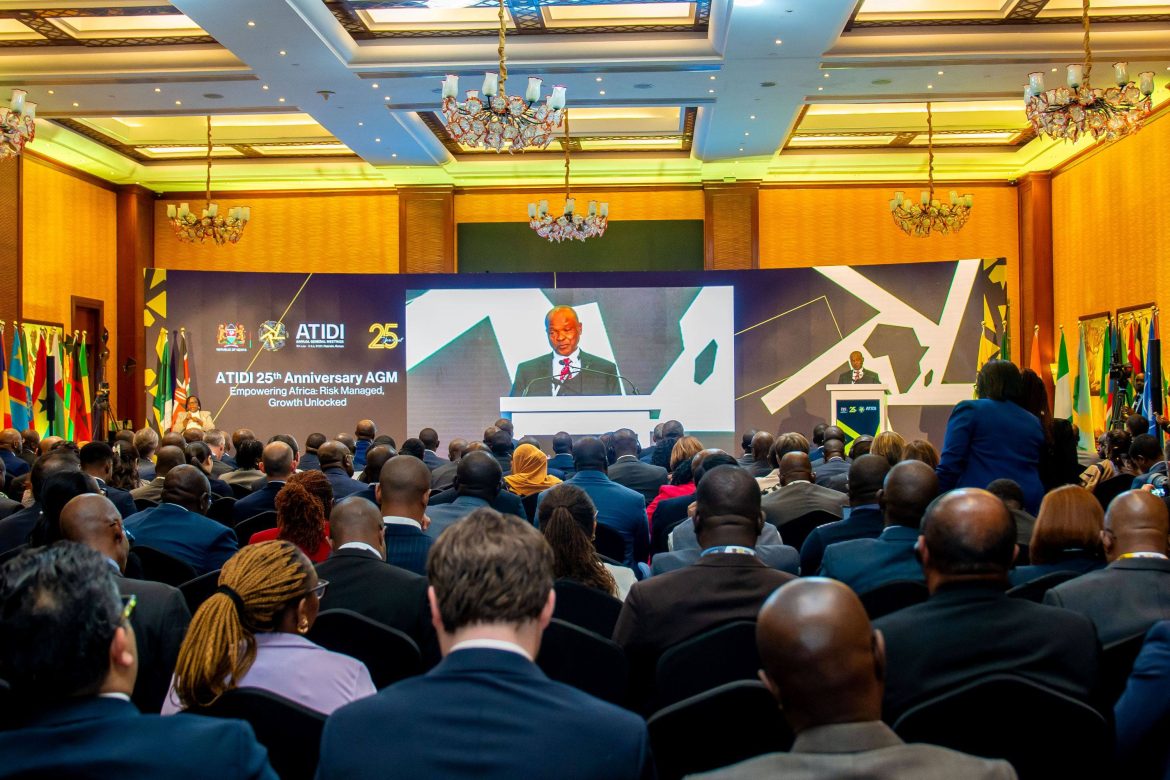
African leaders and financial institutions are intensifying efforts to reshape the continent’s development finance architecture, with calls for stronger regional institutions, improved risk-sharing mechanisms and greater mobilisation of domestic capital taking centre stage at the 26th Annual General Meeting of the African Trade & Investment Development Insurance (ATIDI) held in Nairobi.
The meeting, held from June 30 to July 3, 2026, under the theme “Empowering Africa: Risk Managed, Growth Unlocked,” brought together government leaders, development finance institutions, investors and private-sector representatives to discuss how Africa can reduce financing constraints and increase investment flows into productive sectors.
Speaking during a gala dinner at State House Nairobi marking ATIDI’s 25th anniversary, Kenya’s President William Ruto argued that while reforms to the global financial system remain necessary, African countries must accelerate the development of their own institutions capable of mobilising and directing capital towards economic transformation.
“For years, we have called for a fairer global financial architecture, one that stops mispricing African risk and making our capital needlessly expensive. That call remains right. But Africa cannot wait for reform elsewhere. While the world debates reform, Africa must build,” President Ruto said.

The remarks come amid persistent concerns over Africa’s financing gap, particularly for infrastructure, industrialisation, energy transition and climate resilience. The continent requires hundreds of billions of dollars annually to meet development objectives, yet many African economies continue to face high borrowing costs due to perceptions of elevated risk, limited credit enhancement mechanisms and constrained fiscal space. According to discussions at the ATIDI AGM, Africa holds nearly $4 trillion in long-term domestic savings through pension funds, insurance assets and central bank reserves. However, a significant share of these resources is invested outside the continent, while African economies continue to rely heavily on external financing.
President Ruto said the challenge facing Africa is not a lack of capital but insufficient institutional mechanisms to transform available resources into productive investments.
“Africa does not suffer from a shortage of capital. Africa suffers from a shortage of institutions capable of transforming risk, mobilising savings and connecting them to productive investment,” he said.
The call aligns with the proposed New African Financial Architecture for Development (NAFAD), an initiative launched by African Development Bank Group President Dr. Sidi Ould Tah in April 2026. The framework seeks to strengthen collaboration among African financial institutions, improve risk-sharing capacity and reduce the cost of capital for African economies. At the centre of NAFAD is the Alliance of African Multilateral Financial Institutions (AAMFI), bringing together institutions including the African Development Bank (AfDB), African Export-Import Bank (Afreximbank), Africa Finance Corporation (AFC) and ATIDI.
President Ruto announced that Kenya had approved the establishment of the AAMFI Secretariat in Nairobi, positioning the country as a potential coordination hub for Africa’s evolving financial architecture. He also called for the recapitalisation of ATIDI to $2 billion, arguing that stronger guarantee institutions could play a significant role in mobilising private investment. According to Ruto, every dollar invested in Africa’s guarantee systems has the potential to attract additional private capital by reducing perceived investment risks.
Kenya further announced plans, subject to national approval processes, to increase its shareholding in ATIDI from $25 million to $65 million. The government also provided land for the construction of ATIDI’s permanent headquarters in Nairobi. ATIDI has become an important player in Africa’s investment landscape through political risk insurance, credit enhancement and trade support mechanisms. Since its establishment, the institution has facilitated more than $93 billion in private investment across Africa by helping investors manage political and commercial risks.
The organisation has expanded from seven founding member countries to 24 African countries, 13 institutional members and one non-African member state. It has also maintained investment-grade ratings from major international credit rating agencies, supporting its role as a trusted partner for investors. ATIDI Chief Executive Officer Manuel Moses said the institution’s experience demonstrates the importance of African-led solutions in addressing challenges specific to the continent’s investment environment.
“We have built our success on the ability to combine world-class standards with a deep understanding of African markets, designing solutions that reflect local realities while meeting the expectations of global investors,” Moses said.
The organisation’s financial performance has also strengthened its position within Africa’s development finance ecosystem. In 2025, ATIDI increased its total exposure to $9.2 billion from $8.9 billion in 2024, while profits rose by 20% to $71.4 million. Total assets grew by 20% to $1.06 billion, while equity increased by 12% to $883 million. However, ATIDI leadership emphasised that maintaining investor confidence depends on protecting institutional credibility, including respecting the organisation’s preferred creditor status. This status allows ATIDI to maintain confidence among investors by ensuring obligations to the institution receive priority during periods of financial stress.
Professor Kelly Mua Kingsly, Chairman of ATIDI’s Board of Directors, said confidence remains one of Africa’s most important economic assets.
“Africa’s greatest asset is confidence. If capital is the engine of development, confidence is its fuel,” he said.
The discussions also highlighted the growing role of development finance institutions in supporting private investment as governments face increasing fiscal pressures and debt constraints. Dr. Sidi Ould Tah, President of the African Development Bank Group, said African financial institutions must help address the persistent challenge of risk perception that continues to increase financing costs across the continent.
“The challenge before us is not a lack of capital or opportunities, but a persistent mispricing of the African risk, and this is leading to excessive cost of capital on the continent,” he said.
The African Development Bank has increased its participation in ATIDI’s capital five-fold, becoming the institution’s largest shareholder. The bank is also encouraging additional African countries to join ATIDI and strengthen its capital base. Dr. Tah said the AfDB is shifting towards becoming a catalyst for markets by using guarantees, blended finance and partnerships to mobilise private investment.
“This is why the African Development Bank Group is evolving from a traditional project financier into a catalyst for markets,” he said.
Kenya’s Deputy President Professor Kithure Kindiki also stressed that private-sector participation would be essential as governments face limitations in financing large-scale development programmes.
“The public sector doesn’t have enough resources to undertake some of the ambitions that we have, so that money will have to come from private investments,” he said.
https://www.aecweek-registration.com/2026/
The AGM also showcased investment opportunities in sectors including renewable energy, agriculture, water infrastructure and transport, with business-to-business and business-to-government meetings connecting investors with project developers and public institutions. For Africa, the emerging financial architecture debate carries significant implications for infrastructure development, climate transition and industrial growth. The ability of African institutions to mobilise domestic savings, reduce investment risks and attract private capital will influence whether the continent can finance its development priorities with greater independence.
As global capital markets remain uncertain and many governments face fiscal constraints, strengthening regional financial institutions may become increasingly central to Africa’s economic strategy. The challenge will be translating institutional commitments into scalable financing mechanisms capable of supporting businesses, infrastructure projects and communities across the continent.


