


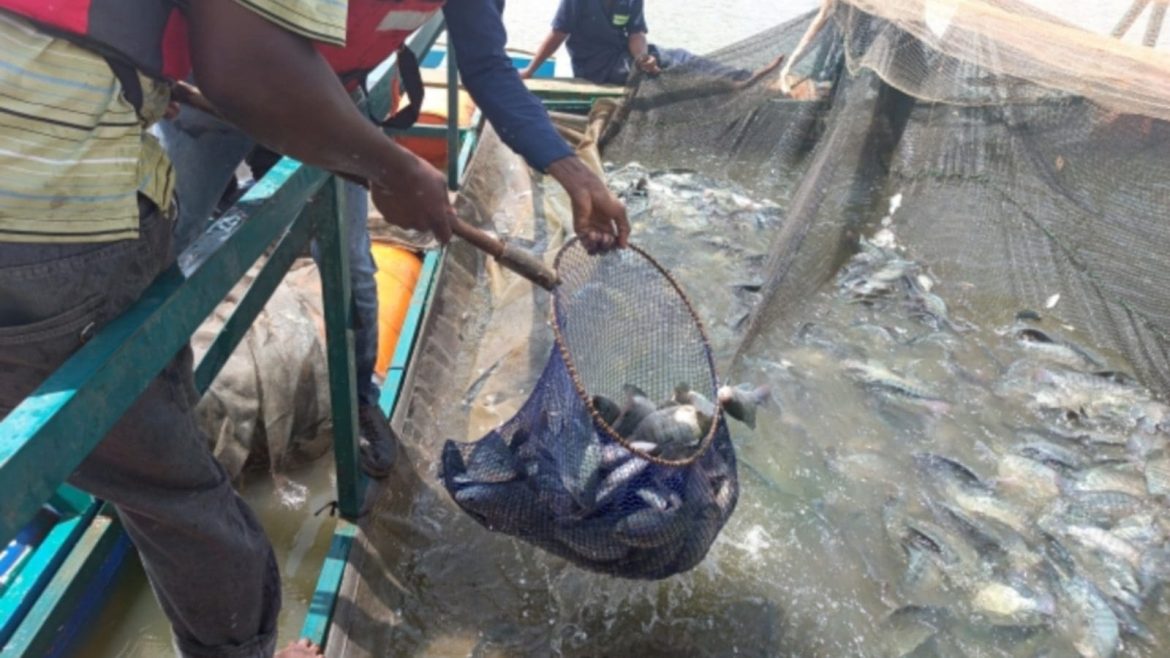
Burkina Faso has begun harvesting fish from 18 floating cages at the Yacouta dam in Dori, marking a new phase in the country’s effort to expand aquaculture and reduce dependence on imported fish. The first harvest, launched on Aug. 24, 2026, is expected to produce about 15 tonnes, a modest volume compared with the country’s large supply deficit but an important test of whether cage farming can be expanded across Burkina Faso’s reservoirs into a commercially viable industry.
The Yacouta project was stocked about six months before the first harvest and is part of a broader government strategy to increase domestic fish production. The launch was overseen by Abdoul Karim Zongo, governor of the Liptako region, while the initial stocking was conducted under the supervision of Ismaël Sombié, Burkina Faso’s minister responsible for agriculture, water, animal resources and fisheries.
The scale of the country’s fish deficit explains why Ouagadougou is looking beyond traditional pond-based aquaculture. Data cited by Ecofin from the Food and Agriculture Organization show that Burkina Faso produced 31,406 tonnes of fish in 2023, of which only 1,127 tonnes came from aquaculture, while apparent fish consumption reached 241,441 tonnes. The gap has been filled substantially through imports. According to data compiled by Burkina Faso’s National Institute of Statistics and Demography, the country imported an average of 165,141 tonnes of fishery products annually between 2020 and 2024, with the associated import bill reaching CFA19.3 billion, equivalent to about $34.7 million. The figures illustrate the foreign-exchange cost of meeting domestic demand through external suppliers and the potential economic value of expanding local production.
The government’s stated aquaculture potential is considerably larger than current output. Official estimates put theoretical annual aquaculture capacity at about 110,000 tonnes, while only around 1% of that potential is currently being exploited. The immediate question is therefore not whether Burkina Faso can produce fish in cages, but whether it can build the infrastructure, financing, input supply and market systems required to do so at scale. Floating cages offer a potentially important advantage in a country where land and water resources compete across agriculture and livestock production. Rather than requiring separate ponds, cage systems allow fish to be raised directly within reservoirs. This can reduce land requirements and make existing water infrastructure part of the productive economy.
Yacouta follows earlier cage-farming initiatives at Samandéni and Bagré. At Samandéni, floating-cage aquaculture was launched in 2024, with the government later reporting that individual cages could produce an average of three to four tonnes over a five- to six-month production cycle. The government has described the reservoir as an emerging aquaculture centre.
At Bagré, the Dumu Ka Fa initiative initially involved 44 private operators and was designed around floating cages with potential annual production of about 1,500 tonnes. The government has increasingly sought private-sector participation as it attempts to shift aquaculture from small-scale activity towards a more structured commercial industry.
The scale of the ambition is becoming clearer. Burkina Faso’s fisheries authorities have outlined a target of producing 100,000 tonnes of fish from floating cages as part of the country’s 2026-2028 agro-pastoral, hydraulic and fisheries offensive. The strategy also includes expanding fish-feed production, rehabilitating fish hatcheries and increasing the supply of fingerlings required to maintain production cycles.
The development of local fish-feed manufacturing could prove particularly important because feed remains one of the industry’s biggest constraints. According to figures cited by Ecofin, feed accounts for roughly 80% of aquaculture production costs in Africa, while supply constraints can leave African producers facing costs 10% to 20% above global averages.
Burkina Faso has already begun addressing that bottleneck. In March, Prime Minister Rimtalba Jean Emmanuel Ouédraogo inaugurated industrial fish-feed production facilities in Bobo-Dioulasso as part of efforts to strengthen domestic aquaculture inputs. The government expects local feed production to support the wider expansion of fish farming.
The policy response also includes fiscal measures. Under the amended 2025 finance law, Burkina Faso introduced a value-added tax exemption on fish feed with the stated objective of reducing production costs and encouraging investment in aquaculture. For investors, however, feed costs are only one part of the equation. Commercial aquaculture requires reliable access to fingerlings, quality feed, cages, technical expertise, cold-chain infrastructure, transport and predictable markets. Financial institutions also need sufficient production and sales data to assess the risks associated with a sector that remains relatively small compared with traditional agriculture.
The experience at Yacouta will therefore be measured by more than the 15 tonnes expected from the first harvest. The more significant indicator will be whether subsequent production cycles can achieve consistent yields, whether farmers and private operators can sell fish profitably, and whether the model can be replicated without creating unsustainable pressure on reservoirs.
Water management will become increasingly important as cage farming expands. Reservoirs serve multiple purposes, including irrigation, livestock, domestic water supply and, in some cases, hydropower. Expanding aquaculture requires appropriate management of stocking densities, feed use, water quality and waste to prevent commercial production from undermining the wider value of these water bodies.

The economic implications extend beyond replacing imported fish. A functioning domestic aquaculture industry could create demand for hatcheries, feed manufacturers, cage fabrication, equipment maintenance, transport, cold storage and fish processing. That would allow more value to remain within Burkina Faso while creating opportunities for small enterprises around production and distribution.
The timing is also significant for a landlocked country facing persistent food-security pressures. Increasing local fish production could diversify protein supply while reducing the need to use scarce foreign exchange to purchase fish abroad. For rural communities around reservoirs, aquaculture could provide another source of income alongside crop and livestock production.
Yet the gap between Burkina Faso’s 110,000-tonne theoretical aquaculture potential and its current output illustrates the scale of the challenge. The country has demonstrated that floating cages can produce fish, but turning individual projects into an industry will require sustained investment in inputs, skills, finance, infrastructure and market access.
Yacouta’s first harvest is therefore best understood as an early commercial test rather than a solution to Burkina Faso’s fish deficit. Its significance lies in whether the country can use the experience of 18 cages to build a repeatable production model across its reservoirs. If it can, aquaculture could become an increasingly important component of Burkina Faso’s food system, rural economy and broader effort to reduce dependence on imported food.


