


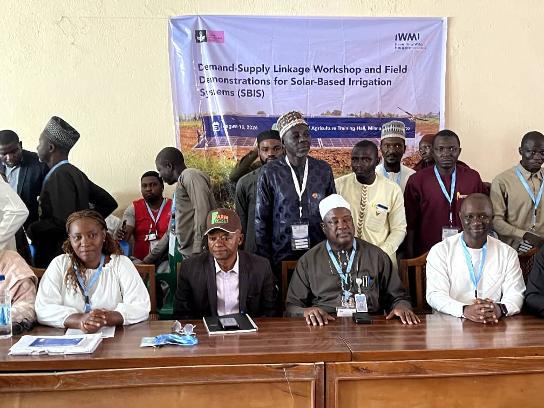
Niger State is seeking stronger financing mechanisms to help smallholder farmers switch from petrol-powered irrigation to solar systems as higher fuel costs and increasingly unreliable rainfall put pressure on dry-season agriculture. The call, made during a solar-irrigation workshop and field demonstration in Minna on Aug. 18, 2026, highlights a wider challenge for Nigeria: the technology for climate-resilient irrigation is increasingly available, but access to affordable finance, technical support, reliable equipment and markets remains limited.
The workshop, organised by the Niger State Ministry of Agriculture in partnership with the International Water Management Institute (IWMI), brought together farmers, financial institutions, equipment suppliers, researchers, government agencies and development partners. The discussions focused on how solar-powered irrigation could allow farmers to extend production beyond the rainy season while reducing exposure to rising petrol costs.
Niger State Commissioner for Agriculture Alhaji Isah Sidi-Rijau said the state’s agricultural potential remained constrained by dependence on rainfall and changing climate conditions. He argued that solar irrigation could help farmers maintain production during dry periods, but stressed that distributing equipment without addressing financing, maintenance and extension support would not deliver sustained adoption.
The financing question is central because the economics of irrigation have changed sharply since Nigeria removed its long-standing petrol subsidy in 2023. Farmers who previously relied on petrol pumps now face higher operating expenses each time they irrigate. Solar systems replace recurring fuel purchases with a larger upfront investment, shifting the financial burden from operating costs to capital costs.
Recent research by IWMI reinforces the scale of the challenge. Only about 5.4% of Nigeria’s agricultural plots are irrigated, leaving large numbers of farmers dependent on rainfall. Northern states including Niger, Kebbi, Kano, Jigawa and Kaduna contain extensive fadama areas and shallow groundwater resources that could support more dry-season farming. The economics can nevertheless favour solar where systems are appropriately designed. IWMI says solar-powered pumping can reduce operating costs by an estimated 60% to 80% compared with diesel-powered alternatives. But the organisation’s recent work also identifies upfront capital costs, fragmented institutions, weak equipment supply chains and shortages of skilled technicians as major barriers to scaling the technology.
At the Minna workshop, IWMI Technical Lead Prof. Oluwaseun Ojeleye said farmers using rivers and fadama areas commonly depend on petrol-powered pumps. He put the cost of two-inch solar pumps at about N300,000 to N350,000 and three-inch models at roughly N400,000 to N500,000, amounts that can be difficult for smallholders to finance even when the equipment promises lower operating costs. That creates a mismatch between the useful life and economics of the equipment and conventional agricultural lending. A farmer may generate income only after harvesting, while a commercial loan may require repayments on a fixed schedule. IWMI has therefore been examining financing models that allow farmers to repay equipment costs from agricultural revenues, including arrangements linked to harvest periods.
This approach has precedent. IWMI’s earlier work on farmer-led irrigation has explored pay-as-you-own, pay-as-you-go and shared-equipment models in which farmers make regular or harvest-linked payments rather than paying the full cost upfront. Such models can also allow private operators to own and maintain irrigation systems while charging farmers for water services. Nigeria already has elements of the institutional infrastructure needed to support such a transition. The Central Bank of Nigeria’s Anchor Borrowers’ Programme, for example, has historically linked smallholder farmers to financial institutions through farmer groups, commodity associations, processors and state governments.
The federal government’s Rural Electrification Agency has also incorporated solar irrigation into its Productive Use of Energy programme. The programme is designed to improve access to solar-powered equipment for smallholder farmers and small businesses and includes solar irrigation, solar cooling and agro-processing technologies among its priority applications. Niger State’s initiative therefore sits within a broader effort to connect renewable energy with agricultural productivity rather than treating solar power solely as an electricity-access intervention. For farmers, the value proposition is not simply cleaner energy. It is the possibility of producing crops when rainfall is insufficient, reducing fuel expenditure and potentially generating more consistent farm revenues.
There is also a water-management dimension that cannot be overlooked. Solar pumping can make irrigation cheaper to operate, but cheaper pumping can encourage greater water extraction if groundwater use is not monitored. IWMI’s current approach therefore places solar irrigation within the wider water-energy-food nexus, emphasising appropriate pump sizing, water-use monitoring and sustainable groundwater management.
That issue is particularly relevant in northern Nigeria, where the availability of shallow groundwater has created significant opportunities for farmer-led irrigation. Nigeria’s Agro-Climatic Resilience in Semi-Arid Landscapes programme estimates that northern and central parts of the country contain about 7 million hectares of cropland with groundwater resources within 25 metres of the surface. The programme is supporting small-scale irrigation, including solar-powered systems, alongside finance and market linkages.
The potential economic gains from better irrigation are already visible in other parts of Nigeria. According to the World Bank, its Transforming Irrigation Management in Nigeria project expanded and rehabilitated irrigation across 43,400 hectares. In Jigawa, farmers reported substantially higher rice yields after improvements in irrigation and water management. The project also strengthened more than 800 water users’ associations.
For Niger State, the next challenge is to translate the technical potential of solar pumping into a functioning rural investment market. That requires banks to understand agricultural cash flows, suppliers to provide quality equipment and after-sales services, and farmer organisations to create structures through which loans can be managed and repaid. IWMI’s latest assessment of solar irrigation in Nigeria argues that the principal constraint is not the maturity of the technology but the wider system surrounding it. Financial institutions, government agencies, equipment suppliers, researchers and farmer organisations need stronger coordination, while quality standards and local repair networks need to improve.
The issue also has implications for women and young people. Dr Adebayo Okey of IWMI has highlighted the potential for solar irrigation to create businesses around water pumping and delivery, allowing decentralised energy systems to support rural enterprise beyond individual farm production. Such models could create additional income streams where financing, training and market access are available. Nigeria’s irrigation policy already recognises the connection between irrigation, food security, employment, wealth creation and rural incomes. The National Irrigation and Drainage Policy and Strategy identifies funding mechanisms, sustainable production, participation and resource management as important elements of irrigation development.

The wider African context makes the financing question more urgent. The World Bank estimates that only about 6% of farmland in sub-Saharan Africa is irrigated, despite irrigation’s role in improving productivity and reducing farmers’ exposure to rainfall variability. As climate pressures intensify and food demand rises, expanding irrigation without making it financially and environmentally sustainable could leave farmers exposed to a different set of risks.
For Niger State, solar irrigation could become an important part of that transition, but the immediate test will be whether a farmer can acquire a reliable pump, access water sustainably, repay the investment from farm income and obtain technical support when the system fails. The state’s appeal to financial institutions therefore points to a broader lesson for Nigeria’s climate-smart agriculture agenda. Renewable technology can reduce exposure to volatile fuel prices, but technology alone does not create resilience. The durable investment case will depend on finance, water governance, equipment quality, farmer organisation and access to profitable markets working together.
If those conditions can be established, solar irrigation could move beyond demonstration projects and become part of the commercial infrastructure of Nigerian agriculture, helping farmers produce through increasingly uncertain seasons while reducing the recurring energy costs that have made dry-season farming harder to sustain.


